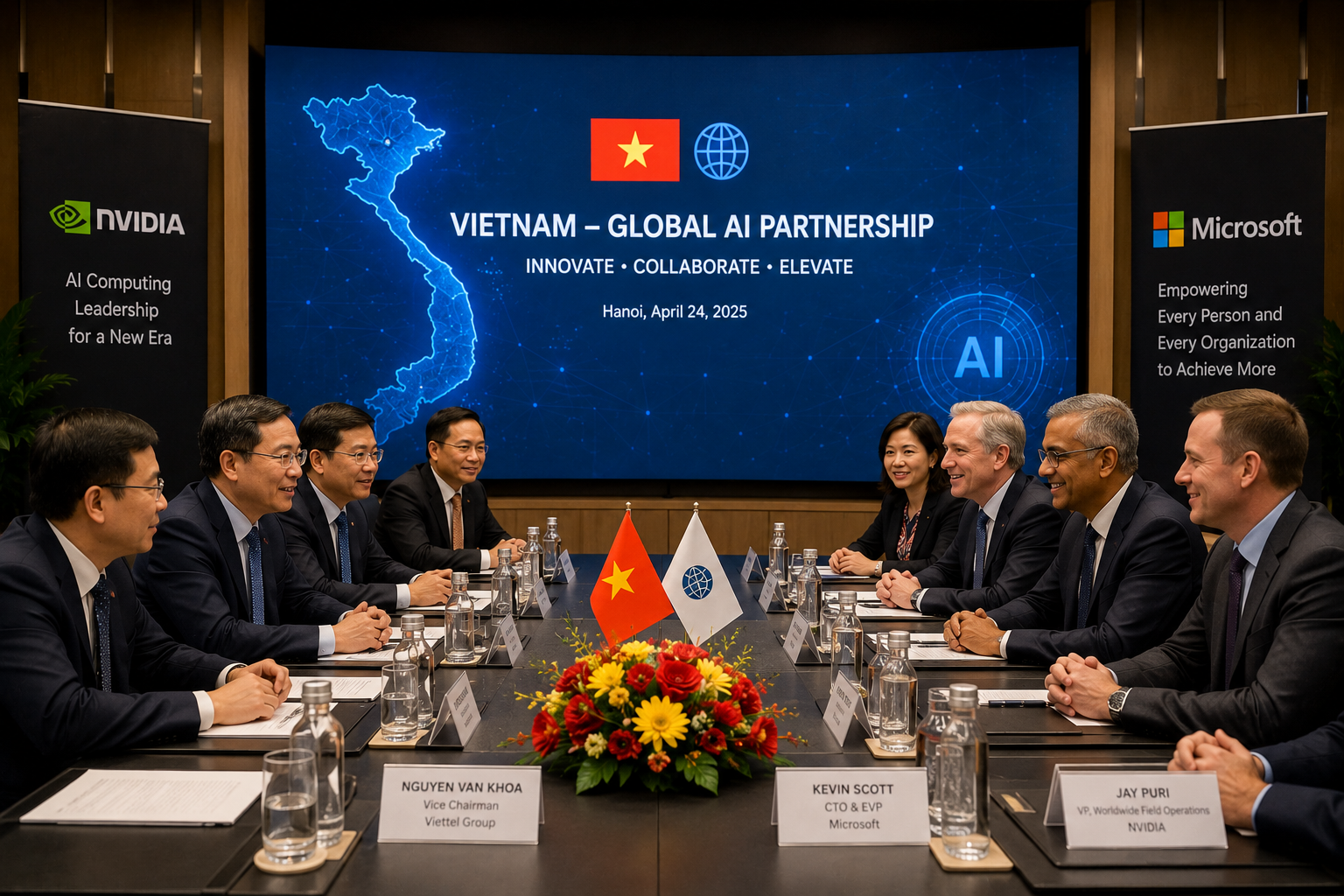
Vietnam spent much of the past two months collecting the kind of technology partnerships that countries twice its economic size have struggled to secure. Nvidia named the country a focal point of its sovereign AI strategy in early June, Microsoft expanded its enterprise AI alliance with Vietnam’s largest technology company later that month, and former Google CEO Eric Schmidt led an international delegation to Hanoi to discuss the country’s AI ambitions directly with its top leadership. None of these moves alone would be remarkable. Together, they describe a government and a private sector moving in the same direction at the same time treating AI infrastructure not as an import to license, but as a capability worth building domestically, with foreign partners brought in as collaborators rather than vendors.
A Seat at Nvidia’s Sovereign AI Table
Vietnam emerged as a focal point of Nvidia’s sovereign AI strategy when the chipmaker announced a new population-scale dataset developed with local technology giant FPT and confirmed that Viettel AI is building a national legal AI application on Nvidia’s open model infrastructure. The announcement, made at Nvidia’s GTC Taipei event alongside Computex, placed Vietnam in a select group of countries receiving dedicated AI development resources from Nvidia, a group that also includes France, Germany, India, Singapore, South Korea, and Japan.
The specific project, called Nemotron-Personas-Vietnam, extends Nvidia’s broader Nemotron Personas initiative by building structured, auditable synthetic datasets grounded in real Vietnamese demographic and labor statistics. That detail matters more than it might first appear. Sovereign AI efforts across Asia have generally focused on running foreign models locally; Vietnam’s version, at least in this instance, involves shaping the training data itself around the country’s own population, an earlier and more foundational layer of the AI stack than most national programs attempt to touch.
Microsoft Doubles Down With FPT
Weeks later, Microsoft moved to deepen its own relationship with the same Vietnamese company. FPT Corporation and Microsoft announced an expanded strategic collaboration aimed at accelerating enterprise AI adoption across Asia, with a stated focus on ASEAN markets, Japan, and South Korea. The arrangement designates FPT as one of Microsoft’s “AI Frontier Companies,” a label the company uses for organizations it considers human-led and agent-operated, integrating AI agents directly into daily workflows rather than treating them as standalone tools.
FPT, which says it employs 30,000 AI-augmented engineers globally, will build on Microsoft 365 Copilot and GitHub Copilot as part of its own internal AI transformation, while using the partnership to sell Microsoft’s platforms into regional markets where FPT already has delivery infrastructure. The arrangement is less a single product launch than a distribution deal: Microsoft gets a regional partner with established relationships across ASEAN, Japan, and South Korea, and FPT gets deeper integration with one of the two or three AI platforms most enterprise customers in the region are already choosing between.
Why Vietnam, Why Now
The clearest signal of how seriously Vietnam’s own government is treating this moment came earlier in June, when Eric Schmidt led an international delegation to the country at the invitation of Vietnam’s National Innovation Center, working alongside the AI Alliance. Vietnam’s Party chief and President To Lam met with Schmidt’s delegation directly, asking for support in developing the country’s AI policy and innovation ecosystem, and encouraging cooperation on building both a domestic AI workforce and indigenous technology enterprises. That a sitting head of state made time to personally court this kind of visit says something about where Vietnam’s leadership believes the country’s competitive position needs to be built.
NIC director Vu Quoc Huy framed the moment in similarly ambitious terms, describing Vietnam as facing a “historic opportunity” to accelerate development in AI and other strategic technologies, with the center positioning itself as the connective layer between government, domestic businesses, and global technology corporations. The event drew participation from Viettel, FPT, Qualcomm, and other regional players, suggesting the government sees its role less as a regulator setting rules for foreign AI companies and more as a matchmaker actively recruiting them.
The Limits of the Momentum
None of this guarantees Vietnam becomes a genuine AI power rather than a well-connected node in other countries’ AI supply chains. The Nvidia and Microsoft partnerships both channel real capability into Vietnam, but they also route through Vietnam’s existing corporate giants FPT and Viettel rather than building a broader base of independent AI research institutions or startups with their own foundation models. That concentration makes sense given where the technical capacity currently sits, but it also means Vietnam’s AI ambitions are, for now, closely tied to how much autonomy Nvidia and Microsoft are willing to extend to their local partners rather than how much independent capability Vietnam builds on its own terms.
There’s also a regional dimension worth watching. Nvidia’s sovereign AI cohort includes Singapore, Malaysia, South Korea, and Japan countries with more mature AI ecosystems and, in some cases, more established domestic chip and cloud infrastructure. Vietnam’s advantage in that competition has historically been cost and engineering talent rather than deep research capacity, and converting a wave of partnership announcements into lasting technological independence will require more than hosting international delegations. It requires Vietnamese-led research producing models and applications the rest of the region wants to build on, not just infrastructure Vietnam hosts on behalf of others.
The Bottom Line
What distinguishes Vietnam’s recent run of AI partnerships from routine corporate press releases is the pattern across them: a chipmaker, a software giant, and a former Silicon Valley CEO all showed up within the same two month window, and Vietnam’s own government treated each visit as a policy moment rather than a courtesy call. That kind of coordinated attention is genuinely rare for a country of Vietnam’s size, and it reflects years of quieter groundwork engineering education, a large technology workforce, and companies like FPT and Viettel that had scale before AI made scale valuable again. Whether this translates into lasting technological independence, rather than a well resourced position inside other countries’ AI ecosystems, will depend on what Vietnam builds with these partnerships over the next several years, not on how many of them it signs this summer.




Leave a Reply