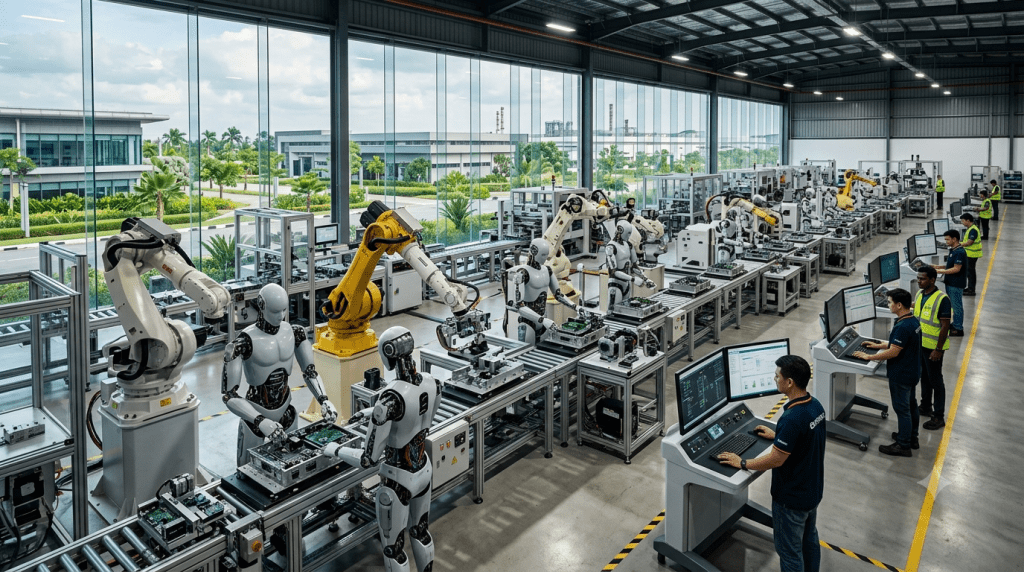
The big robotics stories usually come from Boston or San Francisco. A startup demo. A warehouse deployment. A quadruped dog trotting across a conference stage to polite applause. The geography of where robotics gets built the actual physical manufacturing, the supply chains, the factory floors has been a quieter story.
It is getting louder.
AMC Robotics has signed a lease for a 6,150-square-metre manufacturing facility in Bac Ninh, Vietnam. The facility is being set up to produce the company’s NovaArm robotic arm and, eventually, its Kyro quadruped robot. This is not a pilot program or a research outpost. It is a full-scale manufacturing commitment, and the fact that it sits in Vietnam rather than California or Texas tells you something important about where the economics of the hardware race are heading.
The AMC Robotics Vietnam manufacturing hub is one of the clearest signals yet that Southeast Asia is becoming a serious player in the global robotics supply chain and that companies serious about scaling physical AI cannot afford to build it anywhere else.
What AMC Robotics Is Building
AMC Robotics is not yet a household name, but the products heading to Bac Ninh are worth understanding.
The NovaArm is an industrial robotic arm designed for environments that need both precision and adaptability warehouse logistics, light assembly, retail stock management. Robotic arms are not new, but the NovaArm is built around more recent AI control systems that allow it to handle unstructured environments more reliably than older industrial arms that needed tightly controlled conditions to function.
The Kyro is where things get more interesting. It is AMC’s quadruped robot a four-legged mobile platform in the same category as Boston Dynamics’ Spot and the growing family of legged systems appearing in industrial and commercial settings. Quadrupeds are increasingly the form factor of choice for spaces where wheels cannot navigate: stairs, uneven floors, narrow warehouse aisles, retail backrooms.
The Bac Ninh facility will focus on NovaArm production first, with Kyro manufacturing following as a second phase. That sequencing makes sense. Robotic arms are a more established product with clearer immediate demand. Quadrupeds are still early in their commercial deployment curve, and building the manufacturing infrastructure now means being ready when that curve steepens.
Why Bac Ninh, Vietnam?
Bac Ninh is not a random pin on a map. It is one of Vietnam’s most developed industrial zones, about 30 kilometres northeast of Hanoi, and it already hosts Samsung, Canon, and LG manufacturing operations. The supply chain ecosystem, logistics infrastructure, and available manufacturing expertise there are genuinely competitive with mature Chinese industrial hubs.
For companies looking to diversify away from China concentration, Vietnam is typically the first serious alternative they evaluate. Labour costs remain lower than in China’s coastal zones. Infrastructure has improved rapidly over the past decade. And unlike some emerging manufacturing destinations, Bac Ninh already has a proven track record of supporting complex, precision heavy electronics production at scale.
For a robotics company making its first serious manufacturing commitment, that combination of cost, capability, and political risk diversification makes Bac Ninh one of the most logical choices in the world right now.
The Physical AI Angle Nobody Is Talking About Enough
To understand why this facility matters beyond AMC Robotics specifically, you need to understand where the broader industry is heading.
The phrase Physical AI artificial intelligence designed to perceive, navigate, and act in real-world physical environments has been gaining serious traction as the next major wave after language and image models. Text and image AI operates in a relatively contained digital space. Physical AI has to deal with the messiness of reality: variable lighting, unpredictable human behaviour, objects in unexpected positions, surfaces that are wet or uneven, spaces that were never designed with robots in mind.
The gap between a robot that performs flawlessly in a controlled demo and one that works reliably in an actual retail store is enormous. Closing that gap requires better hardware more robust sensors, more reliable actuators, more durable mechanical systems and the only way to develop hardware at that standard is to build it at real production scale, in real volumes, under real operating conditions.
That is what the Bac Ninh facility represents. AMC Robotics committing real capital to real infrastructure for Physical AI production.
Southeast Asia’s Quiet Robotics Rise
AMC Robotics is not alone in this direction. The shift of robotics hardware production into Southeast Asia has been building for years, just below the headline level.
Vietnam, Malaysia, and Thailand have all been actively positioning for hardware manufacturing that was previously concentrated in China. Electronics assembly and semiconductor packaging moved first. Robotics components are following. The supply chains that support precision manufacturing in Bac Ninh today are materially stronger than they were five years ago, and they will be materially stronger again five years from now.
There is also a self-reinforcing logic to this. Robots deployed in Vietnamese manufacturing facilities make those facilities more competitive. More competitive facilities attract more manufacturers. More manufacturers create more demand for robots. AMC’s Bac Ninh hub is both a product of this dynamic and a contributor to it.
The timing matters too. The broader robotics investment cycle is genuinely accelerating in 2026. SoftBank has been loudly bullish on physical robotics as a multi trillion dollar opportunity. Boston Dynamics continues expanding industrial deployments. Unitree’s robots are appearing in commercial environments across Asia with increasing frequency. The market AMC is manufacturing for is a market that is actively growing faster than almost any other hardware category.
What Happens Next
A lease signing is a beginning, not an end. The real measure of the Bac Ninh facility comes over the next two to three years as production ramps.
For NovaArm, the question is whether AMC can achieve the volume and cost efficiency that makes it genuinely competitive against the established industrial arm market. ABB, Fanuc, Kuka, and YASKAWA have decades of manufacturing experience and customer relationships. A newer entrant needs to either undercut meaningfully on price or offer capability advantages that legacy systems cannot match. The Vietnam cost base helps with the first. The AI control systems are the bet on the second.
For Kyro, the timeline is longer but the opportunity is potentially larger. The quadruped market is early enough that there is genuine room for multiple serious players. If Kyro demonstrates reliable performance in the unstructured retail and industrial environments AMC is targeting, the manufacturing capacity being built now positions the company to scale into that demand without production becoming the bottleneck.
Both bets look more reasonable in 2026 than they would have in 2024. That is not an accident. That is the market catching up to what was always going to be true about physical AI.
BEXORN VERDICT: 8/10 Southeast Asia Became a Robotics Story
The AMC Robotics Vietnam manufacturing hub is the kind of move that looks obvious in retrospect and gets underestimated at announcement. Serious hardware at scale requires serious manufacturing infrastructure, and the companies that build it early are the ones with production capacity ready when demand accelerates. Bac Ninh gives AMC a cost-competitive, logistics-ready base for both an industrial arm and what could become a credible quadruped platform. The bigger signal that Southeast Asia is now a genuine player in the Physical AI supply chain is the story that will keep growing long after this particular lease stops being news.
FAQ
What is the AMC Robotics Vietnam manufacturing hub?
AMC Robotics has leased a 6,150-square-metre facility in Bac Ninh, Vietnam to produce its NovaArm robotic arm, with the Kyro quadruped robot planned as a later production phase. It is the company’s first full-scale dedicated manufacturing facility.
Where is Bac Ninh and why was it chosen?
Bac Ninh is an industrial province about 30 kilometres northeast of Hanoi, Vietnam. It already hosts Samsung, Canon, and LG manufacturing operations. The combination of strong industrial infrastructure, supply chain ecosystem, competitive production costs, and reduced political risk compared to China made it a logical choice.
What is the NovaArm?
The NovaArm is AMC Robotics’ industrial robotic arm, designed to operate in unstructured environments like warehouses and retail spaces. It uses AI-based control systems that allow it to adapt to variable conditions more reliably than traditional industrial arms.
What is the Kyro robot?
The Kyro is AMC Robotics’ quadruped a four-legged mobile robot designed to navigate environments where wheeled robots cannot go, including stairs, uneven terrain, and irregular indoor spaces. It will enter production at Bac Ninh after the NovaArm ramp.
What is Physical AI?
Physical AI is artificial intelligence designed to perceive and operate in real-world physical environments rather than purely digital ones. It is increasingly seen as the next major AI deployment wave, covering applications in warehouses, retail, logistics, construction, and more.
Why is Southeast Asia becoming important for robotics?
A combination of lower production costs, rapidly improving manufacturing infrastructure, and the desire by international companies to reduce single-country concentration risk has been pushing hardware production into Southeast Asia. Vietnam in particular has been one of the primary beneficiaries of this shift.
Related Reading:
• What Is AGI Artificial General Intelligence in 2026 and Are We Already Living With It?
• AI Export War 2026: China Fired Back and America’s AI Advantage Is Now Under Serious Threat
 SpaceX Space Data Centers: The Wildly Ambitious Plan to Build a Million AI Supercomputers in Orbit
  What Is AGI Artificial General Intelligence in 2026 and Are We Already Living With It?
  SoftBank’s Masayoshi Son Says Robots Are the Next Trillion Dollar Bet and He Just Put Real Money Behind It
  Japan Airlines Put Humanoid Robots To Work At Haneda Airport Because There Was No One Left To Hire
  SpaceX IPO 2026: The Risky $1.77 Trillion Gamble That Could Make Musk the First Trillionaire Or Trigger the Biggest Crash in Tech History
  9 Critical Reasons Humanoid Robots Are Advancing Fast — And the Future of Work Debate Has Already Begun
  Murakkab Is the MIT System That Makes Your AI Workflows Faster and Cheaper to Run
  AMC Robotics Vietnam Hub Is Proof the Hardware Race Has Left Silicon Valley
  OpenAI Jalapeno Chip Is Here and NVIDIA Should Be Paying Attention