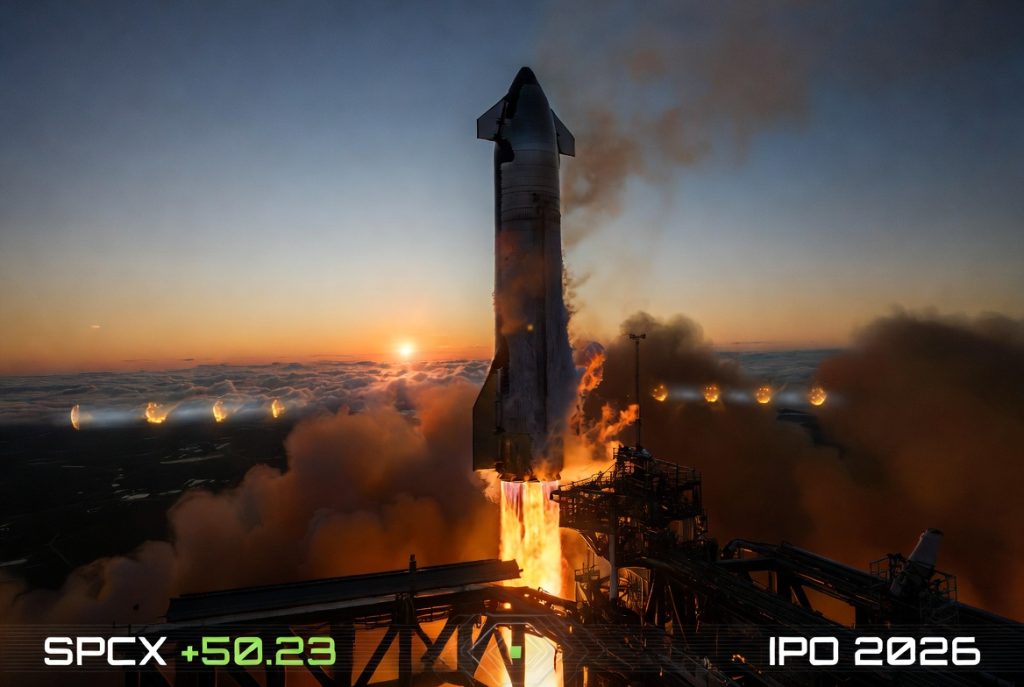
SpaceX IPO 2026
Last Updated 12th June, 2026
SpaceX IPO 2026 stands as one of those rare, electric moments in business and technology that feel like a genuine turning point the kind of event you’ll someday tell your children about as the day everything shifted toward the stars. After more than two decades of operating largely in the shadows as one of the most ambitious and secretive companies on Earth, Elon Musk’s rocket empire is finally preparing to go public in what will almost certainly become the largest initial public offering the world has ever witnessed.
The numbers alone surrounding SpaceX IPO 2026 are enough to take your breath away, but this goes far deeper than balance sheets and market caps. It’s about humanity’s expanding reach into space, the explosive growth of satellite internet that’s connecting the unconnected, reusable rockets that rewrote the economics of launch forever, and one man’s relentless, almost defiant vision that so many once laughed off as pure science fiction.
The details of SpaceX IPO 2026 paint a picture that’s as audacious as the company itself. Targeting a share price of $135, the offering aims to raise approximately $75 billion and debut with a valuation hovering near $1.77 trillion. Should it close as planned, SpaceX IPO 2026 will eclipse the previous record held by Saudi Aramco’s 2019 debut and immediately position the company among the most valuable public entities on the planet. Yet for those who have followed this journey, the real power of SpaceX IPO 2026 lies in the emotional resonance years of spectacular failures followed by quiet triumphs, bold bets that nearly broke the company, and an unyielding drive to make humanity multi-planetary.
In this comprehensive guide to SpaceX IPO 2026, we’ll explore the long road that led here, what the company truly looks like in 2026, the heated valuation debate, the very real risks investors face, what this means for Elon Musk personally, and the broader implications for the future of space exploration and technology.
The Long and Dramatic Road Leading to SpaceX IPO 2026
SpaceX IPO 2026 represents the culmination of a story that began back in 2002, when Elon Musk founded the company with what many considered an impossible dream: dramatically reducing the cost of space travel while ultimately making humanity a multi-planetary species. For the first many years, survival was never guaranteed.
The company scraped by on thin margins, key government contracts, and Musk’s personal fortune from the PayPal sale. There were heartbreaking setbacks rockets exploding dramatically on the launch pad in full view of the world and several moments when it genuinely looked like the entire venture might collapse under its own weight. Those early days tested everyone involved, pushing engineers and leaders to their limits in ways that forged an incredibly resilient culture.
But something profound shifted in the last decade, and that transformation is what makes SpaceX IPO 2026 feel so inevitable now. The breakthrough success of landing and reusing Falcon 9 boosters fundamentally changed the economics of getting to space, dropping costs from tens of millions per launch to a fraction of that amount and opening doors that previously didn’t exist. Starlink, which started as something of a crazy side project, has since blossomed into a highly profitable global satellite internet business that’s already serving millions of customers in remote areas, disaster zones, ships at sea, and even airplanes in flight.
Meanwhile, Starship the next-generation, fully reusable spacecraft continues to make steady progress through increasingly ambitious test flights that keep expanding the boundaries of what’s considered possible. By the time SpaceX IPO 2026 arrived in June 2026, the company had set its pricing at $135 per share, with trading on Nasdaq under the ticker SPCX expected to begin as early as June 12. Demand has been nothing short of extraordinary, with the offering heavily oversubscribed as institutional investors poured in orders well over $10 billion and total interest reportedly approaching $150 billion in some estimates. For longtime observers of SpaceX IPO 2026, this moment carries a deep, almost personal sense of validation after watching years of daring engineering triumphs that most people never get to see up close.
What SpaceX Truly Represents Heading Into SpaceX IPO 2026
To truly appreciate why the valuation for SpaceX IPO 2026 sits so high, you have to understand just how much the company has evolved into a multifaceted powerhouse by 2026. Starlink has clearly emerged as the primary financial engine driving growth. In 2025, SpaceX generated around $18.7 billion in total revenue, with Starlink accounting for the majority roughly 61% according to detailed reports.
The massive satellite constellation now reaches millions of users spread across more than 160 countries, delivering reliable high-speed internet to places traditional infrastructure could never touch while also generating the kind of steady, recurring subscription revenue that SpaceX historically lacked. This predictable cash flow has been a game-changer, providing stability even as the company continues pouring resources into ambitious future projects.
The core launch business remains utterly dominant, with SpaceX now sending more mass to orbit than the rest of the world combined on a regular basis. Falcon 9 has become the dependable workhorse of the entire industry, while Starship promises to unlock entirely new markets if it achieves full operational reusability everything from rapid point-to-point transport here on Earth to supporting lunar bases and, eventually, the long-dreamed-of missions to Mars. Beyond that, newer initiatives add layers of excitement for anyone considering SpaceX IPO 2026.
There’s Starshield, the military-adapted version of Starlink technology, potential developments around space-based data centers, deeper strategic integration with xAI, and of course the overarching, almost poetic goal of making human life multi-planetary. Investors evaluating SpaceX IPO 2026 aren’t simply buying into current revenue streams they’re placing a substantial bet on a future where an expanding space economy sees SpaceX holding a commanding, hard-to-challenge lead.
The Intense Valuation Debate Around SpaceX IPO 2026
At nearly $1.77 trillion, SpaceX IPO 2026 carries a valuation that implies an extraordinary multiple of its current revenue estimates generally land in the 90–100x trailing sales range. That kind of figure stands out as massive by any conventional financial standard, leading some respected analysts, including teams at Morningstar, to openly question whether it makes sense given ongoing losses in certain areas and the enormous capital expenditures still required for continued aggressive expansion.
On the other side of the argument, the most bullish voices contend that traditional metrics simply fail to capture the full scope of what SpaceX IPO 2026 represents. Starlink’s profit margins continue improving at a rapid pace. The dramatic reduction in launch costs has already enabled entirely new business models that weren’t feasible before.
And the strategic, almost irreplaceable importance of reliable space infrastructure spanning communications, Earth observation, national security, and future exploration creates a competitive moat that rivals will struggle mightily to overcome. Prominent long-term investor Ron Baron, who has placed a significant order, has even spoken about the possibility of a $20 trillion company within the coming decade. Whether that vision for SpaceX IPO 2026 sounds inspiring or overly optimistic ultimately comes down to how deeply you believe in Musk’s long-term roadmap and the transformative potential of the space economy.
The Personal Stakes of SpaceX IPO 2026 for Elon Musk
If SpaceX IPO 2026 achieves its targeted valuation, Musk’s reported ownership stake of around 42% could help propel his overall net worth well past the $1 trillion threshold when combined with his substantial Tesla holdings, potentially making him the world’s first trillionaire.
There’s an almost mythic quality to that possibility Musk has always operated at the extremes, repeatedly driving both his companies and himself right to the brink of failure in pursuit of goals that most rational observers once considered impossible.
For him, SpaceX IPO 2026 isn’t merely about a massive personal financial windfall. It represents validation after two decades of relentless effort and a critical opportunity to secure the resources and freedom needed to accelerate the multi-planetary future he has championed since the beginning.
At the same time, going public introduces new pressures. Quarterly results, shareholder expectations, and intense public scrutiny will now apply to every decision, delay, or public statement in ways that could test even Musk’s famous resilience.
Important Risks Investors Must Weigh Before SpaceX IPO 2026
No balanced discussion of SpaceX IPO 2026 can overlook the substantial risks that come with such an ambitious enterprise.
The company remains extremely capital intensive, requiring enormous ongoing investment to build out thousands more Starlink satellites, achieve full Starship reusability, and push forward on multiple experimental fronts. Significant losses have continued in recent periods even as revenue scales upward. Regulatory and geopolitical challenges loom large as well everything from launch approvals and spectrum rights for Starlink to broader international tensions could create meaningful headwinds.
Competition is also heating up, with players like Amazon’s Project Kuiper and various European initiatives working hard to close the gap in satellite communications. And then there’s the undeniable Elon factor: Musk’s attention divided across several high-profile companies and his sometimes polarizing public presence, which has previously impacted stock performance at Tesla. Investors in SpaceX IPO 2026 will need strong conviction to weather that kind of built-in volatility.
The S-1 filing reveals one risk that did not get enough attention in early coverage. While Starlink generated $11.4 billion in revenue in 2025 at a remarkable 63 percent EBITDA margin, the xAI division ran a $6.36 billion operating loss in the same period. SpaceX is not one company with a clean story it is three very different businesses under one valuation. Investors buying into the profitable satellite internet operation are also buying into an AI division that is burning cash at a rate that would concern most analysts if it were a standalone company.
Why SpaceX IPO 2026 Feels Like Something Truly Different
What sets SpaceX IPO 2026 apart from most other public debuts is the sense that this isn’t just about a company reaching maturity it feels like a broader milestone in humanity’s evolving relationship with space itself.
For the first time, depending on how allocations work, ordinary investors could have a real chance to own part of the enterprise that’s actively working to make space more accessible and, someday, to establish a lasting human presence on Mars. Reusable rockets, once widely dismissed as unrealistic fantasy by experts, have become routine.
Starlink is bringing connectivity to corners of the world that traditional systems never reached. And Starship, assuming it fulfills its promise, could fundamentally reshape what’s possible beyond Earth orbit. Whether you see Musk as an unparalleled visionary or a charismatic showman, the tangible progress delivered by SpaceX IPO 2026 is hard to deny.
What Comes Next for SpaceX IPO 2026
Pricing locked in on June 11 at the full $135 per share confirming the $1.77 trillion valuation, with 555.5 million Class A shares sold and the offering closing June 15. Trading opens this morning on Nasdaq under ticker SPCX, though due to the scale of the price discovery process, the opening cross is expected late morning rather than at the 9:30am bell. There is also a political wrinkle Senator Elizabeth Warren formally asked the SEC to delay the offering citing governance concerns, though most observers expect trading to proceed without interruption.
The detail most coverage has missed entirely is what happens the day after listing. MSCI announced that SPCX qualifies for early inclusion in its Global Standard Indexes starting June 13 just one trading day after debut. With only a 4 percent float available, every passive fund tracking MSCI World and MSCI ACWI is required to buy SPCX mechanically to maintain their index weights. That is not speculative demand. It is structural buying that has nothing to do with whether you believe in the company.
For anyone observing from the sidelines, this will serve as a compelling real-world case study in how public markets attempt to assign value to frontier technology companies that combine enormous long-term ambition with equally significant execution risks.
SpaceX IPO 2026 is far more than just another financial event it symbolizes the mainstream arrival of private enterprise as the driving force in space technology. A company that began with little more than a dream of making humanity multi-planetary now finds itself on the verge of being valued like one of the world’s largest corporations.
Only time will reveal whether this lofty valuation ultimately proves justified or ends up as a cautionary tale for future generations. What already feels certain, however, is that the era when space exploration belonged exclusively to governments and a tiny handful of billionaires is drawing to a close. A new chapter is beginning in earnest one where bold private companies lead the charge into the final frontier. At its heart, SpaceX IPO 2026 isn’t solely about rockets or internet satellites. It’s a profound bet on the idea that humanity’s destiny stretches far beyond Earth, and that one company stands better positioned than any other to carry us there.
Frequently Asked Questions
When does trading officially begin for SpaceX IPO 2026?
Trading opens today June 12 on Nasdaq under ticker SPCX. Due to the size of the offering and the price discovery process involved, indicative quotes begin around 10:15am ET with the actual opening cross expected late morning rather than at the standard 9:30am market open.
Many major brokers including Fidelity, Robinhood, Charles Schwab, SoFi, and E*Trade are expected to offer participation. Allocations depend heavily on demand and aren’t guaranteed, though some platforms have adjusted minimums for this historic offering.
What are the key financial figures driving SpaceX IPO 2026?
The company targets a $135 share price at roughly $1.77 trillion valuation while raising about $75 billion. 2025 revenue reached around $18.7 billion, largely powered by Starlink.
Is Starlink profitable as SpaceX IPO 2026 approaches?
Yes, Starlink has become a major profit contributor with strong recurring revenue, though overall company results still reflect heavy investments in growth and R&D.
That decision depends entirely on individual risk tolerance and research. While initial excitement will be high, IPOs often experience significant volatility in the early days.
How large is Elon Musk’s ownership in the context of SpaceX IPO 2026?
Musk’s stake is reported around 42%, which at the targeted valuation levels could contribute substantially toward making him the first trillionaire when paired with his other assets.
 9 Critical Reasons Humanoid Robots Are Advancing Fast — And the Future of Work Debate Has Already Begun
  Microsoft AI Coding Tools 2026: The Uncomfortable Truth Developers Are Just Finding Out
  AI Jobs at Risk by 2030: The Honest Truth Nobody Is Telling You
  Grok AI Review 2026: Is Grok The Most Underrated AI Assistant Right Now?
  Claude Fable 5 vs ChatGPT 2026: The Battle Forcing Millions to Finally Ditch One AI for the Other