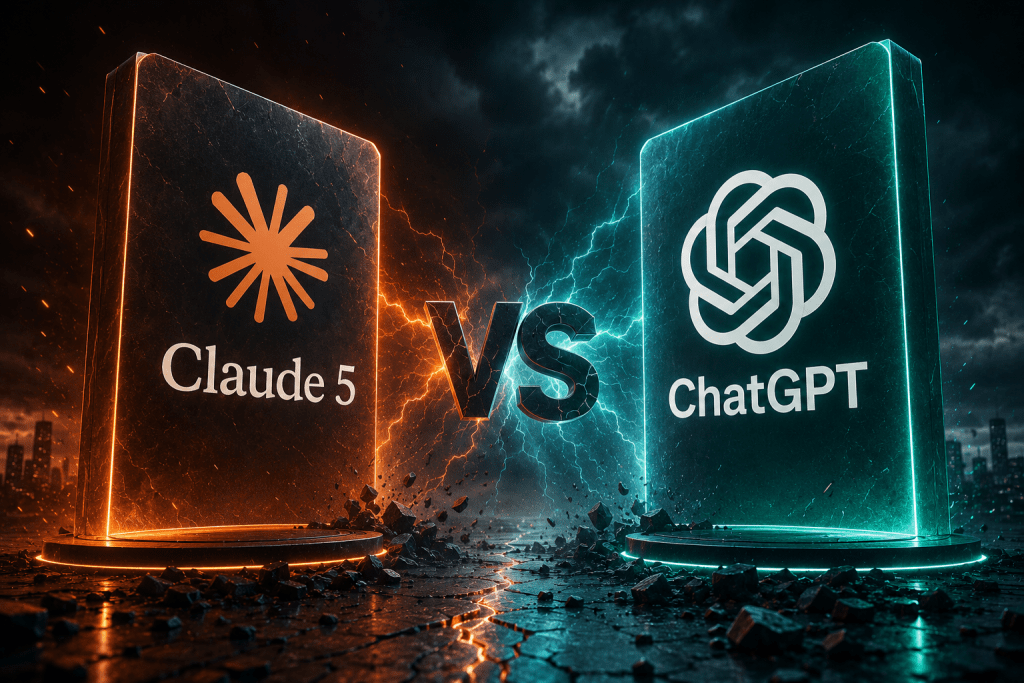
Claude Fable 5 vs ChatGPT 2026 showdown is no longer a tech nerd fodder it has become one of the most meaningful decisions millions of professionals, students, and everyday users are making right now. With Anthropic’s powerful new Claude Fable 5 model dropping and OpenAI pushing GPT-5 updates hard, the competition between these two titans has reached a fever pitch that feels different from previous rounds.
For years the question was simple: which AI is smarter on paper? Now it’s more personal. Which one actually helps you get work done better, feels more reliable in high-stakes situations, and aligns with how you want to work in 2026? The answers are more nuanced and sometimes more surprising than most people expect. This isn’t just another benchmark battle. It’s a real choice that affects daily workflows, creative output, coding sessions, and even how comfortable you feel trusting an AI with important tasks.
In this deep dive into Claude 5 vs ChatGPT 2026, we’ll break down what each model actually delivers today, where one clearly pulls ahead, where the other still dominates, and what the broader implications are as these two companies race toward IPOs and an increasingly regulated AI future.
What Makes Claude Fable 5 vs ChatGPT Different
The Claude 5 vs ChatGPT 2026 comparison arrives at a pivotal moment. Both companies have matured dramatically since the early ChatGPT days. Anthropic has leaned hard into its safety first identity with Claude Fable 5, while OpenAI continues pushing aggressive capability boundaries with GPT-5 iterations.
The gap that once felt massive has narrowed into something more nuanced, where strengths and weaknesses often come down to specific use cases rather than blanket superiority.
Claude Fable 5: Anthropic’s Most Powerful Public AI Model Is Here
Users are no longer choosing based solely on raw intelligence. They’re asking practical questions: Which model writes more naturally? Which one hallucinates less on complex tasks? Which feels safer for enterprise work? Which one simply gets out of your way and helps you ship faster? The answers vary depending on whether you’re a writer, developer, researcher, or student and that personalization is exactly why this Claude 5 vs ChatGPT debate matters so much right now.
Core Strengths: Where Claude Fable 5 Shines Brightest
In the Claude 5 vs ChatGPT 2026 battle, Claude Fable 5 (particularly the Opus and Sonnet variants) has carved out a reputation for thoughtful, high-quality output that many users describe as feeling more human and reliable. Its training philosophy emphasizes careful reasoning, reduced hallucination, and a willingness to say “I don’t know” when appropriate traits that make it especially strong for long-form writing, nuanced analysis, and complex problem-solving where accuracy matters.
Developers often praise Claude for producing cleaner, better structured code with fewer subtle bugs, particularly in larger projects. Writers appreciate its natural prose style and ability to maintain consistent tone across long documents. In side-by-side tests, Claude frequently edges out on tasks requiring deep contextual understanding and careful step-by-step reasoning. The model’s constitutional AI approach seems to translate into responses that feel more measured and less prone to overconfident errors a real advantage when the stakes are high.
However, this careful nature can sometimes manifest as slightly more conservative responses. Claude may push back on certain creative or boundary pushing prompts where users want maximum boldness.
Where ChatGPT (GPT-5) Still Dominates the Conversation
On the other side of the Claude 5 vs ChatGPT 2026 divide, OpenAI’s GPT-5 models continue to impress with raw power, speed on everyday tasks, and a broader ecosystem of features. ChatGPT often feels more versatile for quick interactions, creative brainstorming, image generation (via integrated DALL·E), and multimodal work. The platform’s memory features, custom GPTs, and seamless integration across tools give it a workflow advantage that many heavy users still prefer.
GPT-5 shines in scenarios requiring rapid iteration, broad knowledge application, and handling of diverse creative requests. It can feel more fun and responsive for casual use, and its ecosystem maturity means more plugins, integrations, and community resources are readily available. For users who value speed and a wide range of capabilities over maximum caution on every response, ChatGPT frequently wins the day-to-day experience.
OpenAI IPO 2026: The Shocking Truth Behind ChatGPT’s $1 Trillion Public Debut
That said, some testers note that GPT-5 can still occasionally produce more confident sounding but incorrect answers compared to Claude’s more measured style the classic tradeoff between boldness and reliability that has defined this rivalry for years.
Head-to-Head: Practical Tests and Real Differences
When you put Claude 5 vs ChatGPT 2026 through real world tasks, clear patterns emerge. In coding benchmarks, Claude often delivers more production ready code with better architecture decisions, especially on larger codebases. ChatGPT can feel faster for quick scripts and prototypes. For writing and analysis, Claude tends to produce more coherent long-form content with fewer inconsistencies, while ChatGPT excels at generating multiple creative variations rapidly.
Reasoning tasks show both models trading blows depending on the domain Claude frequently demonstrates stronger step-by-step logical consistency, while GPT-5 can surprise with creative leaps and broader knowledge synthesis. Pricing, context windows, and speed also factor heavily: Claude’s higher end models can be more expensive per token but offer excellent value for deep work, while ChatGPT’s tiered options feel more accessible for lighter daily use.
The EU AI Act taking effect soon adds another layer Anthropic’s safety emphasis may give Claude an edge for companies worried about compliance, while OpenAI’s scale and Microsoft partnership provide different strengths in enterprise deployment.
Which One Should You Actually Use in 2026?
The honest answer in the Claude 5 vs ChatGPT 2026 debate is that many power users now run both and that’s probably the smartest approach. Use Claude for deep work, writing, careful analysis, and coding projects where quality and reliability matter most. Turn to ChatGPT for rapid ideation, creative exploration, multimodal tasks, and when you need maximum speed and ecosystem convenience.
10 Best AI Note-Taking Apps for Students in 2026 That Actually Work
Your choice ultimately depends on your workflow. Students and researchers often lean Claude for accuracy and thoughtful explanations.
Developers split depending on project type. Creative professionals enjoy ChatGPT’s generative flair but return to Claude for polished final output. The gap isn’t massive enough anymore for one to completely replace the other they complement each other in powerful ways.
What This Rivalry Means for the Future
The intense Claude 5 vs ChatGPT 2026 competition is accelerating progress across the entire industry.
While both companies are forced to improve faster, address weaknesses more aggressively, and think seriously about safety, usability, and real world value as they prepare for public markets. Users are the clear beneficiaries of this arms race.
As regulatory pressure increases and both companies face the realities of public company expectations post IPO, this rivalry will likely evolve again. But for now, it has created an incredibly rich environment where talented teams are pushing the boundaries of what’s possible and giving ordinary people access to tools that would have seemed like science fiction just a few years ago.
Frequently Asked Questions
Which is better overall Claude 5 or ChatGPT in 2026?
It depends on the task. Claude often wins on careful reasoning, writing quality, and coding accuracy. ChatGPT excels in speed, creativity, multimodal features, and ecosystem convenience. Many users benefit from using both.
Is Claude Fable 5 better than GPT-5?
In many structured tasks and long-context work, yes Claude Fable 5 frequently feels more reliable. GPT-5 remains extremely strong for broad, fast-paced use and creative generation.
How much do they cost?
Both offer subscription tiers around $20/month for full access, with API pricing varying by model and usage. Higher-tier Claude models can be more expensive per token for maximum capability.
Which is safer or better for work?
Claude’s safety-first approach often makes it preferable for professional and enterprise use, especially with incoming regulations like the EU AI Act.
Can they both be useful?
Absolutely. The smartest strategy in 2026 is using each for what it does best rather than forcing one to be your only tool.
The Claude 5 vs ChatGPT 2026 rivalry represents something bigger than two products competing it’s a window into how artificial intelligence is maturing and how we as users are learning to navigate increasingly powerful tools. Neither model is perfect, but together they offer capabilities that would have been unimaginable not long ago.
Anthropic IPO 2026: The Shocking Truth Behind Claude AI’s Nearly $1 Trillion Valuation
Whether you end up team Claude, team ChatGPT, or happily using both, the real winner is anyone willing to experiment and find the workflow that fits their needs. The AI race is far from over, and the next chapters shaped by these two leaders and the companies racing to catch them will be fascinating to watch.
Pick the one that helps you do your best work today. The gap is smaller than ever, but the differences still matter.
 Grok AI Review 2026: Is Grok The Most Underrated AI Assistant Right Now?
  Gemini vs ChatGPT 2026: Which AI Assistant Is Actually Better?
  What Is Google Gemini and Should You Use It in 2026? (Honest Review)
  Claude AI Review 2026: Is It Worth Using for Writing, Research, and Productivity?
  Microsoft AI Coding Tools 2026: The Uncomfortable Truth Developers Are Just Finding Out
  AI Jobs at Risk by 2030: The Honest Truth Nobody Is Telling You
  Claude Fable 5 vs ChatGPT 2026: The Battle Forcing Millions to Finally Ditch One AI for the Other