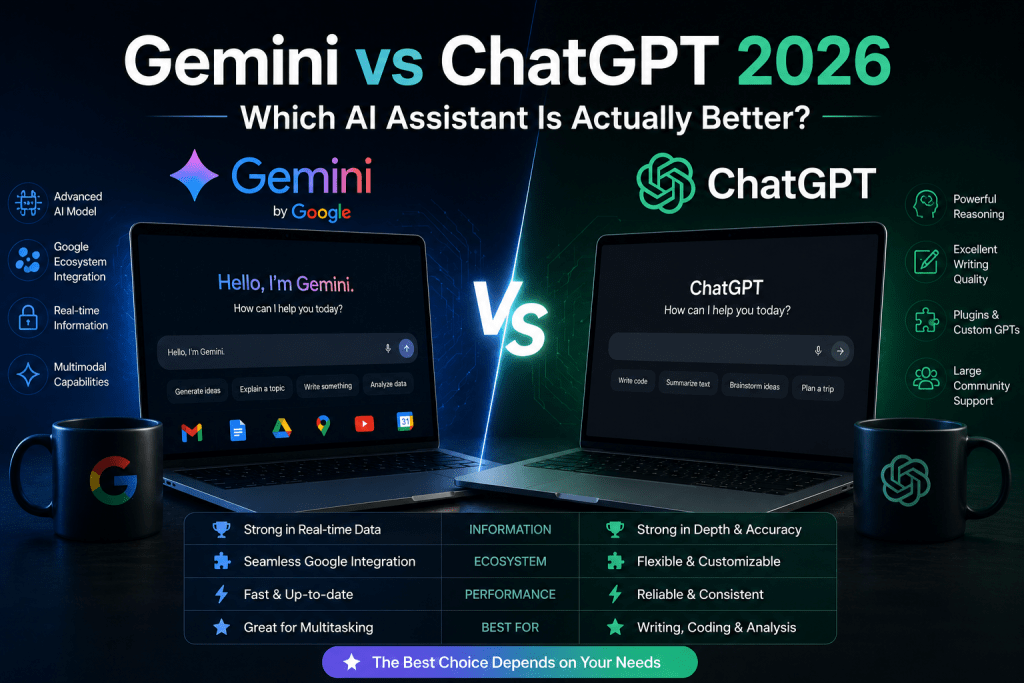
Gemini vs ChatGPT is a comparison that millions of people are searching for right now and for good reason. These are two of the most powerful artificial intelligence assistants available in 2026 and choosing between them is not as simple as picking the more popular one or the one with the bigger marketing budget.
Both tools are genuinely capable. Both have improved dramatically over the past year. And both have specific strengths that make them the better choice for different types of users doing different types of work.
This honest comparison is going to tell you exactly where each tool excels, where each one falls short, and which one deserves a place in your workflow based on what you actually need rather than what sounds most impressive in a press release.
Quick Overview: Where Each Tool Comes From
Before getting into the detailed comparison it helps to understand the companies behind these tools because the philosophy and priorities of each company shape how their AI assistant behaves in ways that matter for everyday use.
ChatGPT is built by OpenAI, the company that arguably triggered the modern AI assistant era when it released the original ChatGPT in late 2022. OpenAI has prioritised capability, versatility, and ecosystem building creating a tool that handles the widest possible range of tasks and connecting it to a broad network of plugins, integrations, and third-party services. ChatGPT remains the most widely used AI assistant in the world with over 900 million weekly active users.
Google Gemini is built by Google DeepMind, the research division formed when Google merged its main AI teams. Gemini replaced Google’s earlier Bard assistant in early 2024 and has been developed with a specific strategic focus embedding AI assistance deeply into Google’s existing ecosystem of products used by billions of people worldwide. Gemini is currently the most searched AI term in the United States, which reflects both Google’s marketing reach and genuine user curiosity about where the company is taking its AI products.
Both tools are available through web interfaces and mobile apps. Both have free tiers and paid subscription options. Both can handle writing, research, coding, analysis, and a wide range of everyday tasks. The differences emerge when you look at how well they handle those tasks and which ones each handles best.
Writing Quality: ChatGPT Has a Slight Edge
For writing tasks, ChatGPT has a marginal but noticeable edge over Gemini in most head-to-head comparisons, particularly for longer, more structured pieces.
ChatGPT produces writing that flows well, maintains logical structure across longer pieces, and adapts reasonably convincingly to different tones and styles when given clear direction. The output requires editing but the editing burden is generally manageable for most everyday writing tasks.
Gemini’s writing is competent and perfectly adequate for most practical purposes emails, summaries, short social posts, straightforward explanations. Where it falls behind is on longer, more demanding pieces where maintaining coherence and voice across many paragraphs becomes more challenging. The gap is not dramatic for casual use but becomes more noticeable when you are producing content that will be published or shared professionally.
For context, both tools trail Claude AI noticeably on writing quality for long-form content if writing is your primary use case, our Claude AI vs ChatGPT comparison explains why Claude is the stronger choice for that specific purpose.
Research and Information: Gemini Wins on Currency
Both Gemini and ChatGPT have real-time web access built into their standard interfaces in 2026, which means both can search the web and provide current information rather than being limited to training data with a fixed cutoff date. This represents a significant improvement over earlier versions of both tools that relied primarily on static training data.
The difference is in how reliably and consistently each tool uses that web access and how well it synthesises the information it finds.
Gemini’s web search integration feels more natural and consistent it draws on Google’s search infrastructure which is the most developed web indexing system in the world. For current events, recent developments, prices, and rapidly changing information, Gemini’s answers tend to be timely and well-sourced.
ChatGPT’s web search has improved significantly and is reliable for most research purposes, but the integration between the conversational AI and the search capability can occasionally feel less seamless than Gemini’s approach.
For research involving very recent information or fast-moving topics, Gemini’s advantage in this area is real and practically meaningful.
Google Workspace Integration: Gemini Wins Clearly
This is the most significant competitive advantage Gemini has and the one that makes it the obvious choice for a specific type of user anyone whose working life is built around Google’s products.
Gemini is embedded directly into Gmail, Google Docs, Google Drive, Google Slides, Google Calendar, and other Google Workspace applications. This means AI assistance is available inside the applications where you are already doing your work rather than in a separate tool you have to switch between.
In Gmail, Gemini can read your emails, understand conversation context, draft replies in your voice, summarise long threads, and help you compose new messages without leaving your inbox. In Google Docs it can generate drafts, improve existing text, summarise documents, and assist with formatting. In Google Drive it can search across your files and surface relevant information based on natural language questions.
ChatGPT has integrations and plugins, and its ecosystem of third-party connections is broad. But it is not embedded inside Gmail or Google Docs in the same way. For users who spend their working day inside Google’s ecosystem, Gemini offers something ChatGPT genuinely cannot match AI assistance that lives where your work already happens.
If you use Microsoft products Outlook, Word, Teams, OneDrive Microsoft Copilot offers a comparable level of integration within that ecosystem. But for Google users specifically, Gemini’s workspace integration is its strongest and most differentiated advantage.
And it is not close for Google users
Coding Assistance: ChatGPT
For coding tasks, ChatGPT has a clear and consistent advantage over Gemini that experienced developers and beginners alike will notice.
ChatGPT’s Code Interpreter feature which can actually execute code, analyse data, produce charts, and show you the output of what it writes is a capability that changes how useful an AI coding assistant can be. Rather than generating code and asking you to run it elsewhere to see if it works, ChatGPT can run it within the conversation, identify errors, fix them, and iterate until the output is correct. For data analysis tasks in particular this integrated execution capability is a meaningful practical advantage.
Gemini handles code competently. It can write scripts, explain what code does, help debug problems, and assist with technical questions. But the gap between generating code and executing it to verify the output is a real difference in capability for users who need to do serious work with code.
For beginners who need code explained in plain language and want help understanding technical concepts, both tools handle this adequately. For anyone doing more substantial coding or data analysis work, ChatGPT’s execution capability makes it the stronger choice.
Versatility and Plugins: ChatGPT
The ecosystem built around ChatGPT is significantly more developed than Gemini’s in terms of third-party integrations, plugins, and custom configurations.
ChatGPT connects to Zapier, project management tools, e-commerce platforms, productivity applications, and dozens of other services through its plugin and integration system. Custom GPTs allow users and developers to create specialised versions of ChatGPT trained on specific information for specific purposes customer service assistants, writing tools tuned to specific styles, research assistants with access to particular databases.
Gemini’s integration story is strong within the Google ecosystem but narrower outside it. For users whose workflows extend beyond Google’s products into a broader range of applications and services, ChatGPT’s ecosystem advantage is real.
Multimodal Capabilities: Gemini
Working with images, audio, and video alongside text what the AI industry calls multimodal capability is an area where Gemini has invested heavily and where it has genuine advantages over ChatGPT for certain types of tasks.
Gemini can analyse images with impressive accuracy, understand the content of videos, process audio, and work across different types of input in ways that feel natural rather than like a bolted-on feature. Google’s years of investment in image recognition, video understanding through YouTube, and audio processing give Gemini a strong foundation for multimodal work.
ChatGPT handles images competently and has improved its multimodal capabilities significantly, but Gemini’s depth in this area reflects a longer and more integrated history of working across different content types.
For users who regularly work with visual content designers, content creators, marketers, researchers who work with charts and graphs Gemini’s multimodal capabilities are worth factoring into the decision.
Honesty and Reliability: Draw With Caveats
Both tools have improved significantly in reliability since their early versions, and both are capable enough that factual errors are the exception rather than the rule for well-established topics.
The honest caveat for both is that neither should be treated as an authoritative source for anything consequential without verification. Both tools can produce errors with confident-sounding language, and both are more reliable for well-established topics than for niche subjects, very recent events, or highly specific technical claims.
Gemini had a more visible history of factual errors in its early versions the launch demonstration error that caused Google’s stock to drop in 2023 became a widely cited example of AI reliability concerns. The current version has improved substantially but the history is worth knowing about.
For users who require maximum reliability and an AI tool specifically designed to acknowledge uncertainty, Claude AI’s approach built from the ground up around honest epistemic behaviour remains the strongest option in this area. Between Gemini and ChatGPT specifically, the gap has narrowed to the point where it is not a decisive factor for most everyday use.
Pricing: Both Offer Genuine Free Tiers
Both Gemini and ChatGPT offer free tiers that provide real access to their core capabilities. Neither is a frustrating preview designed purely to push you toward a paid plan both free versions are genuinely useful for understanding what the tool can do and for everyday light use.
ChatGPT’s free tier gives you access to capable models with usage limits. The paid ChatGPT Plus plan unlocks higher usage, access to the most advanced GPT models, and the Code Interpreter and plugin features that represent the tool’s most differentiated capabilities.
Gemini’s free tier gives you access to the conversational assistant. Gemini Advanced through Google One AI Premium unlocks the most capable models and the deeper Google Workspace integrations that represent Gemini’s most differentiated capabilities. For existing Google One subscribers the value proposition of upgrading to AI Premium is particularly strong since it bundles AI capabilities with existing storage benefits.
For businesses and teams, both companies offer enterprise tiers with additional security, administrative controls, and higher usage limits suited to professional environments.
Both Gemini and ChatGPT offers genuine value at free and paid tiers
Who Should Use ChatGPT
ChatGPT is the stronger choice if coding and data analysis are regular parts of your work the Code Interpreter capability is a genuine competitive advantage for those specific tasks. It is also the better choice if you need deep third-party integrations across a wide range of applications beyond Google’s ecosystem, or if you want access to the broadest possible range of custom AI configurations through the GPT store.
ChatGPT is also the more established starting point for absolute beginners simply because of the volume of tutorials, examples, and community resources that exist for it. If you want the most support available as you learn how to use an AI assistant effectively, ChatGPT’s larger user community is an advantage.
Who Should Use Google Gemini
Gemini is the clear choice if your working life is built around Google’s ecosystem. If Gmail is your email, Google Docs is where you write, and Google Drive is where your files live, Gemini’s workspace integration means AI assistance is embedded in your actual working environment rather than requiring you to context-switch to a separate tool.
Gemini is also the better choice if multimodal work is important to you, if real-time information access is a regular requirement, or if you are already paying for Google One and want to get more value from that subscription by upgrading to AI Premium.
Should You Use Both
For many users the answer is yes and using both is simpler than it sounds since both have free tiers that require no financial commitment.
A practical combined workflow looks like this: use Gemini for tasks where its Google integration shines managing email, working within Docs, searching your Drive, research requiring current information. Use ChatGPT for coding tasks, data analysis, and anything that benefits from its broader plugin ecosystem or Code Interpreter capability.
This complementary approach gives you the best of both tools without requiring you to commit exclusively to either one.
Gemini vs ChatGPT: Quick Comparison Summary
Frequently Asked Questions
Is Gemini better than ChatGPT in 2026?
Neither is simply better they excel in different areas. Gemini wins on Google Workspace integration and multimodal capabilities. ChatGPT wins on coding, data analysis, and third-party integrations. The right choice depends on what you actually use AI for.
Is Google Gemini free?
Yes. The basic version of Gemini is free at gemini.google.com. Gemini Advanced with deeper workspace integration requires a Google One AI Premium subscription.
Which is better for students, Gemini or ChatGPT?
Both are useful for students. ChatGPT has a slight edge for writing tasks and coding. Gemini has advantages for research requiring current information. Students already using Google Workspace for school will find Gemini’s integration particularly convenient.
Can Gemini replace Google Search?
Not entirely, but it is changing how search works. AI Overviews in Google Search already provide direct answers for many queries. The role of traditional search and AI-generated answers is evolving rapidly and Gemini is central to that transition.
Which AI assistant is most popular?
ChatGPT remains the most widely used globally with over 900 million weekly active users. Gemini has become the most searched AI term in the United States reflecting strong interest and Google’s distribution advantage.
How do Gemini and ChatGPT compare to Claude AI?
For writing quality and analytical depth, Claude AI outperforms both Gemini and ChatGPT. For Google Workspace integration, Gemini has no competition. For coding with code execution, ChatGPT leads. Read our full Claude AI vs ChatGPT comparison for a detailed breakdown.
The Gemini vs ChatGPT debate does not have a universal winner and any comparison that declares one simply better than the other is oversimplifying a genuinely nuanced picture.
ChatGPT’s strengths in coding, data analysis, and ecosystem versatility make it the stronger tool for developers, data-focused users, and people whose workflows extend across many different applications. Gemini’s strengths in Google Workspace integration, multimodal capabilities, and real-time information make it the stronger tool for Google users, content creators working with visual material, and anyone who needs current information reliably.
The most useful thing you can do is try both free tiers for a week with the actual tasks you need to accomplish. What each tool does well will become immediately apparent through real use in a way that no comparison article can fully replicate.
 Grok AI Review 2026: Is Grok The Most Underrated AI Assistant Right Now?
  Claude Fable 5 vs ChatGPT 2026: The Battle Forcing Millions to Finally Ditch One AI for the Other
 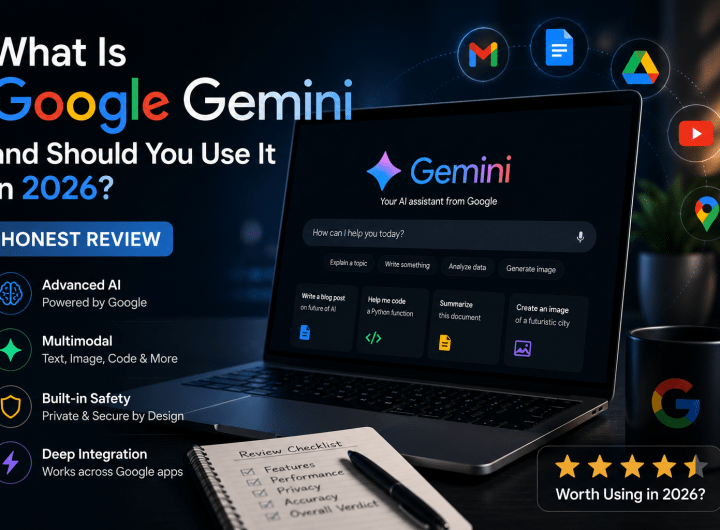 What Is Google Gemini and Should You Use It in 2026? (Honest Review)
  Claude AI Review 2026: Is It Worth Using for Writing, Research, and Productivity?
  Microsoft AI Coding Tools 2026: The Uncomfortable Truth Developers Are Just Finding Out
  AI Jobs at Risk by 2030: The Honest Truth Nobody Is Telling You