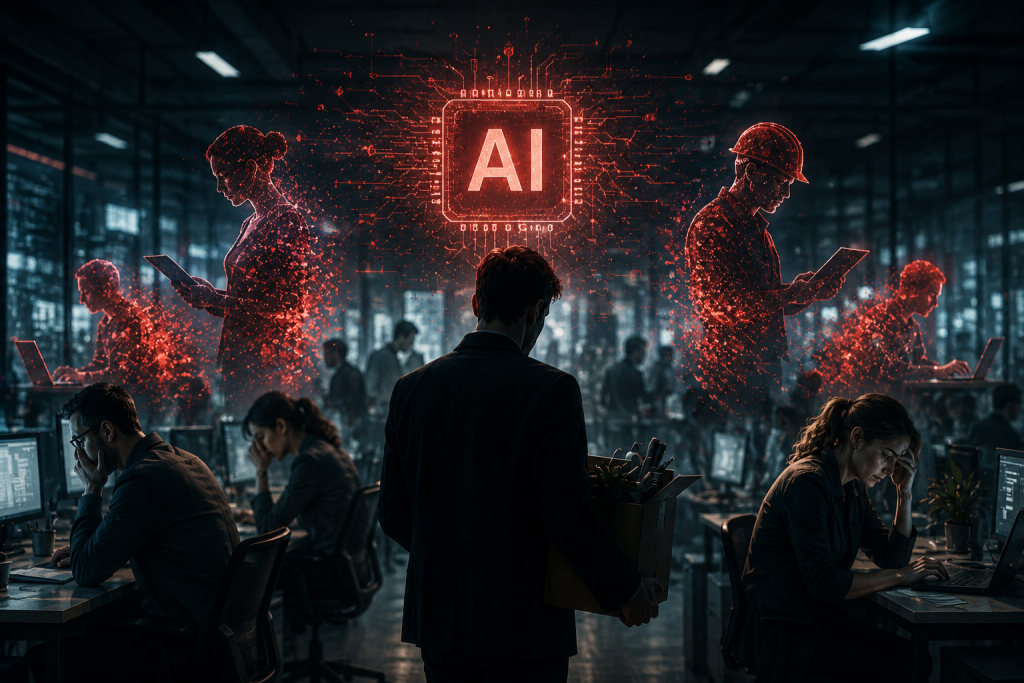
Let’s get the uncomfortable part out of the way first.
If you work in an office, process information for a living, answer the same types of questions repeatedly, or spend most of your day doing tasks that follow a predictable pattern the research on AI jobs at risk by 2030 is not ambiguous about what is coming. The question is not really whether AI will affect your job by 2030. The question is how much, how fast, and what you can do about it before it arrives.
The numbers that keep circulating on social media tend to be either terrifying or dismissive, and most of them miss the more important story underneath. This article is not going to tell you the robots are taking everything and you should panic. It is also not going to tell you not to worry because AI creates more jobs than it destroys. Both of those framings are technically defensible and practically useless.
What follows is the honest version which jobs are genuinely at risk, which ones are safer than most people think, what the research actually says about the timeline, and what the one question you should be asking about your own career right now actually is.
The Numbers on AI Jobs at Risk by 2030 That People Keep Getting Wrong
The headline figure you have probably seen is 92 million jobs displaced globally by 2030.
The World Economic Forum estimates that AI driven job disruption will account for 22 percent of jobs, with 170 million new roles created and 92 million displaced, resulting in a net increase of 78 million jobs.
Read that again carefully. The same report that projects 92 million jobs displaced also projects 170 million new jobs created. The net number is positive. That fact almost never makes the headline.
Claude Fable 5: Anthropic’s Most Powerful Public AI Model Is Here What You Need to Know
But here is why the net positive number is less reassuring than it sounds. The 92 million jobs that disappear are concentrated in specific roles that exist today, held by specific people who trained for those careers. The 170 million new jobs that appear will require different skills, different training, and will be accessible primarily to people who adapted early. The net math works out fine for the economy as an abstract concept. It does not automatically work out fine for the individual whose job is in the 92 million.
The research consensus is that the most significant labour market effects of AI will materialise between 2027 and 2030, as current AI deployments mature and autonomous systems reach commercial scale. That window is not far away. And Anthropic’s research team, which developed a new measure of AI displacement risk based on actual tool usage data rather than theoretical exposure, found evidence that high usage AI occupations are beginning to see modestly slower hiring. The effects remain modest today but are accelerating.
The disruption is not hypothetical. It is already beginning. 2027 to 2030 is when it accelerates.
The Jobs Most at Risk and Why
The pattern is consistent across every credible study. The jobs most vulnerable to AI displacement are not the ones that require the least intelligence they are the ones that require the most predictable, repeatable application of it.
Customer service and call centre roles are at the front of the line. Customer service and data entry roles face 85 to 95 percent automation risk by 2027 due to large language model advancements and AI voice agents. The reason is brutal in its simplicity. Most customer service interactions follow recognisable patterns. The questions are predictable. The answers are knowable. The emotional register required is manageable for current AI. And AI voice agents do not get frustrated, do not have bad days, and work around the clock without overtime.
Data entry and administrative clerks face near certain displacement. Intelligent Document Processing tools now extract, classify, and enter structured data from unstructured sources with 97 percent or higher accuracy. McKinsey’s research categorises 86 percent of data entry tasks as technically automatable today. If your job primarily involves moving information from one place to another in a structured way, that job is already automatable. The only reason it has not been automated yet is cost, transition friction, and organisational inertia none of which hold indefinitely.
Bank tellers, cashiers, and postal workers are named explicitly by the World Economic Forum as roles forecast to decline significantly. Approximately 200,000 jobs are expected to be cut from Wall Street banks over the next three to five years. As much as 54 percent of banking jobs have high potential for AI automation.
Paralegals and legal researchers are further along than most people realise. AI tools are expected to replace a significant portion of legal support roles, with paralegals facing an 80 percent risk of automation by 2026 and legal researchers facing a 65 percent risk of automation by 2027. The document review, contract analysis, and precedent research that junior legal professionals spend years mastering are exactly the kinds of structured reasoning tasks that large language models handle well.
Translators and interpreters are facing a different kind of disruption one that has arguably already arrived. Certain jobs are at very high risk, like interpreters and translators, with tools such as DeepL and Google Translate doing many of their tasks. Neural machine translation has reached near human parity for most common language pairs in business and technical documents. The freelance document translation market has been quietly decimated over the past two years.
The through line across all of these is not complexity it is routine. Automation targets tasks, not entire careers. Research shows that while routine, repetitive work faces the highest automation risk, most jobs contain a mix of automatable and uniquely human elements.
The Jobs That Are Safer Than You Think
The narrative that white collar knowledge workers are safe and factory workers are at risk has been largely inverted by the actual direction of AI development in 2025 and 2026.
Installation, repair, and maintenance jobs are at lower risk from AI and remain in demand. Construction and skilled trades are among the least threatened by AI automation. A plumber diagnosing a non standard problem in an old building, a mechanic troubleshooting an unfamiliar fault, an electrician working through a complex residential rewire these require physical dexterity, real world judgment under uncertainty, and the ability to adapt to conditions that have never been exactly this way before. Current AI cannot do any of that.
Healthcare roles that require human presence are not just safe they are growing. Nurse practitioners are projected to grow by 52 percent from 2023 to 2033, much faster than the average for all occupations. AI augments rather than replaces these roles. The physical, emotional, and ethical dimensions of patient care create a floor below which AI automation cannot reach, regardless of how capable the underlying models become.
Teachers and educators are in a more complicated position than the simple safe label suggests, but the fundamentally human nature of the teaching relationship the mentorship, the reading of a confused student, the cultural sensitivity, the ability to improvise when a lesson plan stops working is deeply resistant to automation in a way that information transfer alone is not.
Therapists, social workers, and counsellors hold some of the most AI-proof positions in the economy. Ethical responsibility and liability must stay with licensed professionals. Social and emotional skills are both the hardest to automate and the fastest growing in demand.
The Uncomfortable Middle Jobs That Will Transform, Not Disappear
Here is where the conversation needs to be more honest than most predictions allow.
The majority of jobs by 2030 will not have been eliminated by AI. They will have been transformed by it and whether that transformation goes well for the people in those jobs depends almost entirely on choices made in the next two to three years.
Almost 49 percent of jobs can now use AI for at least 25 percent of their tasks, showing that AI is already supporting or replacing part of daily work. Employers predict that 34 percent of all work tasks could be fully automated by 2030.
Apple WWDC 2026: Siri Gets AI Superpowers and Claude Is Now on iPhone
Think about what that means in practice. Your job probably will not disappear. But a significant portion of what you currently spend your working hours doing will either be done by AI or be expected to be done faster because AI exists. The people who adapt to that shift who learn which parts of their role to delegate to AI and which parts to double down on will become more valuable. The people who resist it or ignore it will find themselves doing less of what their organisation actually needs.
By 2030, 14 percent of employees globally will have been forced to change their career because of AI. 20 million US workers are expected to retrain in new careers or AI use in the next three years. That retraining figure is not a dystopian projection it is an opportunity statistic. The workers who retrain early are not the ones who get displaced. They are the ones who end up in the 170 million new roles.
One Question You Should Ask About Your Own Job
The question most people ask is: will AI replace my job? That is the wrong question.
The right question is: what percentage of my current tasks could AI do, and what would I do with my time if it did?
If the answer to the second part is “I would do more of the parts that require human judgment, relationships, creativity, or physical presence” you are likely in a position to thrive in an AI augmented workplace. The AI takes your repetitive tasks. You get to do more of the interesting work.
If the answer is “I am not sure what else I would do” that is useful information to have in 2026, when there is still time to develop the skills that will matter, rather than in 2029 when the transition is already well underway.
Global research from the World Economic Forum and McKinsey places leadership, critical thinking, resilience, and people management at the top of required skills for 2025 through 2030. None of those are skills that AI improves at faster than humans do. They are skills that become more valuable as AI handles more of everything else.
What Actually Happens Next
The honest forecast for the period between now and 2030 is not mass unemployment. It is accelerating divergence between industries that adapt and those that do not, between workers who develop AI fluency and those who wait to be told what to do, between organisations that use AI to amplify their best people and those that use it purely to cut headcount.
By 2030, AI driven job disruption will account for 22 percent of jobs, with 170 million new roles created and 92 million displaced, resulting in a net increase of 78 million jobs. The industries most affected include manufacturing at 58 percent, customer service at 45 percent, transportation at 50 percent, and retail at 40 percent.
The people who do worst in that transition will be the ones who treated the arrival of AI as something happening to them rather than something they could act on. The people who do best will be the ones who got curious early, learned what AI could and could not do, and made deliberate choices about which parts of their working life to protect and which parts to hand over.
You have roughly three years before the research consensus says the acceleration becomes undeniable. That is not a comfortable amount of time but it is enough to act.
Frequently Asked Questions
Which jobs are most at risk from AI by 2030?
The highest-risk roles are those built around routine, predictable, high-volume information tasks data entry, customer service, telemarketing, basic legal and financial processing, translation of standard documents, and administrative coordination. These face displacement risk above 80 percent in several credible studies.
Will AI create more jobs than it destroys?
On a net global basis, most major forecasts including the World Economic Forum project more jobs created than lost. The challenge is that the destroyed jobs and the created jobs require different skills and affect different populations, meaning the net positive number does not distribute evenly.
Are white-collar jobs safer than blue-collar jobs?
Not necessarily. Routine white-collar work administrative, legal support, financial processing faces high automation risk. Skilled manual trades like plumbing, electrical work, and construction are significantly harder for AI to automate because they require physical dexterity and real-world judgment in non-standard environments.
What skills will be most valuable by 2030?
Leadership, critical thinking, emotional intelligence, complex problem-solving, and people management consistently top research rankings for AI-resistant skills. These are the areas where human capability is hardest to replicate and where demand will grow as AI handles more routine work.
How do I know if my specific job is at risk?
Ask what percentage of your daily tasks involve routine, predictable, repeatable work versus judgment, relationships, physical presence, or creative thinking. The higher the routine percentage, the higher the risk. This is a more useful frame than job title alone.
Should I change careers now because of AI?
For most people, evolution of your current career is more practical than a full change. Developing AI fluency understanding what the tools can do and how to use them effectively is the single most protective investment most workers can make in the next two to three years.
The AI jobs story is genuinely complicated, and most versions of it the terrifying one and the reassuring one are choosing which half of the data to show you.
The honest version is this: tens of millions of jobs in their current form will not survive to 2030. The roles that disappear will overwhelmingly be ones built around tasks that AI can already do faster, cheaper, and without rest. At the same time, new roles that did not exist five years ago are being created at a rate that has historically accompanied every major technological transition.
The people caught in the middle whose jobs transform rather than disappear face a choice that is available to them right now and will become less available every year. Learning to work with AI is not a technical skill reserved for software engineers. It is a professional survival skill for anyone who wants to be on the right side of that 78 million net figure.
The window is open. The question is whether you use it.
 Microsoft AI Coding Tools 2026: The Uncomfortable Truth Developers Are Just Finding Out
  OpenAI IPO 2026: The Shocking Truth Behind ChatGPT’s $1 Trillion Public Debut
  Claude Fable 5: Anthropic’s Most Powerful Public AI Model Is Here What You Need to Know
  Anthropic IPO 2026: The Shocking Truth Behind Claude AI’s Nearly $1 Trillion Valuation
  7 Powerful Claude AI Effort Settings Tips Every Beginner Must Know
  AI Jobs at Risk by 2030: The Honest Truth Nobody Is Telling You
  Grok AI Review 2026: Is Grok The Most Underrated AI Assistant Right Now?
  Claude Fable 5 vs ChatGPT 2026: The Battle Forcing Millions to Finally Ditch One AI for the Other