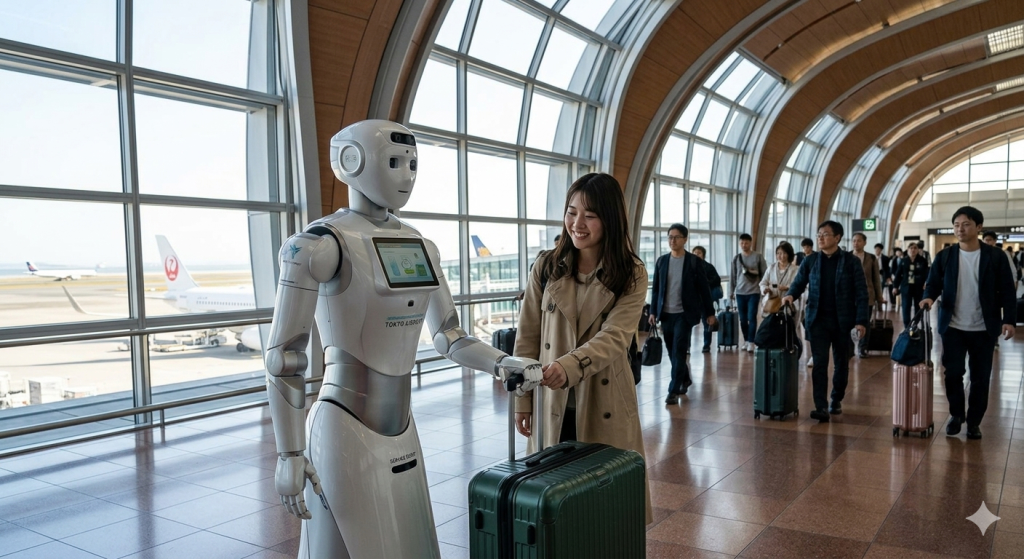
Japan Airlines humanoid robots Haneda airport 2026 mark a three-year commitment to ground handling, driven by a labor shortage no hiring push could fix.
Humanoid robots Haneda airport 2026 is the story that proves humanoid robots have crossed from spectacle into infrastructure.
When Japan Airlines deployed humanoid robots at Tokyo’s Haneda Airport in May 2026, the industry’s message was hard to miss. This was not a press conference stunt but a three-year operational commitment from a legacy aviation carrier in one of the world’s most safety-conscious regulatory environments.
A three-year contract. Not a one-day photo opportunity. Japan Airlines one of the most risk-averse, safety-obsessed companies on the planet looked at humanoid robots and decided they were ready for real operational responsibility.
Why Japan Needed This Right Now
The reason behind this deployment is not about novelty. It is about a demographic crisis that Japan cannot solve any other way.
Japan’s working-age population is projected to decline by 31% between 2023 and 2060. Haneda handles roughly 85.9 million passengers annually. JAL operates around 4,000 ground handling workers, and Japan is targeting 60 million inbound tourists by 2030, up from a record 42.7 million in 2025.
Read those numbers together. A shrinking workforce. A growing passenger load. A government actively trying to attract more tourists. Something has to fill that gap, and Japan has decided humanoid robots are part of the answer.
What This Means Beyond Japan
This is not an isolated case. Across the industry, Figure’s robots are already supporting more than 30,000 vehicles at BMW, and Agility’s Digit units are active at Toyota Canada under a robots-as-a-service arrangement.
The pattern is consistent aging economies and labor-constrained industries are the first adopters, not because the technology is flashy but because the alternative is operational failure. Airports, factories, and warehouses are becoming the proving ground for humanoid robots precisely because the labor shortage there is undeniable and urgent.
FAQ
What are the humanoid robots at Haneda Airport doing?
Japan Airlines deployed humanoid robots for ground handling operations at Haneda Airport as part of a three year operational commitment, addressing labor shortages tied to Japan’s declining working-age population.
Why did Japan Airlines choose humanoid robots specifically?
Japan’s working-age population is projected to decline by 31% between 2023 and 2060, while Haneda handles nearly 86 million passengers annually and Japan targets 60 million inbound tourists by 2030 creating a labor gap traditional hiring cannot fill fast enough.
Related Reading
• Boston Dynamics Just Committed to 30000 Robots a Year and the Factory Race Just Got Real
 DeepSeek Raised $7.4 Billion and the Investors Got Absolutely Nothing to Show for It
  What Is AGI Artificial General Intelligence in 2026 and Are We Already Living With It?
  The Tokenmaxxing Trap: Reasons AI Budget Startups Are Failing in 2026
  Google Lost a Nobel Prize Winner to Anthropic and That Is Only Half the Problem