
For years, running OpenAI’s models meant paying NVIDIA. Every query, every API call, every ChatGPT response ran on NVIDIA hardware. NVIDIA set the price, NVIDIA set the terms, and the entire AI industry essentially paid a GPU tax on every piece of intelligence it consumed.
That arrangement just got a lot more complicated.
OpenAI has officially announced its first custom AI chip, codenamed Jalapeno, built in partnership with semiconductor giant Broadcom. It is designed to power the next generation of OpenAI’s agentic models the systems that don’t just answer questions but plan, reason, and take multi-step actions across long tasks and the company says its performance sits on par with NVIDIA’s Blackwell architecture, the current gold standard in AI computing.
This is the OpenAI Jalapeno chip story. And it is bigger than a product launch. It is the moment OpenAI stops renting the infrastructure of the AI economy and starts building its own.
Why OpenAI Decided to Build Its Own Chip
The short answer is money. The longer answer is control.
OpenAI spends an extraordinary amount on compute. Training frontier models like GPT-5 and running inference at ChatGPT’s scale hundreds of millions of users, billions of queries costs billions of dollars a year. Almost all of that spending historically went to NVIDIA, whose H100 and Blackwell chips remain the dominant hardware for serious AI workloads.
NVIDIA’s gross margins sit above 70 percent. When you are one of the largest buyers of chips in the world and the company selling you those chips is posting margins that most industries only dream about, it is only a matter of time before you ask whether you could build something yourself and keep that margin in-house.
That calculus has already played out at Google, which built its TPU line. At Amazon, which has Trainium and Inferentia. At Meta, which has its MTIA chip program. Every major hyperscaler eventually reaches the same conclusion: the economics of custom silicon beat the economics of paying NVIDIA’s prices at sufficient scale.
OpenAI crossed that threshold. Jalapeno is the result.
What the Jalapeno Chip Actually Is
Jalapeno is not a general-purpose training chip designed to replace NVIDIA across all use cases. It is something more specific and, in some ways, more interesting.
The chip is optimised for inference running AI models rather than training them. And specifically, it is built around the demands of agentic AI workflows: multi-step tasks where a model needs to reason across many turns, call tools, browse the web, write and execute code, and complete complex goals over extended interactions.
That distinction matters because agentic workloads have a very different computational profile than a standard chat response. A single agentic task might involve dozens of sequential model calls, each dependent on the output of the last. Standard GPU clusters are not particularly efficient at this kind of sequential, state-dependent work. Jalapeno is designed from the ground up to handle it.
The Broadcom partnership brings serious credibility. Broadcom is not a startup. It is one of the world’s most experienced custom chip manufacturers, already responsible for the silicon inside Google’s TPU line. OpenAI is not reinventing the wheel here it is applying proven methodology to its specific problem.
What This Means for NVIDIA
Let’s not overstate the immediate impact. NVIDIA is not in trouble. Not today.
NVIDIA’s real competitive advantage is not just the hardware. It is CUDA the software ecosystem, the libraries, the decade of developer familiarity built on top of its chips. Switching to custom silicon means rewriting or porting that entire layer. It is one of the main reasons technically capable alternatives have struggled to take meaningful market share from NVIDIA despite years of trying.
But the direction of travel is clear. The largest AI companies in the world are all moving toward custom silicon as fast as they can execute it. Every chip built in-house is one less chip bought from NVIDIA. At scale, that adds up fast.
The more immediate effect of Jalapeno is on NVIDIA’s pricing power. When OpenAI was a pure customer with no credible alternative, NVIDIA could price accordingly. Now that OpenAI has a working in-house option for inference workloads, that negotiating dynamic shifts. Even if OpenAI never becomes fully self-sufficient in silicon, the existence of Jalapeno gives it leverage it simply did not have before.
What This Means for the Cost of Running AI
This is the question that matters most for people who use AI rather than build it.
OpenAI’s stated motivation for Jalapeno is partly to reduce the cost of running its most advanced models. If inference on custom silicon is meaningfully cheaper than inference on NVIDIA hardware at scale, those savings have the potential to flow through to API pricing and eventually to consumer subscription costs.
That is a big if. Custom chip projects are notoriously difficult to execute, and the gap between a chip announcement and a chip deployed reliably at production scale is often wider than anyone admits at launch. Google’s TPU journey took years from first announcement to the point where it was doing real work at real scale.
But the incentive is aligned. OpenAI needs cheaper compute to stay competitive as its models get more capable and more expensive to run. Jalapeno is the first step on a road that, if followed consistently, could make frontier AI meaningfully more affordable over the next three to five years.
The Agentic AI Connection
There is a reason OpenAI chose this moment to announce a custom chip, and it connects directly to where its product roadmap is heading.
OpenAI has been explicit that its future is in agentic AI systems that do not just respond to prompts but act on behalf of users across long, complex tasks. Its Operator platform and the autonomous coding tools it has been rolling out are early versions of that future.
Agentic AI is computationally expensive in a different way than standard inference. A user asking ChatGPT a question generates one API call. An agentic task doing a week’s worth of research might generate thousands. At that volume, the economics of custom silicon versus commodity GPUs become absolutely critical.
Jalapeno is not just a chip. It is OpenAI building the infrastructure for the kind of AI it actually wants to deploy.
BEXORN VERDICT: 9/10 The GPU Tax on AI Just Got Its First Real Challenge
The OpenAI Jalapeno chip is the most significant infrastructure move in AI since Google proved that custom silicon could compete with NVIDIA at scale. It does not immediately reshape the GPU market, and it will take years of real-world execution to prove out the performance claims at volume. But the strategic direction is unmistakable. OpenAI is not just an AI lab anymore. It is becoming a vertically integrated AI company that trains its own models, runs its own infrastructure, and now designs its own chips. The companies that should be worried are not just NVIDIA. They are every cloud provider whose business model depends on reselling GPU access to AI companies. That model just got a lot more fragile.
FAQ
What is the OpenAI Jalapeno chip?
Jalapeno is OpenAI’s first custom AI chip, built in partnership with Broadcom. It is optimised for inference and agentic AI workloads rather than large model training. OpenAI says it performs on par with NVIDIA’s Blackwell chips for these use cases.
Why is OpenAI building its own chip instead of buying from NVIDIA?
At OpenAI’s scale, the cost of running every inference call on NVIDIA hardware is enormous. Custom silicon lets the company optimise hardware for its specific workloads and reduce dependence on NVIDIA’s pricing. Google, Amazon, and Meta have all followed the same logic with their own chip programs.
Will the Jalapeno chip make ChatGPT cheaper?
Potentially, over time. If OpenAI achieves cheaper inference with custom silicon, those savings could flow through to API pricing and consumer subscriptions. But production-scale deployment typically takes years, so meaningful cost reductions are more likely a 2027 to 2028 story.
Is Jalapeno actually as good as NVIDIA Blackwell?
OpenAI claims parity for its target workloads inference and agentic AI rather than large-scale training. The claim has not yet been independently verified. Third-party benchmarks will be the real measure.
Who manufactured the Jalapeno chip?
It was built by OpenAI in partnership with Broadcom, which already manufactures the custom ASICs inside Google’s TPU line. Broadcom brings substantial hyperscaler chip experience to the project.
What does Jalapeno mean for the AI industry long term?
It accelerates a trend already underway: the largest AI companies building custom hardware to escape NVIDIA dependency. The more companies that succeed at this, the more competitive pressure NVIDIA faces on pricing and the cheaper AI infrastructure becomes across the board.
Related Reading:
• Google Paid 2.7 Billion Dollars to Keep Noam Shazeer and He Left for OpenAI Anyway
• What Is AGI Artificial General Intelligence in 2026 and Are We Already Living With It?
• DeepSeek Raised $7.4 Billion and the Investors Got Absolutely Nothing to Show for It
 AI Export War 2026: China Fired Back and America’s AI Advantage Is Now Under Serious Threat
  Getty Images Signed a Deal With OpenAI The Company It Spent Years Trying to Destroy
  Claude Fable 5 Moved Behind Paywall Today
  DeepSeek Raised $7.4 Billion and the Investors Got Absolutely Nothing to Show for It
  Google Lost a Nobel Prize Winner to Anthropic and That Is Only Half the Problem
  Regular Investors Outbid Wall Street on SpaceX and Some of Them Already Regret It
 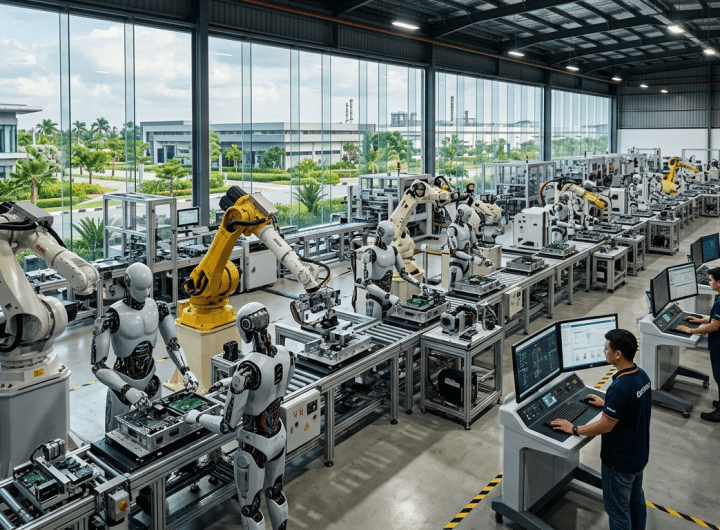 AMC Robotics Vietnam Hub Is Proof the Hardware Race Has Left Silicon Valley
  OpenAI Jalapeno Chip Is Here and NVIDIA Should Be Paying Attention
  SpaceX Space Data Centers: The Wildly Ambitious Plan to Build a Million AI Supercomputers in Orbit