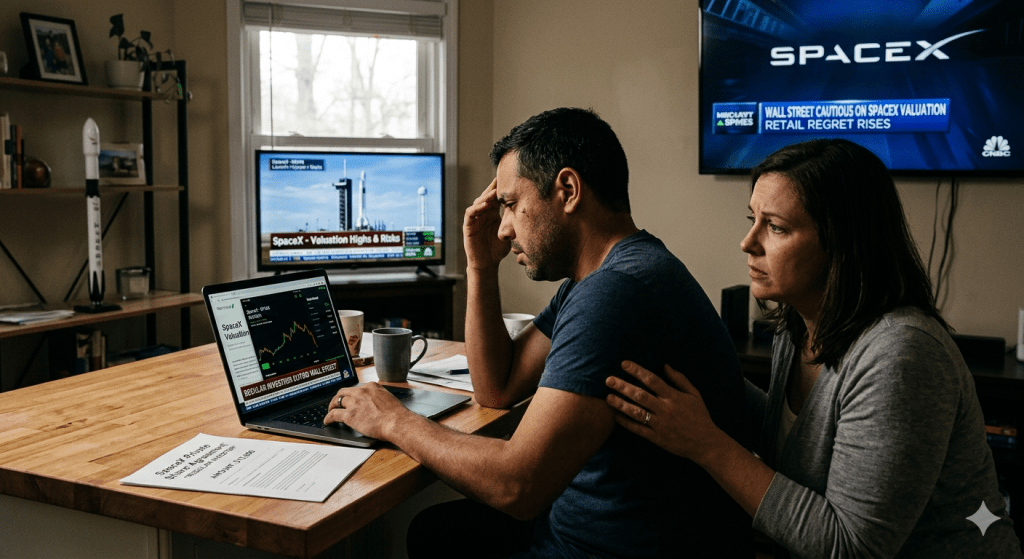
SpaceX retail investors stock 2026 is the story of ordinary people outspending Wall Street’s biggest names on a single stock and some of them walking away within days, already burned.
SpaceX’s Nasdaq debut triggered an unprecedented retail investment frenzy, capturing $369.8 million in net retail inflows during its first three trading days, exceeding the combined purchases of the Magnificent Seven tech giants.
Read that again. Regular people using Robinhood, Schwab, and Fidelity bought more SpaceX stock in three days than institutional grade retail flows bought into Apple, Microsoft, Nvidia, Google, Amazon, Meta, and Tesla combined. Nvidia’s net retail purchases over the same period were just $88.2 million, less than a quarter of SpaceX’s figure, while Tesla and Apple actually experienced net selling an occurrence extremely rare in historical market behavior.
The frenzy is even stranger once you understand how few shares were actually available to chase.
Most IPOs allocate between 5% and 10% of shares to retail investors. SpaceX made as much as 30% of shares available to retail investors through Robinhood, Charles Schwab, and Fidelity.
Even with triple the usual retail allocation, demand crushed supply. Retail investors who clamored for shares received only a fraction of what many had requested. Across online investing forums, users complained of allocations as small as a single share despite requesting far larger amounts.
Marvin Jung, a 51 year old investor who requested 1,000 shares through Robinhood, received just 17. Justin Sacco received 11 shares through Charles Schwab after requesting 75.
A 1.7% fill rate on a $1,000 share request. That is the actual experience most retail buyers had not the triumphant story the headlines suggest.
What Happened to the Money That Did Get In
For people who did get shares, the early returns looked spectacular.
As of one trading session, SpaceX shares were trading at $191.82, up more than 40% from the IPO price of $135. The stock touched an intraday high of $210.45, briefly pushing its market capitalization past Microsoft and Amazon to become the third most valuable public company in the world. For retail investors who bought at the IPO price, paper gains reached around 45%.
That is the part of the story that pulled in even more buyers. Forty five percent gains in days, on a stock everyone was already talking about. But paper gains and locked in gains are very different things, and that difference is exactly what split retail investors into two camps almost immediately.
Why Some Retail Buyers Already Sold
Jung opted to quickly sell his stake after trading began: “I have exited my position of SpaceX stock at $160. It’s struggling too much and can’t find its footing.”
Others took the opposite approach. Sacco did not sell he added to his position after trading started, purchasing four additional shares in the open market and bringing his total holdings to 15 shares.
That split between selling immediately and buying more is the most honest picture of where retail sentiment actually sits. Nobody agrees on what SpaceX is actually worth, including the people who just bought it.
Why Wall Street’s Own Analysts Think the Price Makes No Sense
This is where the retail enthusiasm runs directly into professional skepticism, and the gap is not small.
Morningstar’s discounted cash flow valuation of SpaceX is $780 billion, roughly 48% below its eventual private market valuation of $1.5 trillion. Morningstar said the IPO did not offer the best entry point for retail investors, warning the company “has been significantly overvalued.”
Musk’s roughly $1.75 trillion valuation reflects a price to earnings ratio of almost 100 times. Nvidia, arguably the world’s most valuable company, trades at just over 31 times. Apple trades at about 35 times.
One Seeking Alpha analysis rates SpaceX a Strong Sell due to extreme overvaluation at over 100 times 2025 revenue and ongoing unprofitability, estimating intrinsic value at just $22 per share.
Twenty two dollars a share, against a stock trading near $190. That is not a minor disagreement between bulls and bears. That is two completely different universes of valuation looking at the same company.
Why SpaceX Is Actually Losing Money Right Now
The skepticism is not just abstract financial modeling. The underlying numbers explain exactly where the concern comes from.
SpaceX made $18.7 billion in revenue in 2025, up 33% from the previous year. But losses ballooned from a profit of $791 million in 2024 to a loss of $4.94 billion last year. The company’s new AI division is to blame. Out of nearly $21 billion in capex spending last year, $12.7 billion went to building data centers for xAI more than the company spent building rockets or satellites combined.
SpaceX’s AI segment generated $3.2 billion in 2025 revenue but lost $6.36 billion, consuming most of the company’s capital expenditure and dragging down overall financials.
SpaceX is, at its financial core right now, burning enormous amounts of cash on an AI bet inside a rocket and satellite company. Sixty percent of SpaceX’s revenue comes from Starlink, its satellite internet business, which now has more than 10 million subscribers. (WaveSpeedAI) The rocket company everyone associates with Mars and Starlink is currently being financially defined by an AI division that is losing money faster than it makes it.
Why Musk Gave Retail Investors So Much Access
There is a more cynical read of the unusually large retail allocation, and it deserves to be stated plainly.
Musk isn’t doing this out of the goodness of his heart. He knows that the only way SpaceX gets to this valuation is if it becomes a meme stock. He’s betting that the same retail investors who have stanned Tesla will buy SpaceX shares at any cost.
Tesla’s stock price has long been driven significantly by retail enthusiasm rather than pure institutional valuation models. Giving SpaceX three times the normal retail allocation is, in this reading, a deliberate strategy to recreate that same retail driven momentum for a company whose fundamentals do not yet support its asking price.
BEXORN VERDICT: 4/10 Exciting Story, Risky Trade
The retail enthusiasm around SpaceX is a genuinely remarkable financial story ordinary investors outspending the Magnificent Seven combined on a single new listing has never happened quite like this before. But excitement and value are different things, and right now the gap between what retail buyers are paying and what serious analysts think SpaceX is actually worth is enormous, not small.
At over 100 times annual revenue and current operating losses, the margin of safety for new investors is extremely thin. Unless possessing unique insight into SpaceX’s future profit drivers, investors inspired by euphoria probably risk poor returns despite the company’s extraordinary potential. (Codersera) This is not financial advice talk to an actual advisor before making any trade but the honest read of the public data is that the people who already sold within days may end up looking smarter than the headlines about 45% paper gains currently suggest.
FAQ
How much did retail investors buy in SpaceX after its IPO?
Retail investors poured $369.8 million in net purchases into SpaceX during its first three trading days, exceeding the combined retail purchases of Apple, Microsoft, Nvidia, Google, Amazon, Meta, and Tesla over the same period.
Even with SpaceX allocating up to 30% of shares to retail investors, far above the typical 5 to 10%, demand vastly outpaced supply. Many investors who requested hundreds or thousands of dollars in shares received only a handful.
Is SpaceX overvalued?
Multiple Wall Street analysts believe so. Morningstar values the company nearly 48% below its IPO target, and at least one Seeking Alpha analysis rates it a Strong Sell with an estimated intrinsic value of just $22 per share against a market price near $190.
Why is SpaceX losing money despite strong revenue growth?
SpaceX’s new AI division, tied to xAI, consumed $12.7 billion of capital expenditure in 2025 and lost $6.36 billion, dragging the overall company from a $791 million profit in 2024 to a $4.94 billion loss in 2025.
Should I buy SpaceX stock based on retail enthusiasm?
This is not financial advice. The gap between retail enthusiasm and professional valuation models is unusually wide right now, and anyone considering buying should weigh both perspectives carefully and consult a licensed financial advisor.
Related Reading
• SpaceX Bought The AI Coding Tool You Use For 60 Billion Dollars
• SpaceX SPCX Stock Is Live: 7 Things Every Investor Needs to Know Right Now
• EU AI Act 2026: The Alarming $35 Million Fine Threat That Could Destroy AI Innovation Forever
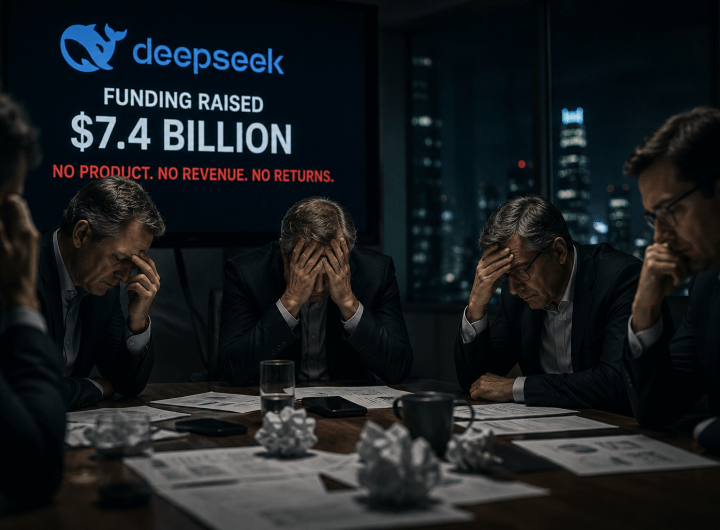 DeepSeek Raised $7.4 Billion and the Investors Got Absolutely Nothing to Show for It
  Google Lost a Nobel Prize Winner to Anthropic and That Is Only Half the Problem
  SoftBank’s Masayoshi Son Says Robots Are the Next Trillion Dollar Bet and He Just Put Real Money Behind It
  SpaceX Bought The AI Coding Tool You Use For 60 Billion Dollars
 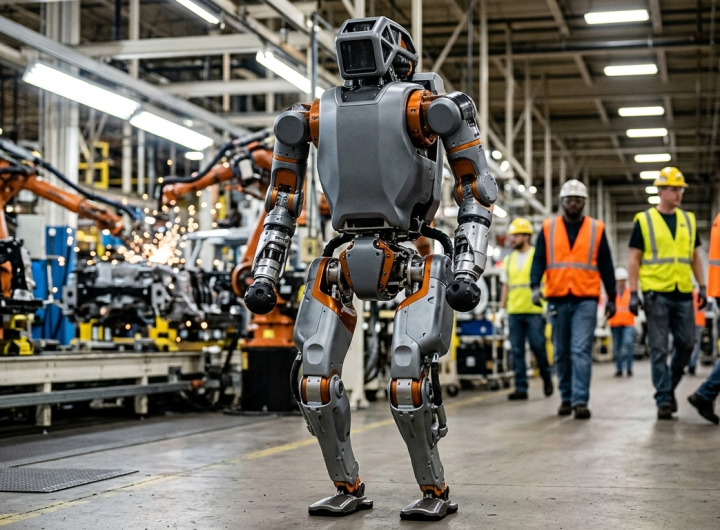 Boston Dynamics Atlas Locked In 30000 Robots A Year And Your Factory Is Next
 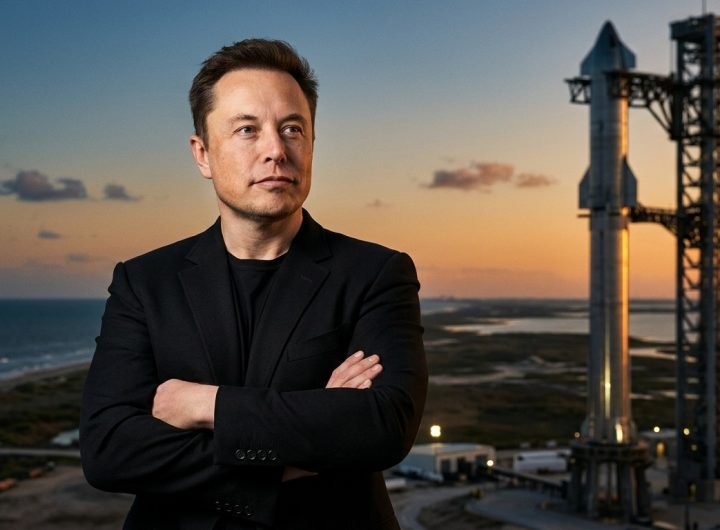 SpaceX goes public: Elon Musk hits trillionaire status after a record-breaking IPO.
  What Is AGI Artificial General Intelligence in 2026 and Are We Already Living With It?
  The Tokenmaxxing Trap: Reasons AI Budget Startups Are Failing in 2026