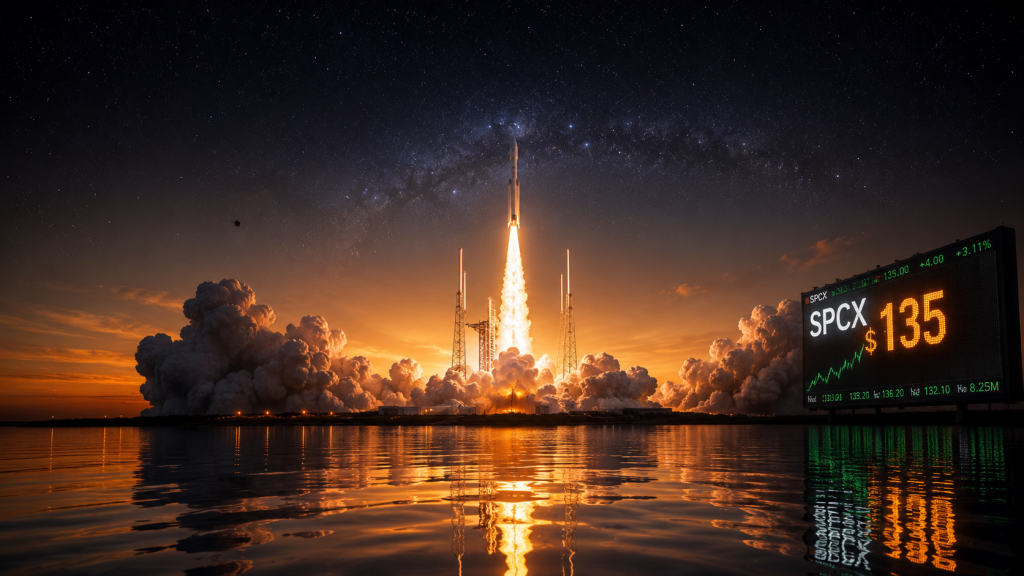
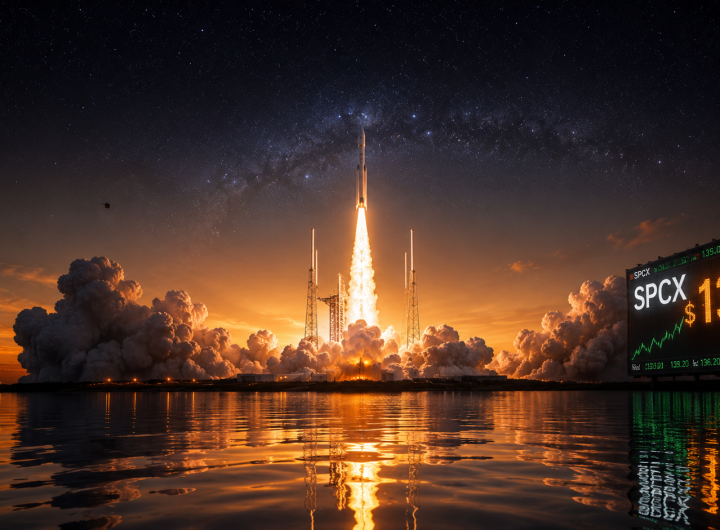
SpaceX SPCX stock began trading on Nasdaq today June 12 2026 and the company that spent 24 years as the most closely watched private business on Earth is now something anyone with a brokerage account can own. The opening price is $135 per share. The valuation is $1.77 trillion. And the story of what happens next is more interesting than most of the coverage this morning is telling you.
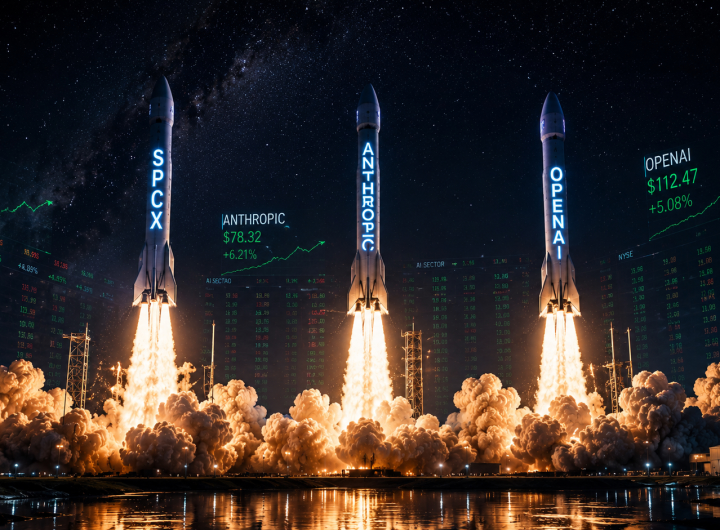
This is not just a milestone for Elon Musk or for SpaceX. It is the opening chapter of the most consequential week in public market history with Anthropic and OpenAI both having filed confidentially behind it, watching every tick of SPCX today to calibrate their own timing. What happens to SpaceX in its first hours of trading will set the tone for the entire AI and space economy IPO wave of 2026.
Here is everything you need to understand about what is happening today and what comes next.
What Just Happened The Numbers Behind SPCX Going Live
The scale of this IPO is genuinely difficult to absorb in one sitting.
SpaceX offered 555,555,555 shares of Class A common stock at $135 per share, raising approximately $75 billion in a single offering more than double the previous record set by Saudi Aramco in 2019 at $35.4 billion. The underwriters have a 30 day option to purchase an additional 83 million shares at the IPO price, which could push the total raise even higher. The offering formally closes on June 15.
The demand that built up before this moment was extraordinary. Total investor demand exceeded $250 billion against the $75 billion on offer, with retail orders alone surpassing $100 billion. The deal was oversubscribed roughly 3.5 to 4 times meaning for every dollar of SpaceX stock available, investors had put in three and a half to four dollars trying to get it.
One detail that got buried in the headline numbers is how SpaceX structured access to this IPO. The company reserved up to 30 percent of shares for retail investors everyday people rather than institutions against the typical 5 to 10 percent in a standard deal. That decision is why Fidelity lowered its minimum account requirement to $2,000 specifically for this offering. SpaceX deliberately chose to let ordinary investors in at the IPO price in a way that almost no company of this size has ever done before.
Why the Opening Price Is Only Half the Story
If you are watching SPCX this morning expecting to see the stock shoot immediately above $135 the moment trading opens, the reality of how large IPOs actually work is worth understanding.
Due to the scale of the price discovery process involved, indicative quotes begin around 10:15am ET with the actual opening cross the first real trade expected late morning rather than at the standard 9:30am bell. The opening cross is the moment Nasdaq matches all the buy and sell orders that have accumulated and sets the first public price. For an offering this size, that process takes time.
The more important number to watch is not the opening price but where SPCX trades by end of day and end of week. Early IPO trading is notoriously volatile as institutional investors who did not get their full allocation buy in the open market, and early holders who did get allocation decide whether to hold or flip.
SpaceX IPO 2026: The Risky $1.77 Trillion Gamble That Could Make Musk the First Trillionaire
Analyst price targets already published range from $140 to $175 in week one, $130 to $165 in month one, and $120 to $200 over the first three months a range wide enough to tell you that nobody actually knows where this settles, and that the variance depends heavily on Starlink subscriber growth numbers and how the market processes the xAI division’s losses.
The Thing Nobody Is Talking About MSCI Inclusion Tomorrow
The single most important post-IPO catalyst is not getting enough coverage this morning and BEXORN readers should understand it clearly.
MSCI announced on June 9 that SPCX qualifies for early inclusion in its Global Standard Indexes starting June 13 one trading day after today’s debut. With only a 4 percent float available on the public market, every passive fund in the world that tracks MSCI World and MSCI ACWI is now required to buy SPCX to maintain their index weights. That buying is mechanical and price insensitive it happens regardless of what any fund manager thinks about SpaceX’s valuation.
At an estimated $1.75 trillion valuation, SPCX would immediately rank among the ten largest constituent securities in both the MSCI World and MSCI ACWI indices. The forced buying that triggers tomorrow is not speculative demand. It is structural. The funds do not have a choice.
This is the hidden story inside the IPO that most mainstream coverage has walked straight past.
What SpaceX Actually Is Three Companies in One Valuation
The S-1 that SpaceX filed with the SEC reveals something important that the headline valuation obscures. You are not buying one company when you buy SPCX. You are buying three businesses with completely different financial profiles bundled inside a single share price.
Starlink the satellite internet division is the star. It generated $11.4 billion in revenue in 2025 with a 63 percent EBITDA margin and subscriber growth from 4.5 million at the start of 2025 to over 10.3 million by early 2026. It is the only part of the business currently making a profit and it is the primary reason the valuation is where it is.
The launch business Falcon 9, Falcon Heavy, Starship is capital intensive and not yet profitable on a standalone basis, but it is strategically irreplaceable. SpaceX sends more mass to orbit than the rest of the world combined. That dominance creates a moat that no competitor has come close to breaching.
The xAI division is the complicated one. It generated $3.2 billion in revenue in 2025 primarily from Grok enterprise subscriptions but ran a $6.36 billion operating loss in the same period. Investors buying SPCX today are buying into an AI division that is burning cash at a rate that would concern most analysts if it were a standalone company. The bet is that the Colossus GPU infrastructure and Grok’s trajectory justify that burn. Whether that bet pays off will only become clear when SpaceX reports its first public earnings in November 2026.
Anthropic IPO 2026: The Shocking Truth Behind Claude AI’s Nearly $1 Trillion Valuation
What This Means for the Broader AI IPO Race
SpaceX trading today is not an isolated event. It is the first domino in a sequence that will define the public markets for the rest of 2026.
Anthropic confidentially filed its S-1 on June 1 at a $965 billion valuation. OpenAI confidentially filed its S-1 on June 8 at an $852 billion valuation. Investment bankers have advised both companies that there is a meaningful first-mover advantage to being the first pure AI model company to list and both are watching SPCX’s first day performance to calibrate their own timing.
If SPCX opens strong and holds, the institutional appetite signal it sends to Anthropic and OpenAI is green. If it disappoints on day one, both companies face a more cautious institutional market when their own roadshows begin. Goldman Sachs has projected that 2026 IPO proceeds could reach $160 billion driven almost entirely by these three listings. The order of events matters enormously.
Today is day one of that sequence. SpaceX goes first and everything that follows is shaped by what happens to SPCX this morning.
Senator Warren and the Political Dimension
Not everyone is celebrating this morning. Senator Elizabeth Warren formally asked the SEC to delay the offering in the final hours before trading, citing concerns around investor protection, market integrity, and governance specifically the dual class share structure that gives Elon Musk voting control regardless of how many shares the public owns.
A letter from a senator does not stop an IPO. Trading is proceeding on schedule. But Warren’s intervention signals that SpaceX’s debut will not be without political friction, and that the governance questions she raised will follow SPCX into its first earnings cycle and beyond. For ordinary investors who are buying in today, understanding that you are buying Class A shares with limited voting rights while Musk retains effective control is not a reason to avoid the stock but it is a fact worth knowing before you press buy.
What Happens Next
The offering closes formally on June 15. MSCI forced buying begins June 13. First public earnings arrive in November 2026 and will be the first real test of whether the xAI burn rate is trending toward sustainability or widening.
The longer term question for SPCX is whether Starlink’s subscriber growth continues at the pace that justifies the valuation multiple, and whether Starship achieves the full operational reusability that unlocks the next generation of launch economics. Both of those answers are years away.
For today, the question is simpler. The largest IPO in history is live. The company that built reusable rockets, connected the unconnected world through satellite internet, and absorbed an AI company worth over a trillion dollars is now something you can own for $135 a share. Whether that price looks cheap or expensive in five years depends on whether you believe Elon Musk’s version of what the next decade looks like.
That has always been the SpaceX bet. Today it just became a public one.
Frequently Asked Questions
What price is SpaceX SPCX trading at today?
SPCX opened at the IPO price of $135 per share on June 12 2026. Due to the price discovery process for an offering this size, the actual opening cross is expected late morning rather than at the 9:30am bell. Check your brokerage for live pricing.
Can I still buy SpaceX stock today?
Yes. SPCX is now trading on Nasdaq and can be purchased through any standard brokerage account Robinhood, Fidelity, Charles Schwab, E TRADE, and others. The IPO allocation window has closed but you can buy in the open market at whatever the current trading price is.
Will SpaceX stock go up on the first day?
Analyst week-one price targets range from $140 to $175 but first-day IPO trading is notoriously volatile. Nobody can predict this reliably. The more important signal will be where SPCX settles after the initial volatility passes.
What is the MSCI inclusion and why does it matter?
MSCI announced SPCX qualifies for early inclusion in its Global Standard Indexes starting June 13 one day after today’s debut. Every passive fund tracking MSCI World and MSCI ACWI is required to buy SPCX mechanically starting tomorrow. That is structural buying that happens regardless of market sentiment.
Retail investors buying SPCX today receive Class A shares with limited voting rights. Elon Musk holds Class B shares which carry significantly higher voting weight, meaning he retains effective control of the company regardless of public ownership levels.
When does SpaceX report its first earnings as a public company?
First public earnings are expected in November 2026 and will be the first real test of whether the xAI division’s losses are narrowing and whether Starlink subscriber growth is sustaining the valuation.
SpaceX SPCX going live today is one of those moments that feels genuinely historic while it is happening. A company that nearly went bankrupt three times in its first decade, that was dismissed by aerospace experts, laughed at by competitors, and held together by one person’s refusal to accept that it could not be done is now a publicly traded company valued at $1.77 trillion.
The financial story is complicated. Three businesses, one profitable, one strategically dominant but capital intensive, one burning billions in AI infrastructure. The structural story is fascinating MSCI forced buying tomorrow, a three way AI IPO race with Anthropic and OpenAI watching every tick, and a retail allocation three times the industry standard that let ordinary people in at the ground floor.
Whether $135 turns out to be the deal of the decade or the peak of a wave depends on questions that will not be answered today. But the bet that SpaceX represents that space infrastructure, satellite internet, and AI compute are the defining industries of the next thirty years is the same bet it has always been. It just moved from private to public this morning.
The rocket has launched. Now we watch where it lands.
 Microsoft AI Coding Tools 2026: The Uncomfortable Truth Developers Are Just Finding Out
  SpaceX IPO 2026: The Risky $1.77 Trillion Gamble That Could Make Musk the First Trillionaire Or Trigger the Biggest Crash in Tech History
  Apple WWDC 2026: Siri Gets AI Superpowers and Claude Is Now on iPhone
  Perplexity AI Comet Browser 2026: The Shocking Threat to Google Search Nobody Saw Coming
  Xiaomi 18 Pro 2026: 7 Powerful Features That Could Make It Android’s Biggest Flagship
  App Store Ecosystem Reaches Record $1.4 Trillion as AI Apps Accelerate Growth
  The AI IPO Race 2026: SpaceX, Anthropic and OpenAI Are All Going Public at the Same Time
  SpaceX SPCX Stock Is Live: 7 Things Every Investor Needs to Know Right Now
  AI Jobs at Risk by 2030: The Honest Truth Nobody Is Telling You