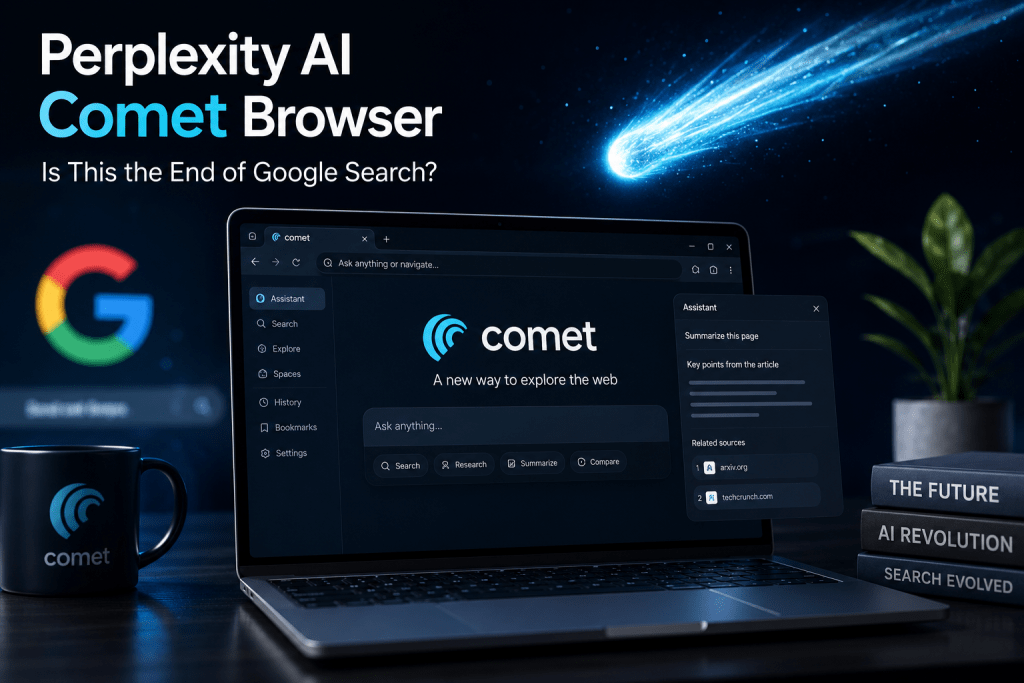
Perplexity AI Comet browser is one of the most ambitious products to come out of the artificial intelligence space this year, and if you have not heard about it yet, you are about to understand why the entire tech industry is paying very close attention to what this relatively young company is doing.
Perplexity started as an AI search engine. A tool that answered questions with cited sources instead of a list of links. That was already a meaningful challenge to the way Google had trained two decades of internet users to find information. But launching a full browser is something else entirely. It is not a feature update or a product improvement. It is a direct declaration that Perplexity intends to own the entire experience of how people navigate the internet not just how they search it.
Whether that ambition succeeds or not, the Comet browser is one of the most interesting technology stories of 2026 and one that every person who uses the internet should understand.
What Is the Perplexity AI Comet Browser
Comet is a web browser built by Perplexity AI with artificial intelligence woven into its core rather than bolted on as an afterthought. Where other browsers have added AI features as extensions or sidebar assistants, Comet is built from the ground up around the idea that AI should be the primary way you interact with the web rather than a supplementary tool you occasionally reach for.
The most immediate difference from a conventional browser is how it handles information. When you use Chrome or Safari, you search, get a list of links, click through to websites, read what you find, and piece together your own answer from multiple sources. Comet collapses that process. You ask a question or describe what you need, and the browser’s AI layer finds the information, synthesises it from multiple sources, and presents you with a coherent answer with the sources cited so you can verify and explore further if you want to.
Think of it as the difference between being handed a library card and a list of relevant shelves versus being handed a knowledgeable research assistant who goes to the shelves, reads the relevant sections, and comes back to explain what they found. The information is the same. The experience of accessing it is completely different.
What Makes Comet Different From a Regular Browser
The hybrid local and cloud approach is one of the most technically interesting things about Comet and one that has practical implications for users beyond the AI features themselves.
Most AI-powered tools process everything in the cloud, which means your queries and the data associated with them travel to remote servers to be processed before the results come back to you. Comet splits this workload between your device and the cloud depending on the nature of the task. Processing that can happen locally does happen locally, which has benefits for both speed and privacy. Sensitive information does not necessarily have to leave your device to be processed, which addresses one of the most common concerns people have about integrating AI deeply into their daily computing.
The browser also integrates with the broader Perplexity ecosystem including its computer capabilities, which means it can do more than retrieve information. It can take actions, interact with interfaces, and handle tasks that go beyond what a conventional browser with a search bar was ever designed to do.
Why Perplexity Is Going After Google Search
To understand why Perplexity is building a browser rather than simply continuing to improve its search product, you need to understand what the company is actually trying to become.
Google Search’s dominance has been built on one fundamental thing: it is where people go when they want to find something on the internet. Everything else Google has built the advertising business, the broader product ecosystem, the data operation flows from that single behaviour. People have a question, they open a browser, they type it into Google.
Perplexity is trying to interrupt that behaviour at the earliest possible point. If the browser itself is the AI assistant, then there is no moment where a user chooses between asking Google and asking Perplexity. The browser is already Perplexity. The question goes directly to the AI layer before a conventional search engine ever enters the picture.
That is a fundamental strategic move, and it explains why the company has also reportedly made a bid to acquire Google Chrome the browser that controls the gateway for a significant proportion of the world’s internet usage. Whether that acquisition happens or not, the intent is clear. Perplexity wants to own the front door of the internet, not just operate a product people occasionally visit.
What This Means for Google
Google is not going to collapse because Perplexity launched a browser. That much is worth saying clearly. The scale difference between the two companies is still enormous and Google has been developing its own AI search capabilities aggressively through products like AI Overviews and Gemini integration into Search.
But the competitive pressure Perplexity represents is genuine and it is landing at a moment when Google’s search business is more vulnerable than it has been at any point in the past decade. AI-generated answers are changing user behaviour in ways that reduce the number of clicks that reach websites, which creates tension with publishers and advertisers who depend on that traffic. Google is trying to evolve its search product while simultaneously protecting the advertising model that depends on the current version of it. That is a difficult balance.
Perplexity does not have that constraint. It is building for the AI-native search experience from scratch without having to protect a legacy business model in the process. That freedom is a genuine competitive advantage even against a company with vastly more resources.
The Legal Challenges Perplexity Is Facing
The Comet browser launch is happening against a complicated legal backdrop that is worth understanding because it shapes how the product can operate and what its long-term trajectory might look like.
Nine organisations have filed active lawsuits against Perplexity for alleged copyright and trademark infringement. The list includes major media organisations and publishers who argue that Perplexity’s AI is using their content to generate answers without appropriate compensation or attribution effectively extracting the value from journalism and publishing without paying for it.
This is not a peripheral concern. It is a fundamental question about how AI search products can legally operate at scale, and the outcome of these cases will have implications not just for Perplexity but for the entire category of AI-powered information retrieval.
Perplexity has taken some steps to address publisher concerns, including launching a subscription model that shares revenue with publishers whose content is used. But the legal challenges are ongoing and represent a meaningful uncertainty for the company’s future.
What Perplexity’s Growth Actually Looks Like
The speed at which Perplexity has grown deserves context because it explains why the tech industry is taking the Comet browser seriously rather than dismissing it as an ambitious product from a small startup.
The company secured $200 million in new funding at a $20 billion valuation shortly after raising $100 million at an $18 billion valuation just two months earlier. Since its founding three years ago, Perplexity has raised $1.5 billion in total. Those numbers reflect genuine investor conviction that the company is building something that has a real chance of reshaping how people find information online.
The product has also expanded significantly. Snapchat has integrated Perplexity AI for conversational search. A partnership with PayPal has brought AI-powered in-chat shopping to users. The Comet browser is now available for free worldwide desktop download. These are not the moves of a company that is struggling to find product-market fit they are the moves of a company that has found it and is now executing an aggressive expansion strategy.
Who Should Pay Attention to Comet
If you are someone who uses the internet primarily to find information and that description covers almost everyone the Comet browser is worth trying when it is available in your region. The experience of AI-assisted browsing is genuinely different from conventional search in ways that are immediately noticeable rather than subtle.
For students and researchers, the ability to ask detailed questions and get synthesised answers with cited sources could meaningfully change how information gathering works for academic and professional purposes.
For content creators and writers who spend significant time researching topics online, a browser that can pull together information from multiple sources and present it coherently rather than requiring manual navigation across dozens of tabs represents a real workflow improvement.
For everyday users who are curious about what AI-native computing actually feels like in practice, Comet is one of the most accessible demonstrations currently available.
What Happens Next
Perplexity is moving fast and the product roadmap suggests the company intends to keep moving fast. The hybrid local-cloud inference system announced at Computex 2026 points toward a future where AI processing becomes increasingly personalised and privacy-preserving, which addresses one of the main objections people have about deeply integrated AI tools.
The legal situation with publishers will play out over the next year or two and the outcome will shape what Perplexity can and cannot do with the content that powers its AI answers. How the company navigates that challenge will tell you a lot about whether its model is sustainable at scale.
The Google acquisition bid, whether serious or strategic positioning, signals that Perplexity understands the distribution problem it faces. Having a better product than Google is not sufficient on its own when Google’s browser handles the majority of the world’s web traffic. Solving the distribution problem is as important as solving the product problem, and Comet is the company’s primary answer to that challenge.
The browser wars have started again. This time artificial intelligence is the battlefield.
Frequently Asked Questions
What is the Perplexity AI Comet browser?
Comet is a web browser built by Perplexity AI with artificial intelligence at its core. Rather than returning a list of links when you search, it synthesises information from multiple sources and presents you with a direct answer with citations built into the browsing experience itself.
Is the Comet browser free?
Yes, Perplexity has made Comet available for free worldwide desktop download. A Comet Plus subscription is also available for users who want premium features including revenue sharing with publishers.
Does Comet replace Google Search?
Not yet for most users, but that is clearly what Perplexity is building toward. The experience is meaningfully different from conventional search and for certain types of information tasks it is already more efficient.
Is Perplexity AI a threat to Google?
It represents genuine competitive pressure, particularly at a moment when Google is navigating the transition to AI-integrated search while protecting its advertising business. Whether it becomes an existential threat depends on user adoption, legal outcomes, and how quickly Google can evolve its own products.
What makes Comet different from Chrome or Safari?
The core difference is that Comet uses AI as the primary interface for finding and interacting with information online rather than returning links and leaving users to navigate websites manually. It also uses a hybrid local and cloud processing approach that has privacy implications for how user data is handled.
Is Perplexity AI safe to use?
Perplexity is a legitimate, well-funded company used by millions of people. The main concerns around it relate to the ongoing legal challenges about how it uses publisher content to generate answers, which is a legitimate debate about AI and copyright rather than a safety concern for individual users.
Final Thoughts
The Perplexity AI Comet browser is not just another product launch in a crowded market. It is a statement about what the company believes the future of the internet looks like one where artificial intelligence mediates the relationship between people and information rather than simply helping them navigate a web of links.
Whether Comet succeeds in challenging Google’s position or becomes a well-regarded alternative used by a smaller audience of AI-forward users, it represents something important. The way we find information online has not fundamentally changed in twenty years. Perplexity is making a serious, well-resourced attempt to change it.
That is worth paying attention to regardless of which browser you end up using.
 Microsoft AI Coding Tools 2026: The Uncomfortable Truth Developers Are Just Finding Out
  Apple WWDC 2026: Siri Gets AI Superpowers and Claude Is Now on iPhone
  Xiaomi 18 Pro 2026: 7 Powerful Features That Could Make It Android’s Biggest Flagship
  App Store Ecosystem Reaches Record $1.4 Trillion as AI Apps Accelerate Growth
  AI Jobs at Risk by 2030: The Honest Truth Nobody Is Telling You
  Grok AI Review 2026: Is Grok The Most Underrated AI Assistant Right Now?
  Claude Fable 5 vs ChatGPT 2026: The Battle Forcing Millions to Finally Ditch One AI for the Other