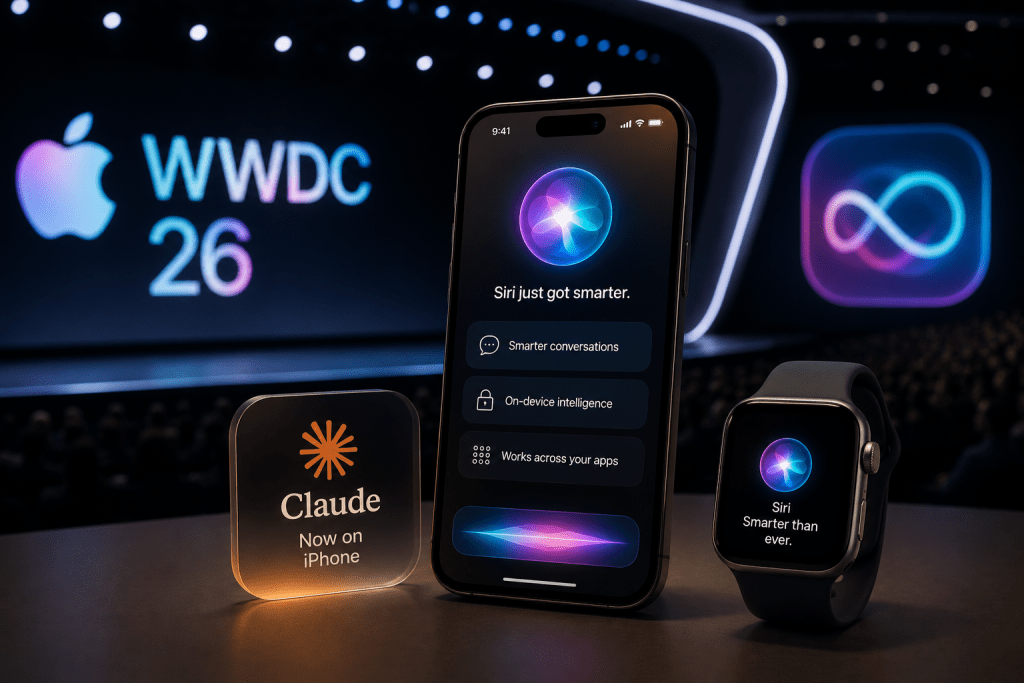
Apple WWDC 2026 was not a normal developer conference. It was a statement. After years of watching OpenAI, Google, and Anthropic define what artificial intelligence looks like in people’s daily lives, Apple used its biggest annual event to announce that it is done playing catch up and the changes coming to iPhone, iPad, and Mac are more significant than anything Apple has shown at a WWDC in at least a decade.
There is also a personal dimension to this particular event that made it unlike any before it. Tim Cook delivered his final WWDC keynote as Apple’s CEO, knowing that in September he will hand over leadership to John Ternus. The man who guided Apple from the post Jobs era to becoming the world’s most valuable company said goodbye to developers in the room where so many of Apple’s biggest announcements have been made. That context made everything on stage carry a weight that the technical announcements alone would not have produced.
This article is going to explain everything that was announced, why it matters for the people who use Apple devices every day, and what the WWDC 2026 announcements reveal about where Apple and artificial intelligence is heading.
What Is WWDC and Why Does It Matter
WWDC stands for Worldwide Developers Conference and it is Apple’s annual event where the company unveils the next versions of its operating systems iOS, macOS, watchOS, and others along with the tools and frameworks developers use to build apps for Apple’s platforms.
For most people who are not developers, WWDC matters because it is where you find out what your iPhone, iPad, and Mac are going to do differently in the next major software update. The features announced at WWDC typically arrive on devices in September alongside new iPhone hardware. What Apple showed at WWDC 2026 will be on hundreds of millions of devices before the end of the year.
This year the conference carried extra significance because the announcements addressed the biggest criticism Apple has faced in the AI era that Siri, the voice assistant that has been on iPhone since 2011, has fallen dramatically behind the intelligence and capability of newer AI tools. Every person who has asked Siri something and then watched it fail while knowing that Claude or ChatGPT would have handled it easily has felt that gap. WWDC 2026 was Apple’s answer to that criticism, and the answer was more comprehensive than most analysts expected.
The Siri Overhaul — What Actually Changed
The Siri announced at WWDC 2026 is not an incremental improvement to the assistant that has been frustrating iPhone users for years. It is a fundamental rebuild and the difference between the old Siri and the new one is significant enough that calling them by the same name almost understates how much has changed.
The new Siri is built on a much more capable underlying model that allows it to understand context across a conversation rather than treating every question as an isolated request. Old Siri forgot what you said two sentences ago. New Siri maintains the thread of a conversation, understands what you are referring to when you say “that” or “it,” and builds on previous exchanges the way a genuinely intelligent assistant would.
The on-screen awareness capability is one of the most practically useful changes. New Siri can see what is on your screen a webpage, a document, a photo, a message and act on it intelligently without you having to explain what you are looking at. You can be reading an article and ask Siri to summarise it. You can be looking at a photo and ask Siri to identify something in it. You can be reading an email and ask Siri to draft a reply based on the context it can see directly. These are things that required switching to a separate AI tool before WWDC 2026. They now happen inside the operating system itself.
The integration with personal context is equally significant. With appropriate permissions, Siri can now access your calendar, your messages, your emails, and your notes to give you answers that are relevant to your actual life rather than generic responses. Ask the new Siri when you are free next week and it checks your calendar. Ask it what someone said about a meeting and it searches your messages. Ask it to remind you about something from a document you were reading and it connects those things rather than treating them as separate requests.
Claude AI Coming to iPhone — What This Means for You
This is the announcement that is most directly relevant to BEXORN readers and it deserves particular attention.
Apple announced at WWDC 2026 that Claude AI the artificial intelligence assistant built by Anthropic that we have covered extensively here on BEXORN is coming to iPhone as one of the AI extension options within the new Apple Intelligence framework. This makes Claude available directly within iOS 27 for the first time, meaning iPhone users will be able to access Claude’s capabilities without leaving their device’s native environment.
To understand why this matters you need to understand what Apple Intelligence actually is. Apple Intelligence is Apple’s framework for bringing AI capabilities to its devices some processed on device for privacy, some processed in the cloud through what Apple calls Private Cloud Compute. Rather than building every AI capability itself, Apple has opened Apple Intelligence to external AI providers through an extensions framework. OpenAI’s ChatGPT was the first external AI integrated this way. Google Gemini was added as part of the WWDC 2026 announcements. And now Claude is joining as a third option.
What this means practically is that iPhone users running iOS 27 will be able to choose Claude as their preferred AI assistant for certain types of requests particularly writing, research, and complex explanations where Claude’s strengths are most pronounced. When Siri encounters a request that would benefit from Claude’s capabilities, it can hand off to Claude seamlessly rather than trying to handle everything itself.
For the millions of people who already use Claude for writing and research, this integration removes friction. Instead of switching between apps, you can access Claude’s quality within the environment where you are already working. For people who have not used Claude before, the iPhone integration introduces them to it in a context where they are already comfortable their own phone, with the familiar interface of iOS.
For Anthropic, having Claude available as a native option on hundreds of millions of iPhones is one of the most significant distribution events in the company’s history. It arrives as Anthropic is preparing for its own IPO and building toward what it hopes will be a trillion dollar public market debut.
Apple Intelligence and the Multi-AI Strategy
The decision to integrate Claude, Gemini, and ChatGPT alongside its own on-device models reflects a strategic choice Apple has made about how to compete in the AI era and it is a smarter choice than it might initially appear.
Rather than trying to build a single AI system that matches the best of what OpenAI, Google, and Anthropic have each spent billions developing, Apple is positioning itself as the platform that gives users access to the best AI from multiple sources, unified within a consistent and privacy-respecting interface. Apple provides the operating system, the privacy architecture, the hardware optimisation, and the user interface. The AI models come from whoever is best at providing them.
This strategy plays to Apple’s genuine strengths hardware integration, privacy, user experience, and the trust that comes from being the device people carry everywhere without requiring Apple to win a model capability race against companies that have been doing AI research longer and have invested more in it.
The privacy architecture is worth highlighting. Apple’s Private Cloud Compute system processes requests in the cloud without storing your data or making it accessible to Apple or its AI partners. For users who have been hesitant about AI tools because of privacy concerns, Apple’s approach offers a middle ground access to capable AI with stronger privacy guarantees than most AI tool providers offer independently.
iOS 27 — Key Features for Everyday Users
Beyond the AI announcements, iOS 27 brings a set of improvements that will affect how everyday iPhone users experience their devices regardless of how much they engage with the AI features.
App launch speed has been improved significantly through optimisations at the operating system level. The difference is noticeable in daily use apps that felt slightly sluggish on older hardware run more smoothly under iOS 27 even without new hardware.
The Photos app has been substantially redesigned with AI-powered organisation that automatically groups images by people, places, events, and themes in ways that actually reflect how you took the photos rather than just by date. Finding a specific photo from a holiday or an event becomes a natural language search rather than a scroll through months of images.
AirDrop has been improved with faster transfer speeds and more reliable connections, particularly for large files. For anyone who regularly transfers files between Apple devices this is a welcome practical improvement.
Parental controls have been significantly expanded with more granular controls over app usage, screen time, and content access. Parents who have found the existing screen time tools limited will find the iOS 27 version considerably more flexible and harder for children to circumvent.
Dictation the ability to speak to your phone and have it type what you say has been improved with AI-powered correction that understands context rather than just phonetics. The result is more accurate transcription in more situations, which makes dictation genuinely practical for longer pieces of writing rather than just short messages.
Tim Cook’s Last Keynote — End of an Era
Tim Cook has led Apple since 2011 when he took over from Steve Jobs. Under his leadership Apple became the first company to reach a one trillion dollar market capitalisation, then two trillion, then three. The iPhone became the most profitable consumer product in history. AirPods created a new product category. Apple Silicon transformed Mac performance. Services became a fifty billion dollar annual business.
The WWDC 2026 keynote was the last time Cook delivered a developer keynote as CEO. John Ternus currently Apple’s head of hardware engineering and the person most responsible for Apple Silicon will take over as CEO in September, with Cook moving to an executive chairman role.
The transition matters for understanding where Apple is heading. Ternus is a hardware engineer by background and by instinct. His tenure as CEO is likely to emphasise the integration between Apple’s hardware capabilities and its software ambitions which is precisely the direction the AI announcements at WWDC 2026 are pointing. The Apple Intelligence framework, the on-device processing, the Private Cloud Compute architecture all of these require the kind of deep hardware-software integration that Ternus has spent his career building.
Cook’s legacy at Apple is as a builder of systems supply chains, retail networks, services businesses, partnerships. Ternus inherits those systems and the question for his tenure is whether he can use them to make Apple a genuine leader in the AI era rather than a fast follower to OpenAI, Google, and Anthropic.
What Happens Next
The features announced at WWDC 2026 will arrive in public beta form over the summer and in final release form in September alongside the iPhone 18 Pro launch. Not all features will be available in all regions simultaneously Apple typically rolls out AI features in English-speaking markets first with other languages and regions following over subsequent months.
The developer community will spend the summer building apps that take advantage of the new Apple Intelligence capabilities and the Claude, Gemini, and ChatGPT integrations. By the time iOS 27 reaches the public in September, a new generation of apps built around these AI capabilities will be ready alongside it.
The competitive response from Google and Samsung will be worth watching. Both companies have their own AI integration stories for their mobile platforms and both will be looking at Apple’s WWDC announcements to understand where the gaps in their own offerings are. The mobile AI feature race that WWDC 2026 has accelerated is going to move fast throughout the rest of 2026.
Frequently Asked Questions
What was announced at Apple WWDC 2026?
The major announcements included a comprehensive Siri overhaul with genuine conversational AI, Claude AI and Google Gemini coming to iPhone through Apple Intelligence extensions, iOS 27 with new features across photos, dictation, parental controls, and app performance, and Tim Cook’s final developer keynote before handing over to John Ternus in September.
What is Apple Intelligence?
Apple Intelligence is Apple’s framework for bringing AI capabilities to iPhone, iPad, and Mac. It combines on-device processing for privacy-sensitive tasks with cloud processing through Apple’s Private Cloud Compute system, and now integrates external AI providers including Claude, Gemini, and ChatGPT.
Is Claude AI now on iPhone?
Yes. Claude AI was announced as one of the AI extension options within Apple Intelligence at WWDC 2026, meaning iPhone users running iOS 27 will be able to use Claude’s capabilities within the native iOS environment for the first time.
When does iOS 27 come out?
iOS 27 will be available in public beta over the summer of 2026 and in final release in September 2026, typically alongside the new iPhone hardware announcement.
Who is replacing Tim Cook at Apple?
John Ternus, currently Apple’s head of hardware engineering and the executive most responsible for Apple Silicon, will become Apple’s CEO in September 2026. Tim Cook will move to an executive chairman role.
Will iOS 27 work on older iPhones?
Apple typically supports iPhones going back several years with major iOS updates, though some AI features may be limited to newer hardware. The full list of supported devices will be confirmed when iOS 27 enters public beta.
Is the new Siri actually better?
Based on the WWDC demonstrations, the new Siri represents a fundamental rebuild rather than an incremental improvement. The on-screen awareness, conversational context, and personal context integration are all genuinely new capabilities. As with all software demonstrations, the real test will come when millions of people use it daily after September.
Apple WWDC 2026 answered the question that has been hanging over the company for the past two years what is Apple actually going to do about artificial intelligence?
The answer is more comprehensive than most people expected. A rebuilt Siri with genuine conversational intelligence. Claude, Gemini, and ChatGPT integrated directly into iPhone. An AI framework that plays to Apple’s genuine strengths in privacy and hardware integration. And a transition to new leadership that signals Apple is taking the AI era seriously at the highest level of the company.
Whether the new Siri delivers on its demonstrations, whether the Claude integration changes how people work on their iPhones, and whether iOS 27 makes Apple genuinely competitive in the AI assistant space those questions will be answered when hundreds of millions of people start using these features in September.
What is clear from WWDC 2026 is that Apple is no longer watching from the sidelines. The company that invented the modern smartphone has decided that artificial intelligence is the next defining shift in personal computing and has committed to leading it rather than following it.
Tim Cook ended his last keynote the same way he has ended every keynote by thanking the developers in the room and the people watching around the world. This time the thanks carried a different weight. Fifteen years of building one of the most remarkable companies in history, and the next chapter is just beginning.
 Microsoft AI Coding Tools 2026: The Uncomfortable Truth Developers Are Just Finding Out
  Perplexity AI Comet Browser 2026: The Shocking Threat to Google Search Nobody Saw Coming
  Xiaomi 18 Pro 2026: 7 Powerful Features That Could Make It Android’s Biggest Flagship
  App Store Ecosystem Reaches Record $1.4 Trillion as AI Apps Accelerate Growth
  AI Jobs at Risk by 2030: The Honest Truth Nobody Is Telling You
  Grok AI Review 2026: Is Grok The Most Underrated AI Assistant Right Now?
  Claude Fable 5 vs ChatGPT 2026: The Battle Forcing Millions to Finally Ditch One AI for the Other