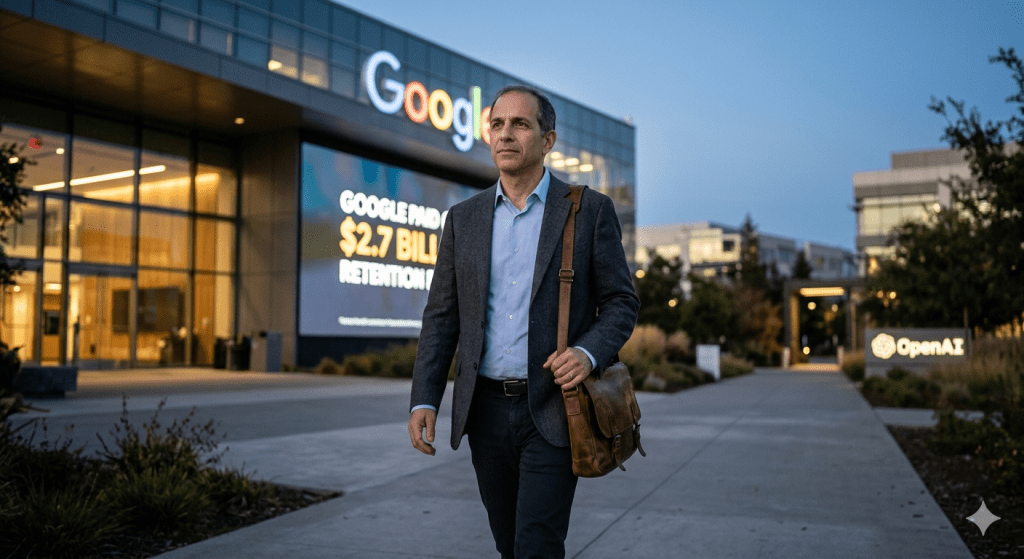
Noam Shazeer leaves Google for OpenAI is the kind of headline that sounds like routine corporate news until you understand exactly who is walking out the door.
Google’s vice president of engineering and a co lead of its Gemini AI models announced Wednesday he is leaving the company to join OpenAI. Shazeer posted on X: “I’m excited to share that I’ll be joining OpenAI and look forward to working with the exceptional team there. It was a difficult decision to move on. I’m incredibly proud of the amazing team at Google and everything we’ve built together.”
A polite exit message. A standard corporate goodbye. None of that prepares you for who Noam Shazeer actually is, or why Google reportedly paid almost three billion dollars two years ago specifically to stop this exact thing from happening.
Why This Is Not a Normal Executive Departure
Executives leave tech companies constantly. Most of those exits barely register outside their own industry. This one is different because of one document Shazeer co-wrote nine years ago.
Shazeer is a co-author of the 2017 paper “Attention Is All You Need,” which introduced the Transformer architecture that underpins virtually every major large language model today including GPT, Gemini, and Claude. (Brytesoft) As one of the authors of that paper, he is among a small group of researchers whose work sits underneath ChatGPT, Claude, Gemini, and most of what the industry now calls AI.
Every conversation you have ever had with Claude, every essay ChatGPT has written for someone, every answer Gemini has given all of it runs on an architecture Shazeer helped invent. He is not a manager who oversees AI products. He is one of the small number of people who built the mathematical foundation the entire industry stands on.
The 2.7 Billion Dollar Bet That Did Not Pay Off
This is where the story gets genuinely uncomfortable for Google, and why it matters beyond one person’s career choice.
Shazeer co-founded and served as CEO of Character.AI before returning to Google’s AI initiative in 2024, following a $2.7 billion licensing acquisition of his startup. (Fello AI) Noam Shazeer is leaving Google for OpenAI just two years after Google paid $2.7 billion to poach Shazeer and part of his team at Character.AI.
Read that timeline slowly. Google spent $2.7 billion specifically to bring this man and his team back. Not to acquire a product. Not to buy market share. To get the person back. Why it matters: this shows the limits of acqui-hires, in which the most valuable assets can walk out the door anyway.
That is the uncomfortable lesson sitting underneath this story. You can pay almost three billion dollars for a researcher’s loyalty, and two years later he can still post a goodbye message on X and walk to your biggest competitor. Money bought his return. It did not buy his commitment.
What Sam Altman Said, and Why It Stings More Than the Resignation Itself
OpenAI chief executive Sam Altman welcomed Shazeer publicly, writing: “noam is one of the people I have most wanted to work with since the very beginning of openai.”
Since the very beginning. Altman has wanted this specific researcher since OpenAI’s earliest days, years before Character.AI existed, years before the $2.7 billion deal, years before any of the recent AI boom. That single sentence reframes the entire story. This was never really about Google losing Shazeer in 2026. It was about OpenAI finally getting someone it had wanted for nearly a decade.
Why Google’s Timing Makes This Worse
Just weeks ago, Google unveiled new AI products at its annual I/O developer conference, including the Gemini 3.5 Flash model and the Gemini Spark AI agent.
Losing a co-lead of your flagship AI program weeks after a major product launch, in the middle of accelerated development, is not the timing any company wants. With the co-lead leaving as Gemini development accelerates, significant changes have become unavoidable in how its internal AI organisation is run.
Google told Reuters the company is “grateful for Noam’s meaningful contributions to Google over the years.” (Crescendo AI) That is the kind of careful, diplomatic statement a company gives when it has nothing better to say. No mention of why he left. No mention of what changes internally because of it. Just gratitude, stated formally, for the cameras.
Why OpenAI Wanted Him Right Now
OpenAI submitted a confidential application for an initial public offering early this month, emerging as one of the most closely watched technology listing candidates in recent years.
For a company whose pitch rests heavily on staying at the frontier of model design, recruiting one of the transformer’s co-inventors is about as direct a statement as it can make. (CostBench) Heading into an IPO, every signal a company sends to investors matters. Announcing that one of the actual inventors of the technology underneath the entire AI industry chose to join your research team, right as you head toward going public, is not just a hiring decision. It is a message to every institutional investor watching the listing.
BEXORN VERDICT: 8/10 A Real Loss for Google, a Real Win for OpenAI
This is not corporate noise dressed up as drama. Shazeer is genuinely one of a handful of people on earth who helped invent the architecture every major AI model runs on, and Google spent nearly three billion dollars specifically trying to keep him. That bet failed, publicly, right as Google races against OpenAI and Anthropic across every front of the AI competition.
The honest caveat is that one researcher leaving does not collapse Gemini overnight. Google has thousands of engineers and an enormous research organization that does not depend on a single person. But symbolically, this is as bad a story as Google could have written for itself this month and as good a story as OpenAI could have asked for heading toward its IPO.
FAQ
Who is Noam Shazeer?
Noam Shazeer is a computer scientist and co-author of the 2017 paper “Attention Is All You Need,” which introduced the Transformer architecture underlying nearly all modern large language models, including GPT, Gemini, and Claude. He served as a vice president of engineering and co-lead of Google’s Gemini AI program before leaving for OpenAI in June 2026.
Why did Google pay 2.7 billion dollars for Shazeer?
In 2024, Google paid a reported $2.7 billion to license technology from Character.AI, the startup Shazeer co-founded and led as CEO, in a deal that also brought Shazeer and his research team back to Google to help lead Gemini’s development.
What did Sam Altman say about Shazeer joining OpenAI?
Altman wrote publicly that Shazeer is “one of the people I have most wanted to work with since the very beginning of OpenAI,” suggesting OpenAI had pursued him for nearly a decade.
Does Shazeer’s departure threaten Gemini’s development?
Google has not detailed specific organizational changes, but acknowledged the loss is significant given Shazeer’s seniority and role co-leading Gemini, especially given the timing just weeks after Google’s I/O product announcements.
Related Reading
• Anthropic Overtakes OpenAI in Business for the First Time and the Numbers Are Wild
• Amazon flipped the switch on Anthropic and Silicon Valley was caught off guard.
 Jeff Bezos Raised 12 Billion Dollars to Build an AI That Designs Jet Engines
  SpaceX Bought The AI Coding Tool You Use For 60 Billion Dollars
  SpaceX SPCX Stock Is Live: 7 Things Every Investor Needs to Know Right Now
  Microsoft AI Coding Tools 2026: The Uncomfortable Truth Developers Are Just Finding Out
  Apple WWDC 2026: Siri Gets AI Superpowers and Claude Is Now on iPhone
  Perplexity AI Comet Browser 2026: The Shocking Threat to Google Search Nobody Saw Coming
  What Is AGI Artificial General Intelligence in 2026 and Are We Already Living With It?
  The Tokenmaxxing Trap: Reasons AI Budget Startups Are Failing in 2026
  Google Lost a Nobel Prize Winner to Anthropic and That Is Only Half the Problem
  Claude vs ChatGPT for Business in 2026 New Spending Data Settles The Debate