Chinese President Xi Jinping opened the 2026 World AI Conference in Shanghai on Friday, marking the first time a Chinese head of state has personally inaugurated the event since its founding in 2018. The shift in protocol Xi previously sent congratulatory letters while Premier Li Qiang handled the opening ceremonies in 2024 and 2025 signals that Beijing now regards the conference as a platform for asserting global rule making authority over AI, not merely showcasing domestic technology.
A Four Day Conference Built Around a Governance Pitch
The event, running through Sunday under the theme “AI Partnership for a Brighter Future,” combines the World AI Conference with a High-Level Meeting on Global AI Governance. Chinese officials had signaled ahead of the opening that Xi would address the ceremony and lay out China’s policies, position, and proposals on AI development and governance, and that the government had invited officials, industry figures, academics, and heads of international organizations from around the world to attend. Foreign Ministry spokesperson Lin Jian had framed the gathering as a chance to build trust and cooperation around what he called the “sound, safe and orderly development of AI.”
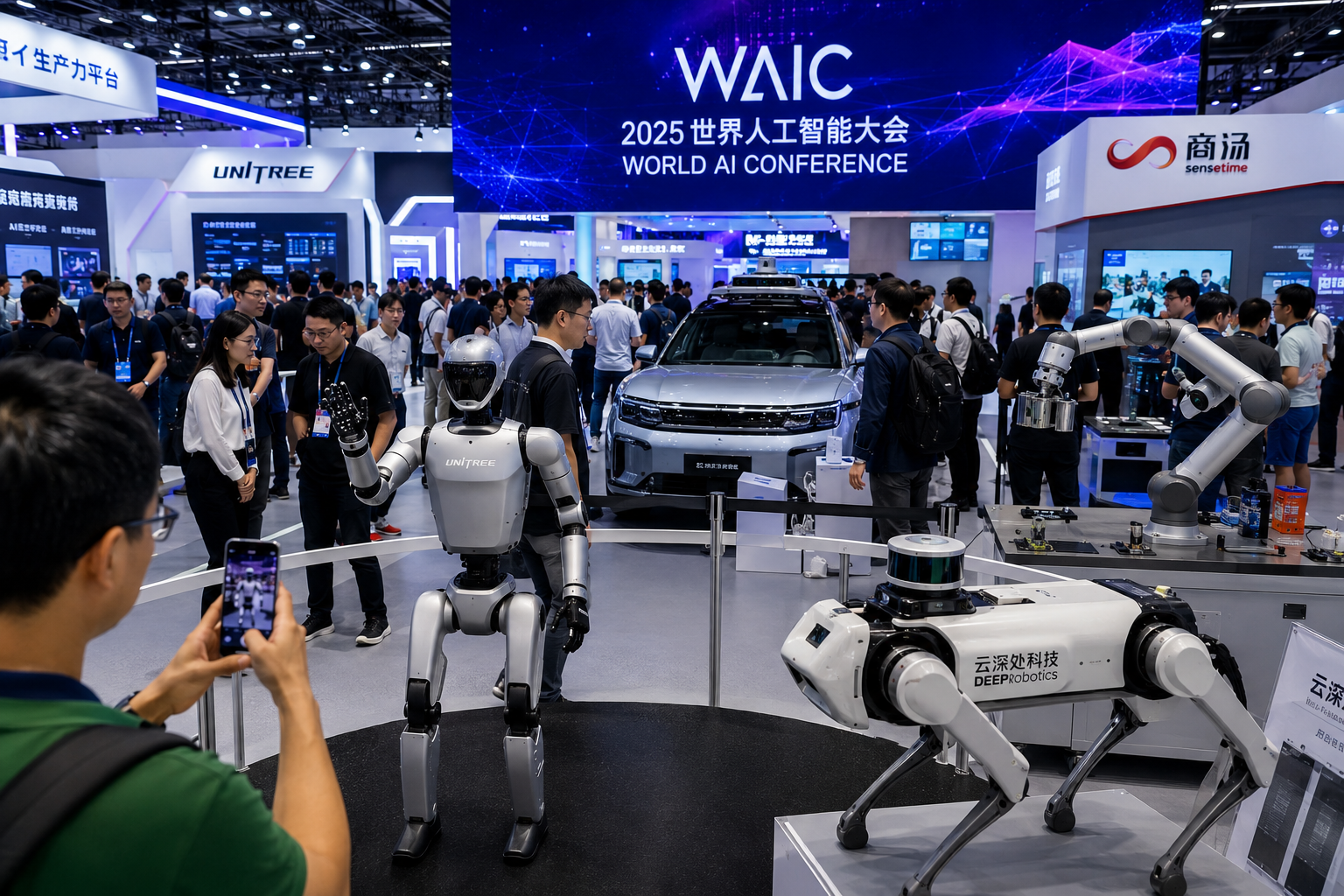
The scale of this year’s edition sets it apart from previous conferences. More than 1,100 exhibiting companies filled a floor exceeding 100,000 square meters, with over 300 products debuting globally, and organizers brought in nine Turing Award and Nobel laureates, along with UN Secretary General António Guterres and heads of state from Kazakhstan and Thailand.
China’s Bid for a Parallel Governance Body
The most consequential development at this year’s conference is Beijing’s continued push for the World AI Cooperation Organization, a body it first proposed in 2025 and wants headquartered in Shanghai. The pitch targets countries the US EU “trusted partners” governance framework has largely left out: open-weight models, cheaper inference costs, and a formal seat at the table on AI rule-setting. No country has yet formally joined, but Xi’s personal presence at the opening ceremony signals that China’s top leadership is now backing the proposal directly.
Asia Group digital practice chair George Chen described the shift in a preview of the conference, noting that the event has evolved into what he called “a geopolitical stage where Beijing seeks to articulate its vision of AI as both a national priority and a diplomatic instrument.” If the organization attracts even a modest number of members from developing nations, it would create a second, parallel set of AI norms operating outside the EU’s AI Act, the OECD’s AI Principles, and the G7’s Hiroshima Process with China holding outsized influence as the body’s founder.
A Narrowing Performance Gap Sets the Backdrop
China’s push for governance leadership arrives alongside data suggesting its models have closed much of the technical distance with the US. Stanford’s 2026 AI Index found the leading American model held only a 2.7 percentage point advantage over China’s best model on Arena Leaderboard benchmarks as of March, down from a gap of roughly 17.5 to 31.6 percentage points in 2023. That compression happened in under two years, with US and Chinese models trading the top ranking multiple times since early 2025.
The resource picture tells a different story. The same Stanford data put US private AI investment at $285.9 billion in 2025 against China’s $12.4 billion, a roughly 23 to 1 gap. China instead leads in AI publication volume, patent filings, and industrial robot deployment a divide between raw model performance, where the gap is narrow, and infrastructure investment, where it remains wide.
Huawei’s Answer to Export Controls
On the exhibition floor, Huawei publicly debuted its Atlas 950 SuperPoD, a computing system built entirely without US components in response to export restrictions that have cut the company off from Nvidia’s leading edge chips since 2020. The system links 8,192 Ascend processors through an all-optical interconnect that functions as a shared memory fabric rather than a conventional network, allowing the chips to operate as a single logical machine. Sixty four of these units combined form a larger cluster incorporating more than 520,000 chips, expected to be available later this year.
The strategy reflects a scale over density approach: rather than matching Nvidia chip for chip, Huawei is betting that linking far more processors through its own interconnect can close the performance gap. DeepSeek’s adaptation of its latest models to run on Huawei’s chips offered an early signal that the approach has moved beyond testing into production use, though Huawei’s software ecosystem still trails Nvidia’s more than fifteen year head start in developer tooling.
A Governance Framework With Legal Strings Attached
Any government or enterprise weighing adoption of Chinese AI infrastructure faces a legal backdrop that predates this week’s announcements. China’s National Intelligence Law obligates all domestic organizations and citizens to cooperate with state intelligence requests, a requirement reinforced by its Cybersecurity and Data Security Laws’ data localization provisions. That framework applies regardless of where a company’s servers sit or what its privacy policy states, which is why Australia, Sweden, the UK and the US have restricted Huawei and ZTE equipment from sensitive infrastructure over the past several years, citing the legal structure itself rather than confirmed incidents.
The Bottom Line
Xi’s decision to personally open this year’s conference reframes an event once built around product showcases into a direct contest over who writes the rules for global AI governance. The pitch to the Global South cheaper models, open weights, and a governance seat the Western framework hasn’t offered lands at a moment when the underlying technical gap between US and Chinese models has narrowed to single digits, giving Beijing’s argument more credibility than it would have carried two years ago. Whether the World AI Cooperation Organization attracts real membership, or remains a proposal without takers, will determine whether this week marks the start of a genuinely bifurcated AI governance landscape or simply China’s most visible attempt yet to claim a seat it has not yet been granted. Governments and enterprises watching from outside China now face a concrete choice about which rulebook they end up operating under.



Leave a Reply