Every major AI company now wants its agents talking to your tools, your data, and each other. What’s unusual is that the plumbing making that possible isn’t a competitive battleground the way most foundational tech infrastructure has been it’s converging into a shared, jointly governed standards stack faster than almost any comparable technology shift in computing history. Anthropic introduced the protocol that started this convergence, the Model Context Protocol, in November 2024. By early 2026, it had been adopted by OpenAI, Google DeepMind, Microsoft, and Amazon, and handed over to a neutral foundation none of them individually control. That’s not how standards wars have historically gone, and the reasons why say a lot about what kind of technology AI agents actually are.
From One Company’s Protocol to an Industry Standard
MCP solves a specific, unglamorous problem: giving AI models a universal way to connect to external tools, data sources, and services, rather than requiring a custom integration every time a model needs to read a database or call an API. Anthropic open sourced it in late 2024, and the protocol’s Python and TypeScript SDKs now see roughly 97 million monthly downloads. In December 2025, Anthropic donated MCP to the newly formed Agentic AI Foundation under the Linux Foundation, converting what had been one company’s open-source project into a vendor-neutral, community-governed standard. The foundation’s platinum members now include Anthropic, OpenAI, Google, Microsoft, AWS, and Cloudflare, alongside Block as a co-founder, and it grew to nearly 150 member organizations within its first three months one of the fastest-growing foundations in the Linux Foundation’s history.
That governance structure is the detail that matters most. MCP isn’t a feature OpenAI could simply decide to stop supporting if a rival came out ahead; it’s an industry standard with binding multi vendor commitments behind it, reinforced by a dedicated developer conference that drew 1,200 attendees to New York in early April, with Amazon and Uber presenting production deployment case studies alongside the protocol’s original maintainers.
A Second Protocol for a Different Problem
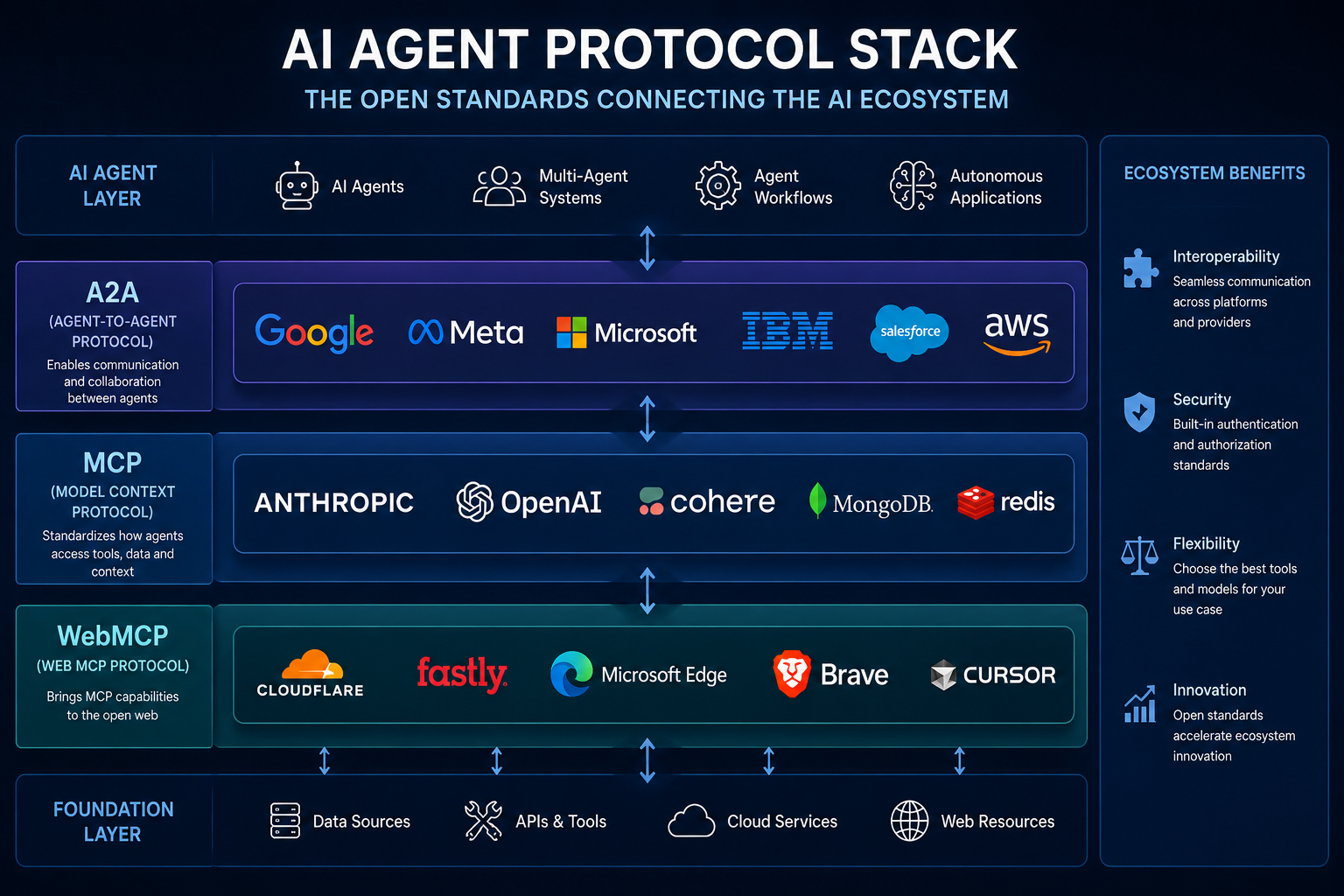
MCP alone doesn’t solve everything agents need to do, and that gap is where Google’s Agent2Agent protocol, or A2A, comes in. Where MCP connects an agent to tools, A2A connects an agent to other agents, letting a client agent discover a remote agent through a published “Agent Card” and then delegate tasks to it over a structured protocol supporting long-running work and multi turn exchanges. Google introduced A2A in April 2025 with dozens of launch partners and, following the same playbook Anthropic used with MCP, donated it to the Linux Foundation within months, placing it under governance shared by founding participants including Amazon, Cisco, Google, Microsoft, Salesforce, SAP, and ServiceNow. IBM’s competing Agent Communication Protocol merged into A2A in August 2025 rather than continuing as a rival standard, and by this spring A2A had reached version 1.0, with signed Agent Cards, more than 150 production organizations, and SDKs across five programming languages.
The community’s own framing of the split is useful shorthand: MCP connects agents to tools, A2A connects agents to peers. A tool call executes and returns a result. A peer delegation negotiates, and can take much longer to resolve. Together, the two protocols form the core of what’s now being described as a layered agent communication stack, with MCP handling vertical integration and A2A handling horizontal coordination between agents built by entirely different vendors.
Extending the Stack Into the Browser and the Marketplace
The stack didn’t stop at tools and agent-to-agent coordination. In February, Google shipped a preview of WebMCP in Chrome Canary, developed jointly with Microsoft on a formal W3C standards track, extending agent interoperability directly into the browser itself a notable pairing given how fiercely Google and Microsoft have historically competed over browser market share. A separate layer, generally referred to as UCP, is emerging to handle commerce and transaction functions for agents that need to actually buy things or complete payments, filling a gap neither MCP nor A2A was designed to address.
What’s forming, in other words, isn’t a single winning protocol but a composed architecture: tool access, peer coordination, browser integration, and commerce transactions, each governed by overlapping but distinct multi vendor coalitions, with most of the internet’s largest technology companies holding seats in more than one of them simultaneously.
Why Rivals Are Cooperating Instead of Forking
The comparison worth making here isn’t to a prior AI cycle it’s to earlier standards fights like the browser wars or the VHS-Betamax split, where competing formats fragmented markets for years before one won out. Nothing like that has happened with agent protocols, and the reason is structural rather than a sudden outbreak of corporate goodwill. An AI agent is only as useful as the tools and other agents it can actually talk to, and if every vendor ships an incompatible protocol, the entire category of agentic AI stays stuck in demos rather than reaching production deployment. No single company, however dominant its underlying models, benefits from being the one ecosystem an agent can’t connect to. That network-effect logic pushed Anthropic and Google to donate their respective protocols to neutral governance almost immediately after introducing them, rather than trying to hold onto proprietary control the way past platform owners often did.
Where the Real Competition Still Lives
None of this means the competitive dynamics between these companies have disappeared they’ve just moved up a layer. Anthropic, OpenAI, and Google are cooperating on the plumbing while competing intensely on what runs through it: whose models perform best inside agent workflows, whose agent SDKs offer the deepest native integration, and whose products developers actually choose to build on top of a shared protocol stack. Governance seats matter too. Being a platinum member of the Agentic AI Foundation, or a founding participant in A2A’s Linux Foundation home, gives a company real influence over how these standards evolve next, even if no single member can unilaterally redirect them. And newer layers, like WebMCP’s browser integration and UCP’s commerce functions, remain far less settled than MCP and A2A, meaning the next real skirmishes over agent standards are more likely to happen at those emerging edges than in the now stable core.
The Bottom Line
What makes this moment worth watching isn’t that Big Tech agreed to cooperate companies this size rarely do that without a reason bigger than goodwill. It’s that the reason here is unusually clean: agents that can’t talk to each other’s tools and to each other simply don’t work at the scale any of these companies need them to work at, so competing on protocol lock-in would have shrunk the market everyone is trying to grow. The actual race isn’t over who owns the standard. It’s over who builds the best products on top of a standard nobody owns outright, and over who accumulates enough governance weight in these shared foundations to shape where the stack goes next. That’s a quieter, less visible competition than a format war, but it may end up mattering more for how AI agents actually function once they move from developer previews into the everyday tools people rely on.


Leave a Reply