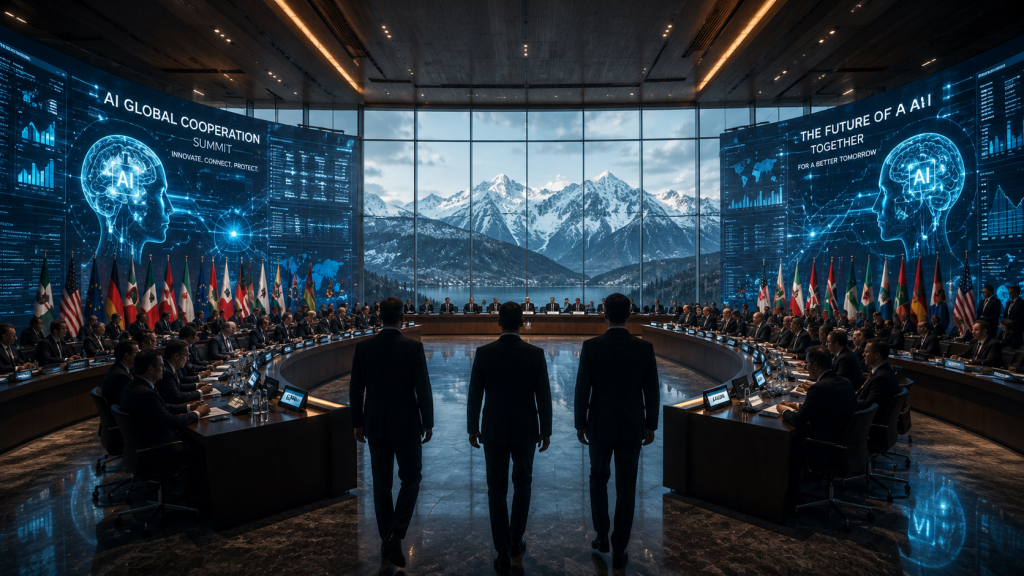
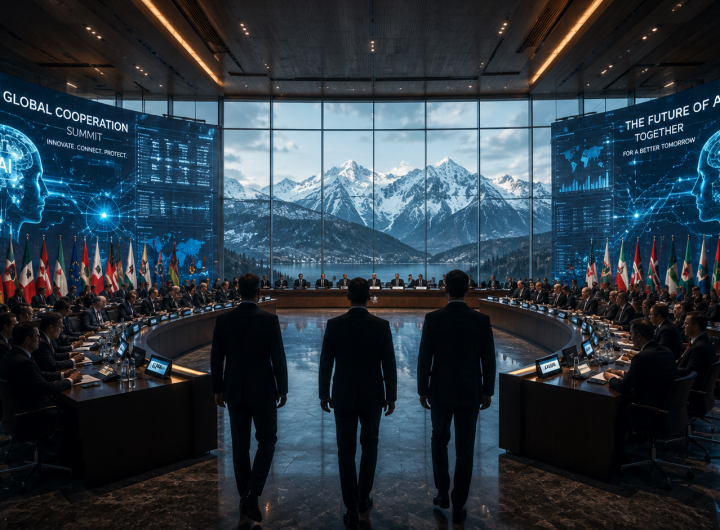
Sam Altman, Dario Amodei, and Demis Hassabis are heading to France next week. Not for a tech conference. Not for a product launch. They are sitting at the same table as the leaders of the United States, United Kingdom, France, Germany, Japan, Italy, and Canada at the G7 Summit in Évian-les-Bains from June 15 to 17.
That has never happened before. And the fact that it is happening now the same week SpaceX completed the largest IPO in history, the same week Anthropic and OpenAI are both preparing their own public listings tells you something important about where AI sits in the global power structure in 2026. It is no longer a technology story. It is a geopolitical one.
Here is what is actually on the table when those three walk into the room.
What the G7 Summit Is and Why This Year Is Different
The G7 is an annual gathering of the leaders of the world’s seven largest advanced economies the US, UK, France, Germany, Japan, Italy, Canada, and the European Union. It is where global policy gets shaped before it becomes law, where alliances get tested behind closed doors, and where the agenda items that appear on its schedule become the regulatory priorities of the following twelve months.
France is hosting this year’s summit in Évian les Bains, and positioning itself as Europe’s leading AI hub has been a particular priority for President Macron going into it. That ambition explains the guest list more than any other single factor.
The G7 conference runs from June 15 to 17, with AI expected to feature prominently on the agenda. Sam Altman was personally invited by Macron to participate in the Leaders Summit which would be the first time he has attended at that level.
The Leaders Summit is not the side room. It is the main event. Altman sitting in that conversation means AI company leadership is now part of the same discussion as heads of state making decisions about trade, security, and global economic policy. That is a shift in status that would have seemed extraordinary two years ago.
What Each CEO Is Actually There to Discuss
The three executives are not attending as passive observers. They have a specific agenda item.
Sam Altman, Dario Amodei of Anthropic, and Arthur Mensch of European AI company Mistral are attending a dedicated lunch on Wednesday focused on protecting minors in the digital sphere.
That agenda item child safety online sounds narrow but it is the entry point to a much broader conversation about AI content moderation, platform responsibility, and the regulatory frameworks that G7 governments are preparing to impose on AI companies. The lunch is where the CEOs make their case directly to the people writing the rules. What gets agreed informally over that table in France this week will show up in legislation in multiple countries within months.
Macron has recently been on a charm offensive with tech leaders more broadly. Over the weekend before the summit, SoftBank announced plans to invest 45 billion euros over five years to build AI infrastructure in France, after Macron personally courted SoftBank CEO Masayoshi Son. The pattern is deliberate France wants to be where AI investment lands, and bringing the industry’s most powerful executives into the G7 conversation is part of that strategy.
Why Macron Is the One Making This Happen
The invitation did not come from Washington or London. It came from Paris. That matters.
France has a specific strategic interest in being at the centre of the AI conversation both as a host nation and as a country that wants to compete with the United States and China in AI development without being absorbed into either orbit. Macron’s invitation to Altman, Amodei, and Hassabis is not just hospitality. It is positioning.
The G7 summit agenda this year includes addressing macroeconomic imbalances, strengthening economic security and critical mineral supply chains, and reforming international development partnerships all of which intersect directly with AI infrastructure and the global competition for GPU computing capacity.
Critical minerals supply chains and AI are the same story told from different angles. The chips that run every AI model in the world depend on rare earth minerals and semiconductor manufacturing capacity that is currently concentrated in Taiwan, South Korea, and China. Every G7 leader in that room has a national security interest in that supply chain. The AI executives have a commercial interest in it. The conversation that happens between those two groups next week will shape policy that affects every AI product every person reading this uses daily.
The Timing Is Not a Coincidence
It would be easy to read the G7 AI summit as separate from the IPO wave happening this week. It is not. The two stories are the same story.
SpaceX listed on Nasdaq this morning. Anthropic and OpenAI have both filed confidentially for their own listings. The AI industry is moving from the phase where it operated largely outside public accountability private, lightly regulated, answerable mainly to investors into the phase where it is publicly listed, government scrutinised, and operating inside the same regulatory frameworks as banks, pharmaceutical companies, and energy providers.
The G7 summit is the political expression of that same transition. Governments that spent the past three years watching AI develop from a distance are now pulling the CEOs of the most powerful AI companies into the room where global economic policy gets made. That is not a courtesy. It is a signal that the regulatory era for AI is beginning in earnest and that the companies which engage constructively with that process will have more influence over its shape than those that resist it.
Altman, Amodei, and Hassabis walking into Évian-les-Bains next Monday are not walking into a photo opportunity. They are walking into the opening negotiation of the framework that will govern their industry for the next decade.
AI IPO Race 2026: Why SpaceX, Anthropic and OpenAI Are All Going Public Right Now
What This Means for People Who Use AI Every Day
The decisions made in France next week will not show up in your AI tools immediately. They will show up in twelve to eighteen months as new content moderation requirements, data handling rules, liability frameworks for AI generated content, and potentially mandatory transparency disclosures about how AI models are trained.
The child safety agenda item is the most immediate. AI generated content involving minors, AI tools accessible to children without parental controls, and AI systems used to generate or distribute harmful content targeting young people are all areas where G7 governments are ready to legislate quickly. The lunch on Wednesday is where AI companies get to influence what that legislation looks like before it is written not after.
For the hundreds of millions of people who use Claude, ChatGPT, and Gemini daily, the G7 conversation matters because the product you use in 2027 will be shaped by what gets agreed in Évian this weekend. The rules being negotiated next week will determine what these tools can do, what they must refuse to do, and who is liable when they get it wrong.
What Happens After the Summit
The French presidential office confirmed the attendance of Sam Altman, Demis Hassabis, and Dario Amodei on a formal list released today. All three companies confirmed directly. That level of formal confirmation means this is not a casual appearance it is coordinated engagement with the summit process.
Watch for joint statements on AI safety and child protection emerging from the summit on June 17. Watch for Macron to use the summit to announce new French AI investment commitments that extend beyond the SoftBank deal. And watch for the language that comes out of the leaders’ communiqué on AI because that language becomes the template for domestic legislation in seven of the world’s largest economies within months of publication.
The G7 AI moment has been building since the Paris AI Safety Summit in 2025. What happens in Évian next week is the next chapter and for the first time, the people building the technology are in the room when the chapter gets written.
Frequently Asked Questions
Who are the AI executives attending the G7 Summit 2026?
Sam Altman of OpenAI, Dario Amodei of Anthropic, Demis Hassabis of Google DeepMind, and Arthur Mensch of Mistral AI are attending. All confirmed their attendance after the French presidential office released the official list.
When and where is the G7 Summit 2026?
The summit runs from June 15 to 17 in Évian-les-Bains, France a spa town on the shores of Lake Geneva. France holds the G7 presidency this year.
What will the AI executives discuss at the G7?
The confirmed agenda item is a dedicated lunch on Wednesday June 18 focused on protecting minors in the digital sphere. The broader conversation will cover AI regulation, infrastructure investment, and the geopolitical competition between the US, Europe, and China in AI development.
Why did Macron invite AI executives to the G7?
France is actively positioning itself as Europe’s leading AI hub. Macron has been personally courting tech leaders the SoftBank $53 billion France investment announced this week is one result of that strategy. Bringing AI executives into the G7 Leaders Summit is part of the same effort.
What does the G7 AI discussion mean for everyday users?
Decisions made at the G7 typically become domestic legislation in member countries within twelve to eighteen months. The AI discussions in France will shape content moderation rules, child safety requirements, data handling frameworks, and liability standards for AI-generated content across the US, UK, EU, and beyond.
What is the G7 Summit?
The G7 is an annual meeting of the leaders of the world’s seven largest advanced economies the United States, United Kingdom, France, Germany, Japan, Italy, and Canada, plus the European Union. It is where global economic and security policy gets shaped before becoming law in member countries.
Who is hosting the G7 in 2026?
France is hosting the 2026 G7 Summit in Évian-les-Bains, a spa town on the shores of Lake Geneva in the French Alps. The summit runs from June 15 to 17 under French President Emmanuel Macron.
Is Donald Trump attending the G7 in 2026?
Yes. Trump confirmed attendance at the France summit which was not guaranteed given his history with multilateral gatherings. His presence alongside AI executives makes the agenda particularly significant for the future of US AI policy.
Who are the leaders attending the G7 in 2026?
The core G7 leaders represent the US, UK, France, Germany, Japan, Italy, and Canada. Macron also invited leaders from Brazil, Egypt, India, Kenya, and South Korea as guests plus AI executives Sam Altman, Dario Amodei, and Demis Hassabis for the AI and digital safety sessions.
Three AI CEOs sitting with world leaders at the G7 is a sentence that would have read as science fiction in 2022. Today it is a confirmed calendar item for next Monday.
The AI industry spent its first decade largely outside the rooms where global power operates. That era ended this week between SpaceX listing on Nasdaq, Anthropic and OpenAI filing for their own IPOs, and now the three most powerful AI executives in the world receiving formal invitations to the most significant gathering of world leaders on the annual calendar.
What gets discussed in Évian-les-Bains over three days next week will not make headlines as loudly as a stock price or a model benchmark. But it will matter more to the long-term shape of AI than almost anything else happening in the industry right now. The technology is no longer being built outside the system. It is being absorbed into it.
 Anthropic Project Glasswing 2026: The Secretive AI Safety Program That Found 23,000 Security Holes
  ChatGPT Used for China Influence Operations: What OpenAI Just Admitted and Why It Matters
  Claude AI Growth 2026: The 306% Number That Should Worry Every ChatGPT User
  The AI IPO Race 2026: SpaceX, Anthropic and OpenAI Are All Going Public at the Same Time
  Microsoft AI Coding Tools 2026: The Uncomfortable Truth Developers Are Just Finding Out
  AI Jobs at Risk by 2030: The Honest Truth Nobody Is Telling You
  AI Executives Attending the G7 Summit in France and the Agenda Goes Deeper