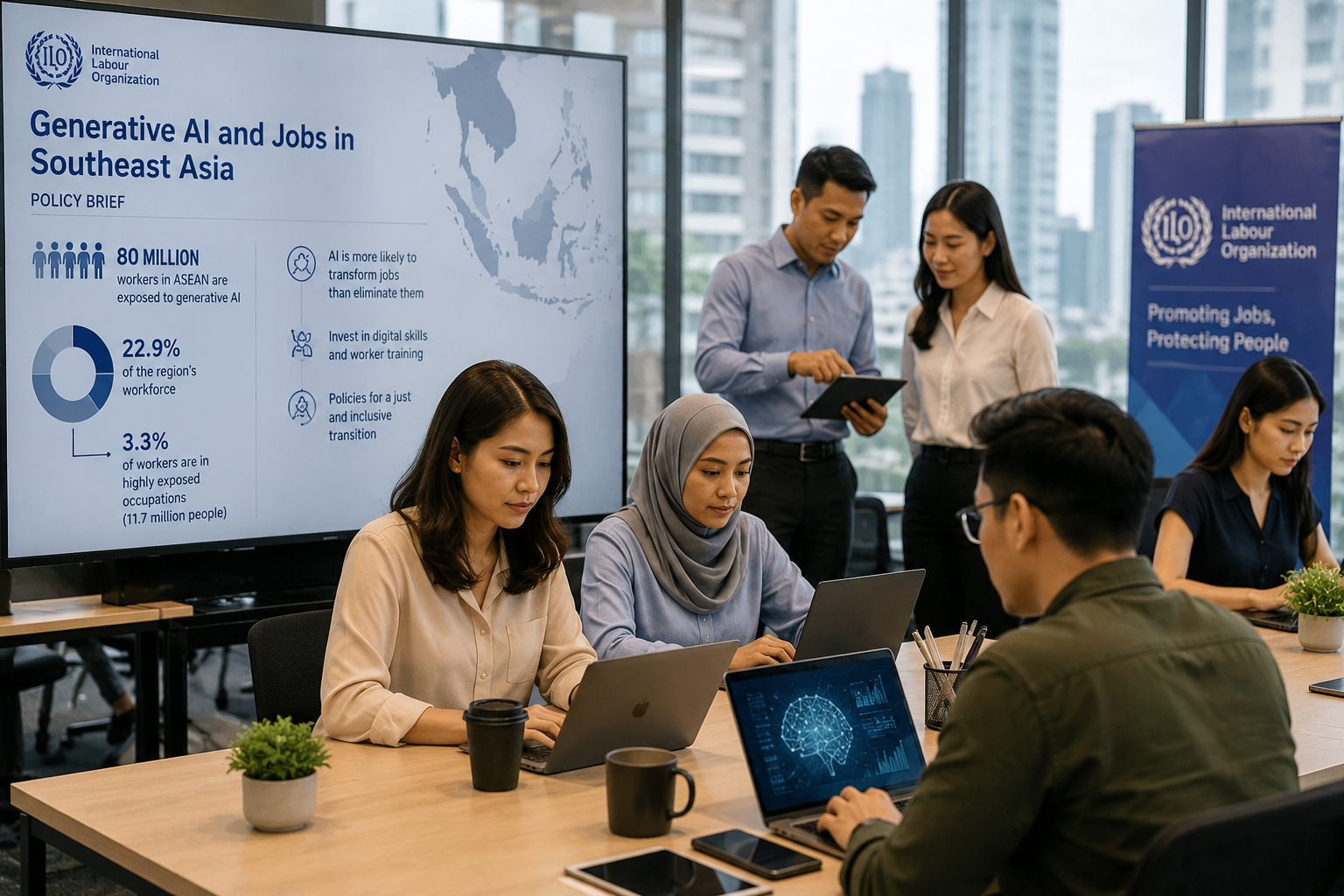
Generative AI is set to touch the working lives of nearly 80 million people across the Association of Southeast Asian Nations, according to a new International Labour Organization study released this week, but the report’s central finding cuts against the more alarmist predictions that have circulated around AI and employment. According to ILO estimates for 2025, 22.9% of total employment in ASEAN, equivalent to nearly 80 million workers, is in occupations with more than a minimal degree of potential exposure to generative AI. Only a small proportion of those workers hold jobs facing the highest levels of exposure, and there is no evidence to date of large-scale job losses tied to the technology.
The report, titled “Generative AI and labour markets in ASEAN: Significant exposure, limited disruption, uneven preparedness,” examines all 11 ASEAN member states by measuring both occupational exposure and the actual pace of GenAI adoption inside workplaces. The distinction between those two measures turns out to be the report’s most important finding: a job can be technically exposed to automation without employers actually deploying the technology to do it, and across Southeast Asia right now, that gap is wide.
The Numbers Behind the Exposure
Exposure varies sharply by country, tracking closely with how service- and knowledge-intensive each economy is. Singapore recorded the highest share of employees in occupations with more than minimal GenAI exposure, at 42.2% of total employment, followed by the Philippines at 28.1%, reflecting its large information technology and business process outsourcing sector. Indonesia, Vietnam, and Thailand followed in a tighter band, with exposure rates ranging between roughly 20% and 22%. At the other end of the spectrum, roughly 67% of ASEAN’s total workforce remains concentrated in manual, agricultural, or physical occupations with no measurable AI exposure at all, a reminder that the report’s headline numbers describe a meaningful minority of the region’s labor force, not a majority.
Within that exposed population, the report draws a sharper distinction still. Only 3.3% of the regional workforce, representing 11.7 million workers, sits in the highest-exposure category, where tasks face more direct automation pressure rather than the kind of task level augmentation the report expects for most exposed roles. That figure is the closer proxy for genuine displacement risk, and it is a fraction of the 80 million headline number that has driven most of the coverage.
Exposure Doesn’t Equal Adoption
The report’s most consequential finding may be how little of this exposure has translated into actual workplace deployment so far. GenAI adoption remains at an early and uneven stage, with usage concentrated in technology intensive occupations and comparatively limited uptake in office and administrative roles, despite those roles showing among the highest exposure levels in the data. Singapore, the region’s most digitally advanced economy, illustrates the gap starkly: a 2026 Ministry of Manpower survey cited in the report found that 71.5% of firms had not yet begun adopting AI, while only 3.8% had fully integrated it into core business processes.
That gap matters because it reframes the entire policy conversation. A workforce facing high theoretical exposure to a technology that employers haven’t actually deployed yet is a very different problem than one already experiencing displacement, and it gives governments and companies a real window to prepare rather than simply react.
Who Bears the Impact
The report identifies a clear and significant gender gap running through the exposure data. Women are more than twice as likely as men to be employed in occupations with high GenAI exposure, a pattern the ILO traces to their concentration in clerical, administrative, and professional roles precisely the categories the report flags as highly exposed but not yet heavily automated. Young workers face a related but distinct concern. While workers aged 15 to 24 show broadly similar overall exposure levels to older workers, the report notes emerging signs of weaker employment outcomes for young people in some entry level jobs in specific economies, including the Philippines and Thailand, suggesting the first visible effects of AI-driven labor market change may show up in who gets hired into junior roles rather than who gets displaced from existing ones.
The Preparedness Gap
Perhaps the most useful contribution the report makes is separating exposure from preparedness, since the two don’t move together. Singapore stands out as the only economy in the region combining both high AI exposure and high institutional readiness, backed by advanced digital infrastructure and a globally competitive AI ecosystem. The Philippines, despite ranking second in raw exposure, ranked only fourth in preparedness among the economies the ILO assessed, illustrating that a country’s workforce can face significant AI-driven change without yet having the digital infrastructure, skills systems, or governance frameworks in place to manage it well.
ILO economist and lead author Christian Viegelahn framed the takeaway directly, saying labor market outcomes will depend less on exposure levels themselves and more on the policy choices made to build resilience among workers, employers, and institutions. That framing shifts responsibility away from the technology itself and toward the surrounding systems, a distinction the report returns to repeatedly.
What the ILO Recommends
The report’s policy recommendations follow directly from its preparedness findings rather than treating exposure as an emergency requiring blanket restriction. It calls for human-centred AI governance across ASEAN, expanded upskilling and reskilling programs targeted specifically at women and young workers, support for micro, small, and medium enterprises to overcome barriers to AI adoption, and stronger regional coordination on workforce development and knowledge sharing between member states. None of these recommendations assume mass job losses are coming; they assume the transition will be uneven across countries, sectors, and demographic groups, and that the policy response needs to match that unevenness rather than treat ASEAN as a single labor market.
The Bottom Line
What this report actually documents is a region standing at an early, undecided stage of AI driven labor change rather than in the middle of a crisis. Nearly 80 million exposed workers is a large number, but the ILO’s own data shows most of that exposure hasn’t yet become adoption, and the narrower group facing direct automation risk is closer to 12 million people, concentrated unevenly by country, gender, and age. The more useful number in this report isn’t the headline exposure figure at all. It’s the gap between Singapore’s readiness and the rest of the region’s, because that gap is what will determine whether Southeast Asia’s AI transition looks like the reskilling story the ILO hopes for, or the disruption story it says hasn’t materialized yet, but hasn’t ruled out either.



Leave a Reply