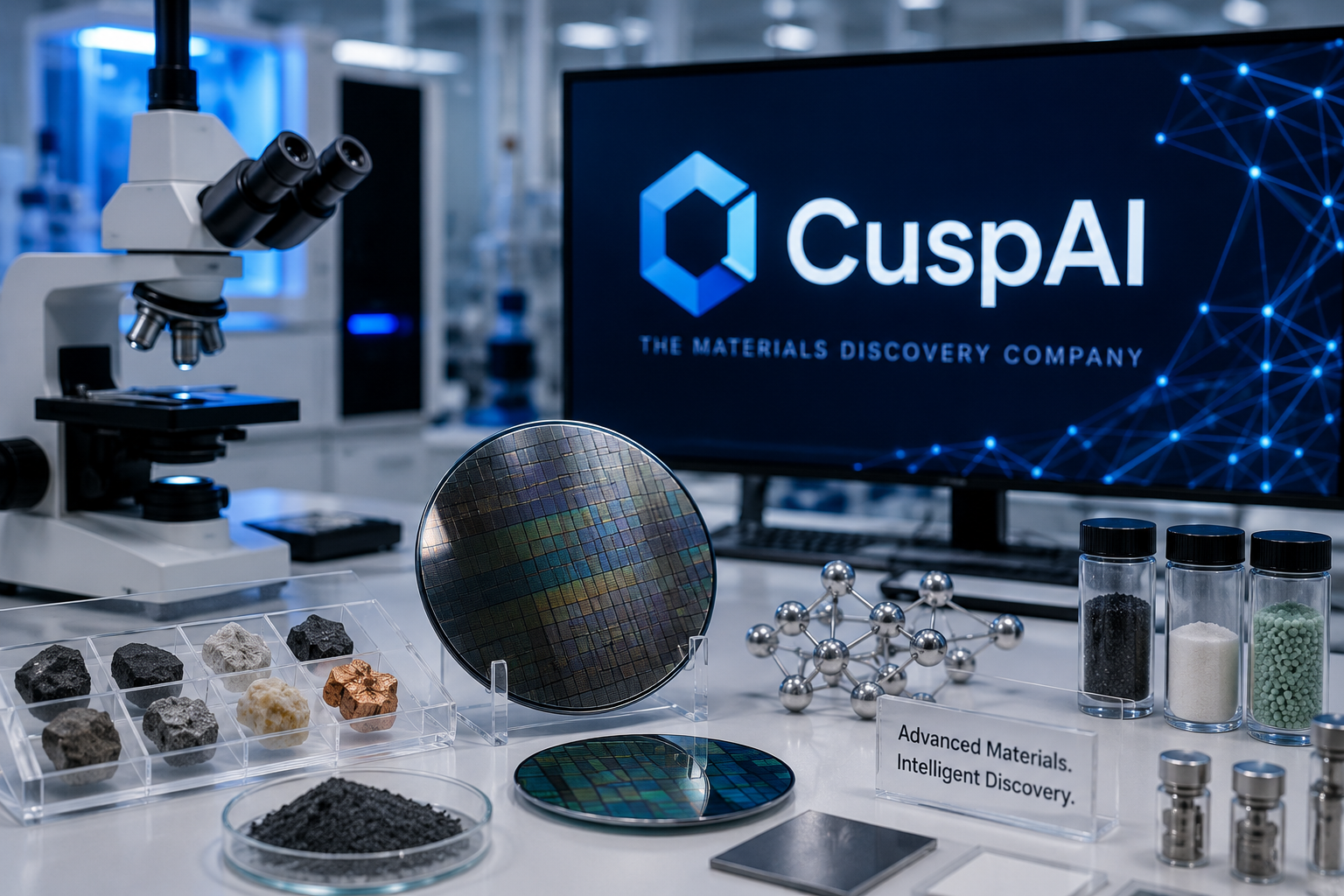
CuspAI, a Cambridge, UK based startup that uses generative AI to design new materials, has closed a funding round reported at roughly $450 million, with Jeff Bezos’s family office Bezos Expeditions and Kleiner Perkins among the lead investors. The deal pushes the two-year-old company’s valuation to about $2.6 billion, up from $520 million less than a year ago.
The company paired the raise with the launch of the AI Materials Foundry, a coalition of more than 48 technology companies, industrial manufacturers and research institutions, including Nvidia, Meta and Hyundai, organized around accelerating AI-driven materials discovery as a shared industry effort rather than a single vendor’s product.
CuspAI’s platform generates candidate molecules with specific physical properties, then evaluates whether those materials would hold up outside a simulation. The company describes it as a search engine for the material world: researchers specify what they need strength, conductivity, thermal tolerance and the system proposes chemical compositions that could otherwise take years to identify through conventional trial and error. Its current customers include ASML, Meta and Hyundai, applying the technology to semiconductor manufacturing, computing hardware, energy storage and water purification.
The round marks a fivefold valuation increase since CuspAI’s $100 million Series A in September 2025, which was co led by New Enterprise Associates and Temasek with participation from Nvidia’s venture arm, NVentures, and Samsung Ventures. Hyundai has separately partnered with CuspAI on materials for batteries and hydrogen fuel cells. The company’s advisory board includes AI pioneers Geoffrey Hinton and Yann LeCun, alongside Kristin Persson, who leads UC Berkeley’s Materials Project.
Bezos’s involvement extends a broader push into what he has called physical AI applying AI models to problems in the physical world rather than text or image generation. His family office’s stake in CuspAI follows Bezos’s own venture, Project Prometheus, which raised roughly $10 billion earlier this year to pursue similar ground. CuspAI is one of several startups chasing the same opportunity: rivals XtalPi and Periodic Labs, founded by former OpenAI and DeepMind researchers, have also drawn substantial funding for AI driven materials work.
The bet across these investments is that generative AI, applied to molecular design rather than language, can shorten a materials-discovery process that has historically taken a decade or more per compound. Semiconductor manufacturing, battery chemistry and water purification all depend on finding materials with narrow, specific properties the kind of search space AI models can explore far faster than manual lab testing, though whether that translates into materials that are actually manufacturable and cost-effective at scale remains to be proven as CuspAI’s technology moves from research partnerships toward commercial deployment.




Leave a Reply