
Every technology wave has a moment where the number of serious companies entering a space goes from a handful to a flood. Language AI had that moment in late 2022. Image generation had it in 2023. The signals are now accumulating that Physical AI the technology that lets robots and autonomous systems perceive and act in the real world is approaching that same inflection point.
Striding AI has officially launched. The new company’s stated focus is on building robotic foundation systems: the core infrastructure layer that physical robots need to understand and navigate real-world environments. Not a specific robot for a specific use case. A foundational platform that could underpin many robots across many use cases the same way large language models became a foundation layer for a wide range of software applications.
The Striding AI Physical AI robotics startup launch is worth paying close attention to not just because of what the company is building but because of what its existence signals. When serious people start companies in a category, it usually means the category is real, the timing is right, and the capital is available. All three of those conditions appear to be true for Physical AI right now.
What Striding AI Is Building
Striding AI’s focus on robotic foundation systems is a deliberate positioning choice that reflects where the robotics industry’s real bottleneck currently sits.
Most robotics companies today build vertically a robot designed for warehouse logistics, a robot for agricultural harvesting, a robot for retail restocking. Each vertical solution tends to require its own bespoke perception system, its own navigation stack, its own approach to handling the unpredictability of real world environments. This means enormous duplicated engineering effort across the industry and slow progress on the fundamental problems that all physical robots face.
The foundation model approach tries to change that dynamic. Just as a language model trained on broad data can be fine tuned for many specific applications, a robotic foundation system trained on broad physical world data could potentially be adapted for many specific robot deployments. A single perception and action model that understands physical space, object relationships, and the logic of navigating among humans could serve as the base layer for robots deployed in retail, logistics, healthcare, construction, and more.
Striding AI is betting that this foundation layer is the most valuable place to build in the Physical AI stack right now before the market fragments into dozens of incompatible vertical solutions that all end up reinventing the same core capabilities independently.
Why Physical AI Is Having Its Moment in 2026
The concept of robots that can operate in unstructured real world environments is not new. What is new is the convergence of several capabilities that were previously not mature enough to make it work at commercial scale.
Vision and perception have improved dramatically. The same transformer architectures that made language models capable of nuanced reasoning have been applied to visual understanding, producing perception systems that can interpret complex scenes identifying objects, estimating their positions, understanding spatial relationships in ways that rule-based systems never could.
The ability to transfer learned behaviours from simulation to real world deployment has also improved significantly. Training robots in physical environments is slow and expensive. Training them in high-fidelity simulations and then deploying in the real world sim to real transfer has historically been a major bottleneck. Recent advances have made that transfer meaningfully more reliable.
And the cost of the hardware itself has been falling. Sensors, actuators, and the compute required to run real time perception models have all gotten cheaper and more capable simultaneously the kind of hardware cost curve that historically signals a market is about to expand.
Striding AI is launching into that specific window where the technology is good enough to build real products but early enough that the foundational architecture has not yet been decided. That is historically one of the most valuable moments to enter a market.
The Real World Deployment Challenge
The name Physical AI is evocative but it also points at the core difficulty: real physical environments are harder than any controlled environment will ever be.
A robot navigating a warehouse that is always clean, always lit the same way, with products always in the same locations is a very different engineering problem from a robot navigating an actual retail store on a busy Saturday afternoon. Spilled liquids. Shopping carts left in unexpected places. Children running. Products in the wrong locations. Lighting that varies by section. Other robots operating simultaneously. Human staff moving in ways that are not predictable.
The robotic foundation systems that Striding AI is building need to handle all of that not just the easy version of the environment but the full messy reality of the places where physical robots actually need to operate to be commercially valuable.
This is precisely why the foundation model approach is compelling. A system that has been exposed to an enormous variety of physical environments, object configurations, and human behaviours during training is better positioned to handle novel situations at deployment than a system trained narrowly for one specific environment type. The breadth of training is the source of the robustness.
What the Competitive Landscape Looks Like
Striding AI is entering a space that already has serious players. Figure AI, Physical Intelligence (Pi), and Apptronik have all raised significant capital to work on general-purpose robotics and the underlying AI systems that enable them. Boston Dynamics, after years of impressive hardware demonstrations, has been working to commercialise its platforms at scale. In China, Unitree and a growing number of well-funded competitors are pushing hard on both hardware and AI capabilities.
The foundation model angle is Striding AI’s specific positioning within that landscape. Rather than competing directly on robot hardware, the company is positioning itself as a platform layer that other robot makers and deployers could potentially build on top of. This is a higher-risk, higher-reward bet. If Striding AI gets the foundation model right, the business case is enormous — every Physical AI deployment in every vertical becomes a potential customer for the platform. If the foundation model approach turns out to be less transferable than the language model analogy suggests, the company is building something that does not quite fit any specific customer’s needs.
The next twelve to eighteen months of product development and early deployment partnerships will tell a great deal about which of those outcomes is more likely.
Why This Matters Beyond the Startup Story
New startup launches happen every day. The reason the Striding AI launch is worth covering as more than a routine funding announcement is what it represents about the state of the Physical AI market.
When smart, well resourced people decide to build a foundation layer for a technology category, it is usually because they have concluded that the category is about to scale rapidly and that the foundational infrastructure does not yet exist in the right form. That is a strong signal about where serious people think the market is going.
Combine Striding AI’s launch with AMC Robotics building a full scale manufacturing hub in Vietnam for its quadruped and industrial arm products, with the wave of investment flowing into humanoid and quadruped robotics globally, and with the improving hardware cost curves making robot deployment economics more viable and you get a picture of a category that is approaching genuine commercial scale, not just impressive demos.
The question for Physical AI is not whether it becomes a major technology category. It will. The question is how long the path is between here and the kind of widespread commercial deployment that makes it part of everyday life. Companies like Striding AI are betting that path is shorter than most people currently believe.
BEXORN VERDICT: 8/10 The Foundation Layer Bet at Exactly the Right Moment
The Striding AI Physical AI robotics startup launch is the kind of company formation that tends to look prescient in retrospect. Building the foundational infrastructure for Physical AI deployment before the market fragments into incompatible vertical solutions is a smart place to be, and the timing converging improvements in perception, sim to real transfer, and hardware cost curves is as good as it has ever been. The foundation model analogy from language AI is compelling but not guaranteed to transfer directly to physical systems. That is the core risk. The core opportunity is that whoever builds the right robotic foundation platform at this moment in the market could occupy a position in Physical AI similar to what the major LLM providers occupy in language AI today. That is a very large prize to be competing for.
FAQ
What is Striding AI?
Striding AI is a newly launched startup focused on building robotic foundation systems the core AI infrastructure that enables robots to perceive and act in real-world physical environments. It is targeting the foundation model layer of the Physical AI stack rather than specific robot hardware.
What is Physical AI?
Physical AI refers to artificial intelligence designed to enable robots and autonomous systems to perceive, navigate, and act in real-world physical environments as opposed to AI that operates purely in digital spaces. It covers the perception, reasoning, and action systems that make physically deployed robots useful in commercial settings.
What are robotic foundation systems?
Robotic foundation systems are broad-based AI models trained on diverse physical-world data that can be adapted for many different robot deployment scenarios. The concept mirrors how large language models function as a foundation for many software applications a single trained model that can be fine-tuned for specific use cases rather than every application requiring a bespoke AI system.
Why is 2026 a significant moment for Physical AI?
Several capabilities have matured simultaneously: transformer-based visual perception, improved sim-to-real transfer for robot training, and falling hardware costs. This convergence has made commercial-scale Physical AI deployment more viable than at any previous point.
Who are Striding AI’s main competitors?
The Physical AI space includes Figure AI, Physical Intelligence, Apptronik, Boston Dynamics, and a growing number of Chinese companies including Unitree. Striding AI’s specific positioning around foundation systems rather than robot hardware differentiates it from most of these players.
What would success look like for Striding AI?
Success would mean that Striding AI’s robotic foundation platform becomes a standard layer that robot manufacturers and deployers build on top of the equivalent of what iOS or Android became for mobile applications, or what major LLM APIs have become for AI software. Achieving that position would make the company one of the most valuable in the Physical AI ecosystem.
Related Reading:
• AMC Robotics Vietnam Hub Is Proof the Hardware Race Has Left Silicon Valley
• What Is AGI Artificial General Intelligence in 2026 and Are We Already Living With It?
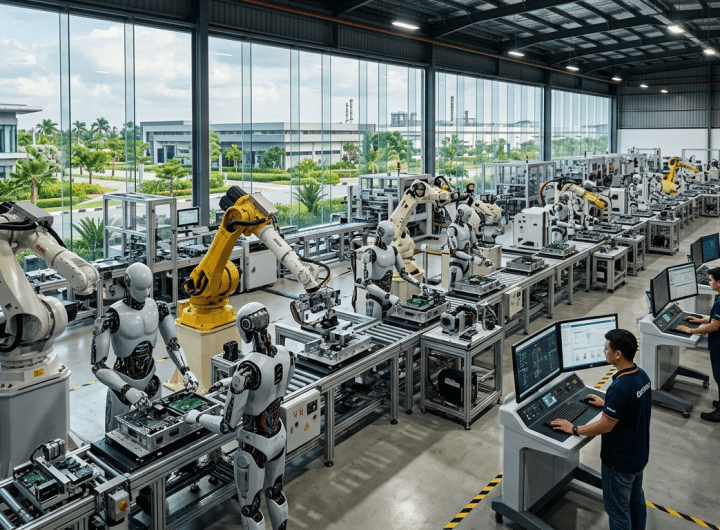 AMC Robotics Vietnam Hub Is Proof the Hardware Race Has Left Silicon Valley
  SpaceX Space Data Centers: The Wildly Ambitious Plan to Build a Million AI Supercomputers in Orbit
  What Is AGI Artificial General Intelligence in 2026 and Are We Already Living With It?
 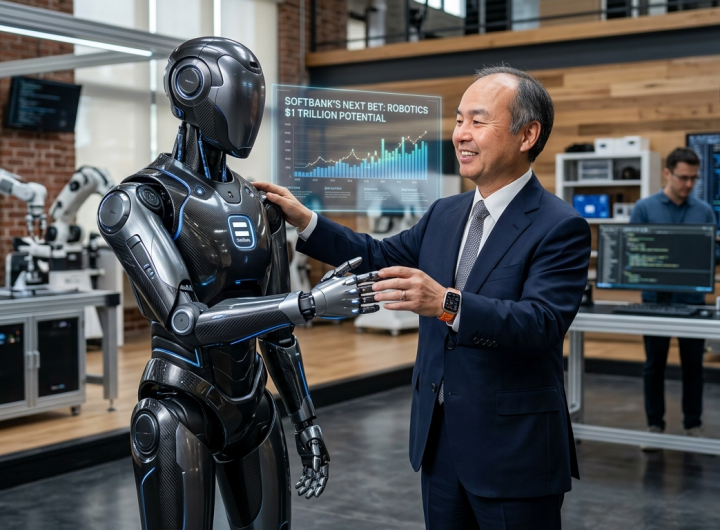 SoftBank’s Masayoshi Son Says Robots Are the Next Trillion Dollar Bet and He Just Put Real Money Behind It
 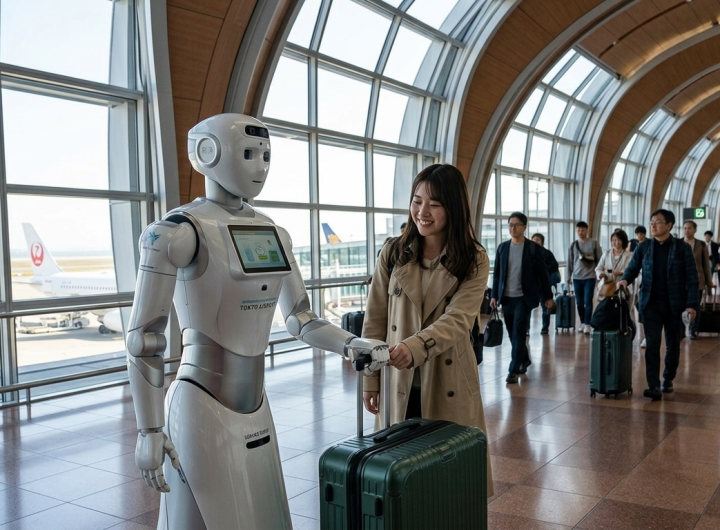 Japan Airlines Put Humanoid Robots To Work At Haneda Airport Because There Was No One Left To Hire
  SpaceX IPO 2026: The Risky $1.77 Trillion Gamble That Could Make Musk the First Trillionaire Or Trigger the Biggest Crash in Tech History
  Striding AI Launch Is the Clearest Signal Yet That Physical AI Is the Next Frontier
  Murakkab Is the MIT System That Makes Your AI Workflows Faster and Cheaper to Run
  OpenAI Jalapeno Chip Is Here and NVIDIA Should Be Paying Attention