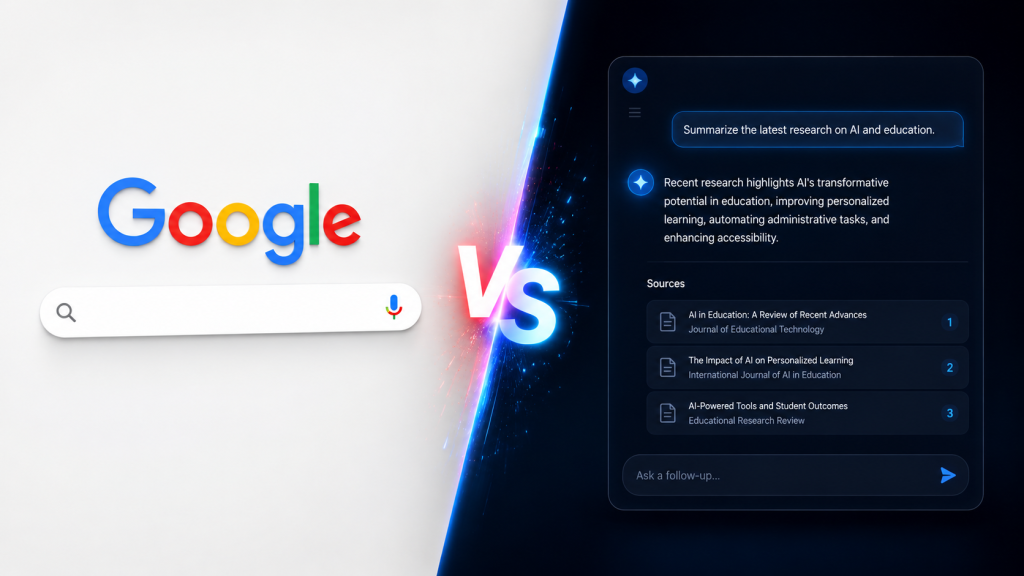
Perplexity vs Google Search 2026 is not a fair fight and that’s exactly the point.
You’ve used Google your whole life. You type something in, you get a list of links, you click around, and eventually you find what you needed. That system worked for twenty years. But something shifted in 2025 and it’s only gotten louder in 2026. A different kind of search engine showed up and it doesn’t give you links. It gives you answers. Cited answers. In plain English.
That tool is Perplexity AI. And right now, millions of Americans are asking the same question: is it time to make the switch?
This article isn’t going to hand you a vague “it depends.” By the time you’re done reading, you’ll know exactly when to use Perplexity, when to stay on Google, and whether paying for Perplexity Pro is actually worth your money.
Perplexity vs Google Search 2026: What You’re Actually Comparing
Before we get into features, you need to understand that these two tools were built for completely different jobs. Most comparison articles skip this part and jump straight to a feature list. That’s a mistake.
Google is an ecosystem. It has Maps, Shopping, YouTube, Gmail, Images, Scholar, and a search index built over two decades. When you search on Google, you’re tapping into the largest web directory ever created. Google runs what’s called a “query fan out system” your search gets split into multiple sub queries that run simultaneously across its web index, Knowledge Graph, YouTube transcripts, Shopping feeds, Maps, and more. Gemini then synthesizes all of it into a single answer.
Perplexity is an answer engine. It doesn’t try to do everything. It reads the live web in real time, pulls information from multiple sources, and delivers a direct, cited answer to your question. Perplexity provides AI generated answers with transparent citations from five or more sources, while Google combines traditional search results with AI Overviews that have less transparent attribution.
So you’re not comparing two search engines. You’re comparing a search ecosystem with a research tool. That framing changes everything.
How Each One Actually Works
How Google Works in 2026
Google in 2026 is not the Google you used in 2015. It has changed significantly and not entirely in your favor as a user.
Ads now appear in roughly 25% of AI generated search results, up almost 400% from a year ago. Google’s AI Mode the conversational search experience they’re pushing hard ends in zero clicks to external websites 93% of the time. Google is keeping you inside Google, showing you ads, and you’re clicking out to the open web less than ever.
That’s worth sitting with for a moment. Google’s business model is advertising. The longer you stay on Google without clicking to another website, the more ads you see. Its AI features aren’t designed to send you somewhere better faster. They’re designed to keep you inside the Google world.
That said, Google is still exceptional at certain things. Local search, Maps, Shopping, Images nothing comes close. If you’re looking for a restaurant nearby, comparing product prices, or pulling up directions, Google remains the undisputed leader.
How Perplexity Works in 2026
Perplexity works differently at every level. You type a question, it searches the live web in real time, reads multiple sources simultaneously, and writes you a synthesized answer with every source cited inline. You can see exactly where each piece of information came from.
Perplexity achieves between 90 and 97% accuracy on factual queries through multi-source verification, while Google’s AI Overviews carry up to a 15% error rate due to hallucinations.
Perplexity has grown from a niche AI research tool to 45 million active users with 1.2 billion projected monthly queries by mid 2026 driven by 800% year over year growth. Those numbers don’t happen by accident. People are finding it genuinely useful, not just interesting.
Perplexity vs Google Search 2026: Head-to-Head by Category
Research and Complex Questions
Perplexity wins here and it’s not close.
Picture this: you’re a grad student writing a paper on the economic impact of AI on American jobs by 2030. On Google, you get ten blue links. You open five tabs. You read four articles. You piece together your answer yourself. That process easily eats thirty minutes of your afternoon.
On Perplexity, you ask the same question in plain English. It reads fifteen sources simultaneously, synthesizes the key findings, and delivers a structured answer with every source cited so you can verify each claim. Perplexity reduces research time by up to 30% for in depth, multi source questions.
For researchers, students, and professionals who regularly need synthesized information from multiple sources, Perplexity is a real upgrade for this specific type of task.
Everyday Quick Searches
Google wins here still comfortably.
“What time does Target close?” “Weather this weekend in Chicago.” “What’s the score of the Lakers game?” These are fast, practical, local queries. Google handles them instantly. It has the infrastructure, the real time local data, and the integrations to answer them better than any AI tool available right now.
Google remains the stronger option for local search, Maps, shopping, and any task that requires deep integration with your existing Google account. (Perplexityaimagazine) That’s an honest assessment and Perplexity wouldn’t argue with it.
Accuracy and Trust
This is where things get uncomfortable for Google.
Google’s AI Overviews carry up to a 15% error rate due to hallucinations. (AIToolRanked) You may have already seen this play out. Screenshots went viral in 2024 and 2025 showing Google confidently telling users to add glue to pizza sauce or eat rocks for nutritional benefits. Those were AI hallucinations the model generating confident-sounding nonsense with zero accountability.
Perplexity’s citation system is its most important feature precisely because it builds in accountability. Every claim links back to a real, verifiable source. You can check it. You can push back on it. You’re not just trusting an invisible algorithm.
Speed of Answers
When you need an answer synthesized from multiple sources into one coherent response, Perplexity is significantly faster than Google. For complex questions, the time you save not clicking between tabs and skimming multiple articles adds up fast over a workday.
For simple, single fact answers, Google is instant. It’s been optimized for that kind of speed for over twenty years.
The Pricing Reality
Google Search
Free. That single fact shapes the entire conversation. You’re not paying with money you’re paying with your attention, your data, and your time inside Google’s advertising ecosystem. That’s a real trade off, even if most people don’t think about it that way.
Perplexity Pricing in 2026
Perplexity offers a Free plan with five Pro searches per day, a Pro plan at $20 per month or $200 per year with unlimited Pro searches and access to advanced models, and a Max plan at $200 per month designed for heavy professional usage.
Students can access Education Pro at $10 per month through verified university programs via SheerID, and it has been available for as low as $5 per month during promotional periods.
The free tier is genuinely usable for casual users. If you only need deep research a few times a day, five Pro searches might be enough to get started. But if you’re using Perplexity for serious work or academic research, the $20 Pro plan is where the tool fully opens up.
Choose Perplexity If…
You’re a student who needs to research papers, essays, or assignments quickly without managing ten open browser tabs. You’re a professional who regularly needs synthesized information from multiple credible sources. You want full transparency on where every piece of information in your answer actually came from. You’re fed up with Google trapping you in its ecosystem instead of pointing you toward the best answer on the web.
Choose Google If…
You need Maps, local business hours, or turn by turn directions. You’re shopping and want to compare prices and read product reviews. You need Images or YouTube results integrated directly into your search. You need something completely free with no daily search limits whatsoever.
The Honest Truth Most People Won’t Tell You
You don’t have to choose.
The smartest approach in 2026 is to use Perplexity for synthesis when you need a direct answer, a literature review, or a technical comparison with verified sources and keep Google for transactions: local search, Maps, shopping, and anything that requires deep integration with your Google account.
Most people who try Perplexity don’t delete Google from their lives. They add Perplexity for a specific type of work and keep Google for everything else. For simple searches, Google remains the go to. For complex or research heavy topics, Perplexity usually performs better at finding and synthesizing information hidden deeper on the web.
That hybrid approach isn’t a cop Out. It’s just practical. Two tools built for different jobs will always outperform one tool trying to do everything.
Frequently Asked Questions
Is Perplexity better than Google in 2026?
For research, complex questions, and cited answers yes. For local search, shopping, Maps, and fast everyday queries Google is still stronger. The right answer depends entirely on what you’re searching for.
Is Perplexity AI free?
Yes. There’s a free tier with five Pro searches per day. The Pro plan costs $20 per month and unlocks unlimited advanced searches. Students can access Education Pro for $10 per month.
Does Perplexity replace Google?
Not entirely and it’s not trying to. Perplexity is an answer engine built for research and synthesis. Google is a search ecosystem built for everything. Most users find both useful for different tasks.
Why does Perplexity show sources while Google often doesn’t?
Perplexity’s entire model is built around transparency every claim cites its source. Google’s AI Overviews pull from its broader index but don’t always attribute information clearly, which is a key reason its error rate is higher.
Is Perplexity Pro worth it?
If you regularly use AI for research, writing, or professional work and need more than five deep searches per day yes, Pro is worth $20 per month. If you’re a casual user, start with the free tier and upgrade when you hit the limits.
 Best AI Tools for Founders 2026 and the Mistake Most Founders Make Buying Them
  EU AI Act 2026: The Alarming $35 Million Fine Threat That Could Destroy AI Innovation Forever
  10 Best AI Note-Taking Apps for Students in 2026 That Actually Work
  How to Use Claude AI for Beginners: 7 Simple Steps to Powerful Results 2026
  Claude AI vs ChatGPT 2026: Which AI Assistant Is Actually Better?
  10 Best AI Tools for Students in 2026 (Free and Paid Options)
  SpaceX Space Data Centers: The Wildly Ambitious Plan to Build a Million AI Supercomputers in Orbit
  AI Export War 2026: China Fired Back and America’s AI Advantage Is Now Under Serious Threat
  Getty Images Signed a Deal With OpenAI The Company It Spent Years Trying to Destroy
  Claude Fable 5 Moved Behind Paywall Today