Claude AI vs ChatGPT is the comparison that millions of people are searching for right now, and for good reason. These are the two most talked about artificial intelligence assistants in the world, they are both genuinely capable, and choosing between them is not as straightforward as most comparison articles make it sound.
The honest answer is that neither one is simply better than the other. They are different tools with different strengths, and the right choice depends almost entirely on what you are actually trying to do with them. This article is going to give you that honest comparison what each tool does well, where each one falls short, and a clear recommendation based on specific use cases rather than a vague declaration of a winner.
By the end of this Claude AI vs ChatGPT breakdown you will know exactly which one deserves a place in your workflow and whether there is a case for using both.
A Quick Overview of Both Tools
Before getting into the detailed comparison it helps to understand what each tool is and where it comes from, because the company behind an AI tool shapes how that tool behaves in ways that matter for everyday use.
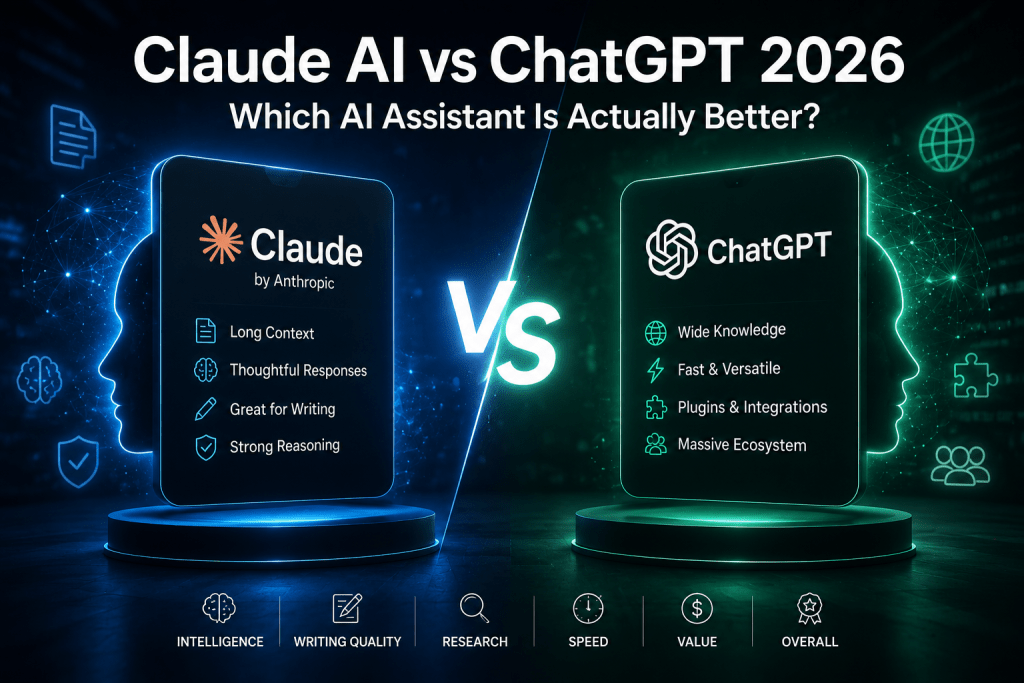
Claude AI is built by Anthropic, a company founded by former members of OpenAI who left specifically to build AI with a stronger focus on safety, honesty, and reliability. Claude is designed to be helpful without being reckless it is built to acknowledge uncertainty rather than always sounding confident, to produce careful and considered responses, and to handle language with a level of nuance that has earned it a strong reputation among writers and researchers.
ChatGPT is built by OpenAI, the company that arguably started the modern AI assistant era when it released the original ChatGPT in late 2022. OpenAI’s approach has prioritised capability and versatility building a tool that can handle the widest possible range of tasks and integrating it with a broad ecosystem of plugins, tools, and external services. ChatGPT remains the most widely used AI assistant in the world with over 900 million weekly active users.
Both tools have free tiers and paid subscription options. Both are accessed primarily through a web browser or mobile app. Both can handle a wide range of tasks involving language, research, writing, and problem solving.
The differences emerge when you look at how they handle those tasks and which ones each one handles best.
Writing Quality: Claude AI Wins
If writing quality is your primary concern and for a large proportion of people it is Claude AI has a consistent edge over ChatGPT that becomes immediately noticeable when you use both for the same task.
The difference is not dramatic on short, simple writing tasks. Ask either tool to write a two sentence email reply and both will produce something usable. The gap opens up on longer, more complex pieces blog posts, essays, reports, detailed explanations where the structure needs to hold together across many paragraphs and the writing needs to feel coherent from beginning to end.
ChatGPT’s writing is competent and often impressive, but it has a recognisable style that experienced readers have learned to identify. Sentences tend toward a certain rhythm. Transitions can feel formulaic. The output is clearly generated rather than written, in a way that requires editing before it sounds fully human.
Claude’s writing feels more natural. The sentences vary more. The structure develops rather than repeats itself. The tone adapts more smoothly to what you ask for. When you give Claude a specific voice or style to match, it does so more convincingly than ChatGPT manages with the same instruction.
For writers, content creators, bloggers, and anyone who produces written material professionally, this difference is meaningful. Less editing time, more natural output, and a final product that does not require significant work to sound like something a human wrote.
Winner: Claude AI
Research and Explanation: Claude AI Wins
For research tasks and explaining complex topics, Claude again has a noticeable advantage particularly for the kind of deep, nuanced explanation that actually builds understanding rather than just summarising surface information.
Claude explains things the way a knowledgeable person would explain them in conversation. It gives you context, uses examples, anticipates follow-up questions, and goes as deep as you need rather than stopping at a definition. If you are trying to genuinely understand something difficult a concept from economics, a principle from science, a development in technology Claude is more likely to leave you actually understanding it rather than just having read about it.
ChatGPT explains things competently but tends toward breadth over depth. It covers the main points clearly but often does not go far enough into the underlying logic to build real understanding. For quick fact-finding and surface-level research it works well. For genuinely understanding something complicated it often falls short of what Claude delivers.
The one area where ChatGPT has a research advantage is real-time information. ChatGPT has more developed web browsing capabilities and integrations that allow it to pull current information from the web more reliably in certain configurations. Claude’s knowledge has a cutoff date, and while it also has web search capabilities, ChatGPT’s ecosystem for accessing current information is more mature.
For timeless research understanding concepts, analysing information, synthesising complex material Claude wins. For very current information and news, ChatGPT has an edge.
Winner: Claude AI for depth, ChatGPT for current information
Document Analysis: Claude AI Wins Clearly
This is one of the clearest advantages Claude has and one of the most practically useful for people who work with large amounts of written material.
Claude handles long documents exceptionally well. You can give it a lengthy research paper, a detailed contract, a comprehensive report, or a set of meeting notes and ask specific questions about the content. Claude reads the whole thing, maintains coherence across the full document, and gives you accurate, specific answers based on what is actually in the material.
ChatGPT handles documents but less reliably on very long inputs. It can lose the thread in lengthy documents, miss details from earlier sections, or produce summaries that are too general to be genuinely useful. For shorter documents the difference is small. For longer, more complex documents the gap is significant.
For anyone who regularly works with dense written material researchers, analysts, lawyers, business professionals, students working with academic papers Claude’s document analysis capability is one of the strongest practical arguments for choosing it over ChatGPT.
Winner: Claude AI
Coding Assistance: Closer Than You’d Think
Both tools are capable coding assistants and the gap between them is narrower here than in writing or research.
ChatGPT has historically been considered the stronger coding tool and it maintains advantages in certain areas. Its Code Interpreter feature which can actually run code, analyse data, and produce charts is a genuine capability that Claude does not match in the same integrated way. For data analysis tasks involving code execution, ChatGPT’s ability to run the code it writes and show you the output is a meaningful practical advantage.
Claude is strong at explaining code, writing clean readable scripts, debugging, and walking you through technical problems in plain language. Where Claude particularly shines is in explaining what code does and why which is valuable for beginners learning to code or for non-developers who need to understand a technical system without becoming programmers themselves.
For professional developers who need to run code and analyse data within the AI interface, ChatGPT has an edge. For beginners learning to code, for non-developers who need coding help occasionally, and for anyone who wants thorough explanations alongside the code itself, Claude is competitive and in some cases better.
Winner: ChatGPT for execution, Claude for explanation
Versatility and Integrations: ChatGPT Wins
This is where ChatGPT pulls ahead most clearly. The ecosystem built around ChatGPT plugins, integrations, custom GPTs, API accessibility, third party tools is significantly more developed than what is available for Claude.
You can connect ChatGPT to Zapier, to your calendar, to project management tools, to e-commerce platforms, to dozens of services that extend what it can do beyond the core conversation interface. Custom GPTs allow users to create specialised versions of ChatGPT trained on specific information for specific purposes.
Claude is more focused on doing the core thing intelligent conversation, writing, research, analysis exceptionally well, and has a less developed ecosystem of integrations and extensions around it. For users who want a single AI tool that connects deeply into their existing workflow and tools, ChatGPT’s ecosystem advantage is real and practically significant.
Winner: ChatGPT
Honesty and Reliability: Claude AI Wins
This is an underappreciated difference that matters more than it might initially seem.
Claude is specifically designed to acknowledge uncertainty. When it does not know something, or when it is not confident in an answer, it says so. When it makes a mistake and you point it out, it engages with the correction thoughtfully rather than defensively. This design philosophy building an AI that is honest about its limitations comes directly from Anthropic’s focus on safety and reliability.
ChatGPT can be overconfident. It sometimes presents uncertain or incorrect information with the same confident tone it uses for things it knows well, which makes it harder to calibrate how much to trust any particular response. This tendency toward confident-sounding answers regardless of actual certainty is one of the most commonly cited frustrations among experienced ChatGPT users.
For anyone using AI output for anything consequential research that informs decisions, professional work, learning where accuracy matters Claude’s built-in epistemic honesty is a genuine practical advantage. You can calibrate your trust more accurately because Claude signals its own uncertainty rather than hiding it.
Winner: Claude AI
Pricing: Both Offer Free Tiers
Both Claude AI and ChatGPT offer free tiers that provide genuine access to their core capabilities. Neither is a watered-down preview both free versions are usable for real work, though both have usage limits that heavy users will eventually encounter.
Paid plans for both services offer higher usage limits, access to the most advanced models, and additional features. Pricing is comparable between the two and both companies update their plans regularly, so checking each company’s website directly for current pricing is the most reliable approach.
For beginners and casual users, both free tiers are sufficient to get real value and to determine whether the tool fits your workflow before spending anything.
Who Should Use Claude AI
Claude AI is the stronger choice if your primary use cases involve writing, research, document analysis, and learning. If you produce written content professionally, study or work with large amounts of written material, or want an AI assistant that explains things with genuine depth and honesty, Claude is the better fit.
It is also the better choice for anyone who values output they can trust Claude’s tendency to acknowledge uncertainty rather than always sounding confident means you can calibrate how much to rely on its answers more accurately than with tools that always project the same level of confidence.
Students, writers, researchers, content creators, and professionals who work primarily with language and information will generally find Claude more useful for their specific needs.
Who Should Use ChatGPT
ChatGPT is the stronger choice if versatility and integrations matter to you. If you want an AI tool that connects into your existing workflow through plugins and third-party integrations, if you need to run code and analyse data within the AI interface, or if you work across a very wide range of tasks and want one tool that handles all of them competently, ChatGPT’s broader ecosystem is a genuine advantage.
It is also the better starting point for absolute beginners simply because of its familiarity more tutorials, more community support, more examples of how to use it exist for ChatGPT than for any other AI tool. If you are completely new to AI assistants and want the most resources to help you learn, ChatGPT’s larger user base is an advantage.
Should You Use Both
Honestly, yes if you are a regular AI user, using both makes sense and is not as complicated as it sounds.
Many experienced users settle into a pattern where Claude handles writing, research, and document analysis while ChatGPT handles tasks that benefit from its integrations and code execution capabilities. Both have free tiers, so there is no cost barrier to experimenting with both and developing a sense of which one serves which part of your workflow better.
The comparison is less about which tool is objectively superior and more about which one is better suited to what you specifically do. Understanding that distinction is the most useful thing this article can leave you with.
Claude AI vs ChatGPT: Quick Comparison Summary
Writing Quality — Claude AI
Research and Explanation — Claude AI
Document Analysis — Claude AI
Coding Assistance — Draw, ChatGPT for execution
Versatility and Integrations — ChatGPT
Honesty and Reliability — Claude AI
Pricing — Draw
Best for Beginners — ChatGPT for familiarity, Claude for quality
Frequently Asked Questions
Is Claude AI better than ChatGPT?
For writing, research, and document analysis, Claude AI generally produces better results. For versatility, integrations, and code execution, ChatGPT has advantages. The better tool depends on what you are actually trying to do.
Which is more accurate, Claude or ChatGPT?
Claude tends to be more reliable about acknowledging uncertainty, which makes it easier to calibrate trust in its responses. ChatGPT can be overconfident, presenting uncertain information with the same tone as things it knows well.
Can I use Claude AI and ChatGPT together?
Yes, and many experienced users do. Both have free tiers, so there is no barrier to using both and developing a sense of which one handles different tasks better for your specific workflow.
Which is better for students?
Claude AI is generally stronger for the tasks students most need help with — understanding difficult concepts, writing essays, analysing research papers, and explaining complex material in depth.
Which is better for coding?
ChatGPT has an advantage for running code and data analysis within the interface. Claude is stronger for explaining code and helping non-developers understand technical systems.
Is Claude AI free?
Yes, Claude AI has a free tier that provides genuine access to its core capabilities. Paid plans are available for higher usage limits and access to the most advanced models.
Which AI assistant is most popular?
ChatGPT remains the most widely used AI assistant globally with over 900 million weekly active users. Claude has been growing rapidly and has developed a strong reputation particularly among writers and professionals.
Final Thoughts
The Claude AI vs ChatGPT debate does not have a single correct answer, and any article that tells you otherwise is oversimplifying. Both are genuinely capable tools that are improving rapidly. Both have meaningful strengths. Both have real limitations.
What this comparison should give you is a clear enough picture of those strengths and limitations to make a sensible decision based on your actual needs rather than general reputation or marketing.
If you write, research, or work with documents and want the highest quality output with the most honest responses, Claude AI is where you should start. If you need deep integrations, code execution, or the broadest possible ecosystem of tools around your AI assistant, ChatGPT deserves serious consideration.
And if you are not sure try both. The free tiers exist precisely for that purpose, and the hour you spend experimenting will tell you more than any comparison article can.
 EU AI Act 2026: The Alarming $35 Million Fine Threat That Could Destroy AI Innovation Forever
  10 Best AI Note-Taking Apps for Students in 2026 That Actually Work
  How to Use Claude AI for Beginners: 7 Simple Steps to Powerful Results 2026
  10 Best AI Tools for Students in 2026 (Free and Paid Options)
  10 Best Free AI Tools for Beginners in 2026
  Microsoft AI Coding Tools 2026: The Uncomfortable Truth Developers Are Just Finding Out
  AI Jobs at Risk by 2030: The Honest Truth Nobody Is Telling You
  Grok AI Review 2026: Is Grok The Most Underrated AI Assistant Right Now?
  Claude Fable 5 vs ChatGPT 2026: The Battle Forcing Millions to Finally Ditch One AI for the Other