Paris based Mistral AI unveiled its first robotics model on July 8, marking Europe’s leading AI startup’s formal entry into what the industry has started calling “physical AI” AI systems built to perceive and act in the real world rather than just generate text. The move follows deals with major European industrial customers including Airbus and BMW, and it lands squarely inside a broader shift that Nvidia has spent much of 2026 pushing from the infrastructure side, arguing at its own developer conferences that robotics is having its own version of the ChatGPT breakthrough. Two very different companies, working from two very different starting points, are converging on the same wager: that the next major AI market isn’t chatbots or coding assistants, but machines that can move and act reliably in physical space.
What Robostral Navigate Does
Mistral’s new model, called Robostral Navigate, is deliberately narrow in scope. It lets robots navigate complex environments using a single RGB camera and basic language prompts, and Mistral says it was trained entirely through simulation. The model is hardware-agnostic, meaning it can be deployed across any robot fleet regardless of manufacturer, and it’s built specifically for navigation rather than object handling or manipulation. On the R2R-CE benchmark, an industry-standard test for how well robots follow instructions in unfamiliar settings, Mistral says the model achieved a 76.6% success rate on unseen environments, outperforming the previous best single camera approach by close to 10 points.
The launch follows Mistral’s acquisition of Austria’s Emmi AI in May, and CEO Arthur Mensch tied the release directly to the company’s broader European strategy, saying scaling infrastructure in Europe is critical to keep AI innovation and autonomy at the continent’s core. Mistral is actively expanding its robotics team, recruiting research scientists and engineers as it builds out a category the company had no presence in as recently as this spring.
Skipping LiDAR Is the Interesting Part
The more consequential detail here isn’t the benchmark score. It’s the sensor choice. Most robotics navigation systems lean on more expensive hardware setups, including depth sensors, LiDAR, and multiple cameras working together, and Mistral is explicitly betting that navigation doesn’t require that much sensing hardware to work reliably. If a single ordinary camera can do the job a LiDAR array used to do, the cost and integration overhead of standing up a robot fleet drops substantially, and pilot programs stop being about acquiring exotic hardware and start being about whether a given workflow is repeatable and safe enough to automate first.
That reframing matters because navigation, unglamorous as it sounds next to dexterous manipulation or humanoid mobility, is often the actual bottleneck standing between a robotics demo and a working warehouse or factory deployment. A model that narrows the gap between AI software and physical operations by removing hardware complexity is solving a more practical problem than one chasing a general purpose robot brain, even if it’s a less headline grabbing one.
Nvidia’s Bigger Bet on the Same Trend
Nvidia has been building the infrastructure case for physical AI all year, and its framing has been considerably more sweeping than Mistral’s. At its March GTC conference, Nvidia unveiled Cosmos 3.0, described as the first world foundation model unifying synthetic world generation, vision reasoning, and action simulation, alongside new Isaac GR00T models built specifically for humanoid robots. CEO Jensen Huang put the company’s ambitions in blunt terms: “The ChatGPT moment for robotics is here.” Nvidia’s argument is structural rather than product specific that its full stack of processors, simulation software, and open models gives partners across every category of robotics, from industrial arms to humanoids, the foundation they need to move from single task machines to what the company calls generalist-specialist systems.
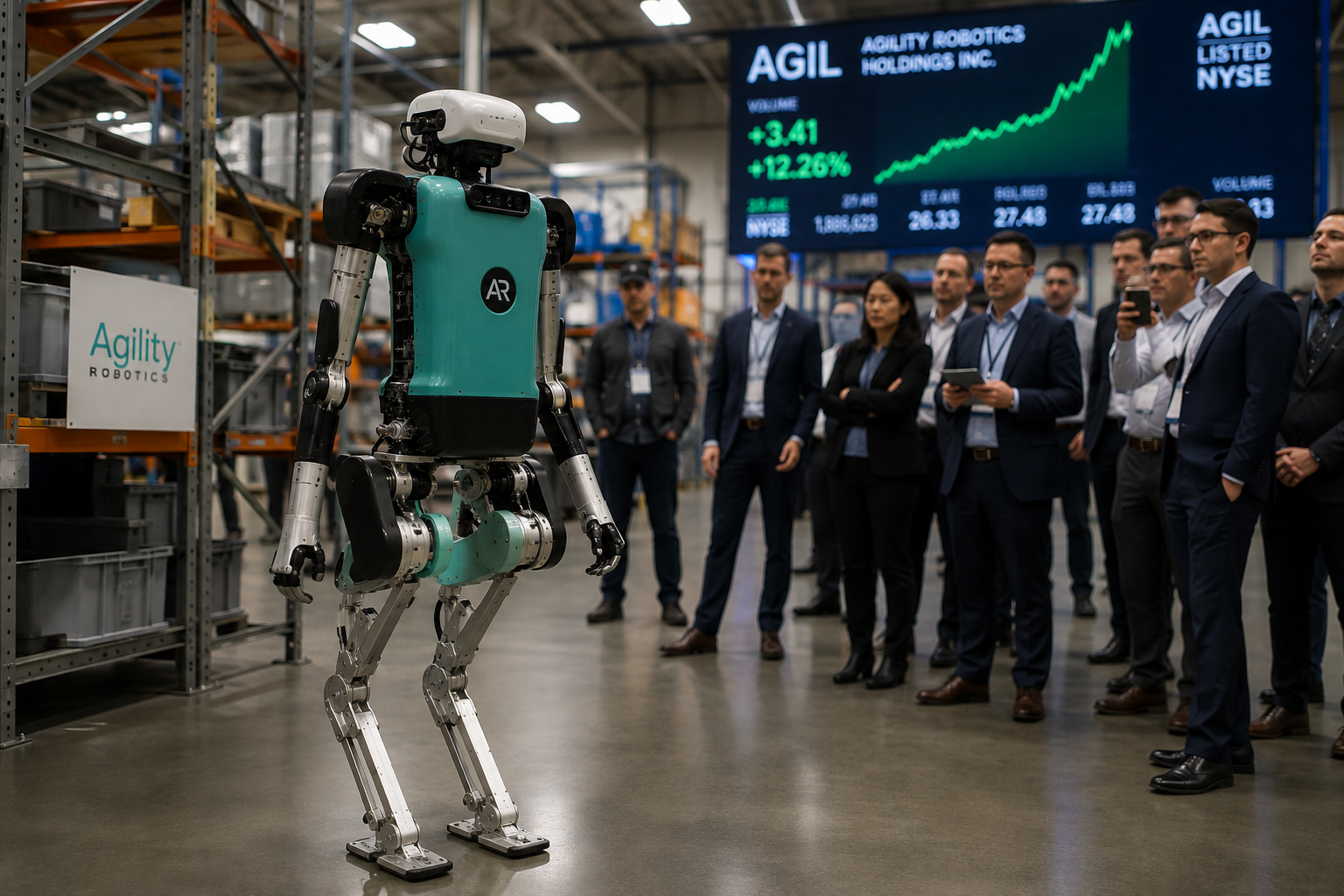
The partner list backing that pitch is broad by design, spanning industrial robotics giants like ABB, FANUC, and KUKA, humanoid developers including Figure and Agility, and even surgical robotics firms like CMR Surgical and Medtronic. Nvidia has also targeted the deeper problem underlying all of this: a shortage of quality training data for physical tasks, the kind that language models never had to worry about because humans had already generated decades of text to train on. Its Physical AI Data Factory Blueprint, announced at GTC, is aimed directly at that gap, giving developers tools to generate and curate real and simulated robot data at scale.
Two Different Bets on the Same Shift
Mistral and Nvidia are approaching the same underlying trend from opposite directions, and the contrast is worth sitting with. Mistral is shipping a narrow, single-purpose model aimed at one hard problem, navigation, with an explicit cost and simplicity argument attached. Nvidia is building the infrastructure layer meant to underpin dozens of different robotics categories at once, from warehouse logistics to humanoid dexterity to surgical precision, betting that owning the simulation, compute, and foundation-model stack matters more than any single application.
Neither approach obviously wins over the other, and that’s arguably the more interesting signal than either announcement individually. When a narrow European challenger and the dominant infrastructure incumbent are both allocating serious resources to physical AI in the same season, without directly competing for the same customers, it suggests the category has moved past the experimental phase where only one kind of bet makes sense.
Beyond the Announcements
The practical implication for anyone running a factory, warehouse, or logistics operation is that physical AI is no longer a single monolithic technology to evaluate. It’s becoming a stack, with different vendors solving different layers of the same underlying problem Mistral tackling navigation cheaply, Nvidia tackling simulation and generalist robot reasoning at scale, and companies like Boston Dynamics and Figure building the physical hardware those models eventually run on. That stratification mirrors how the broader AI industry organized itself around chips, models, and applications, and it suggests physical AI is now following a similar maturation curve, just a few years behind.
The Bottom Line
What makes this week’s Mistral launch worth tracking isn’t the benchmark number or even the Airbus and BMW deals behind it. It’s that a European AI lab with no prior robotics footprint chose to enter the category now, with a product narrow enough to ship, at the same moment Nvidia has spent the better part of a year building the infrastructure it hopes every robotics company will eventually run on. Physical AI’s “ChatGPT moment,” as Huang has repeatedly framed it, hasn’t arrived in the form of one breakthrough product. It’s arriving as a stack of increasingly specific, increasingly shippable pieces, and whether that stack actually reaches factory floors at scale will depend less on any single announcement than on whether models like Robostral Navigate hold up outside their own benchmarks, in warehouses and plants that were never built with robots in mind.


Leave a Reply