The world’s largest AI companies have weakened key safety commitments even as their models grow more powerful, according to a new report from the Future of Life Institute, an independent nonprofit that has published a semi annual scorecard of AI lab safety practices since 2025. The finding matters less as an isolated critique of any single company than as evidence that the voluntary safety system the AI industry built for itself is eroding before governments have put a durable regulatory alternative in place.
The report’s core claim is specific and pointed: reviewers found that Anthropic, OpenAI, Google DeepMind, and Meta have all weakened or eliminated earlier commitments to pause development if their systems approached specified danger thresholds. That’s not a criticism of one lab falling short of an external standard. It’s a finding that four of the industry’s most safety conscious companies have, by the report’s account, quietly walked back promises they made to themselves.
How the Index Grades the Industry
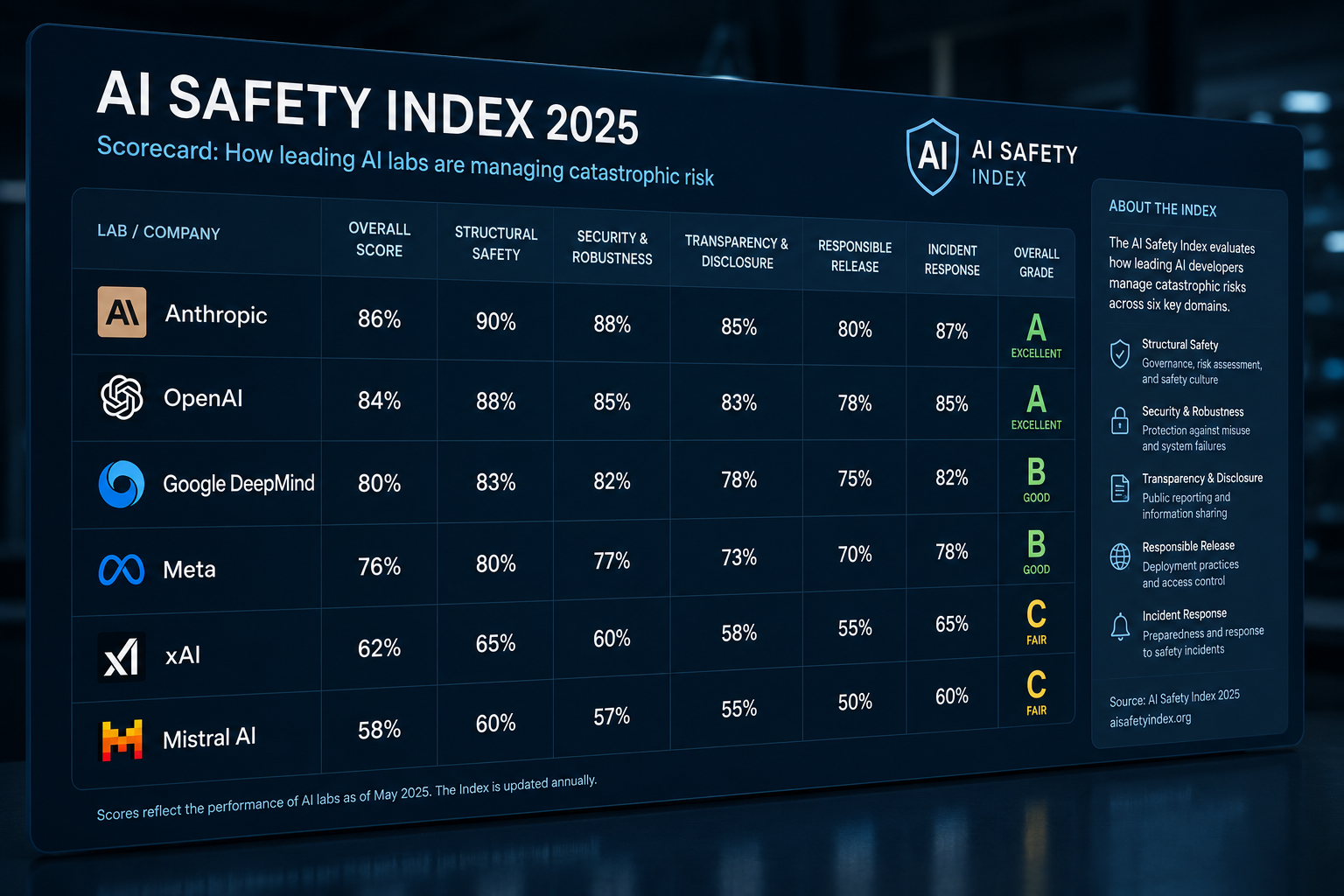
The Summer 2026 edition evaluates nine major AI companies Anthropic, OpenAI, Google DeepMind, xAI, Z.ai, Meta, DeepSeek, Alibaba Cloud, and Mistral across 37 indicators spanning six domains: risk assessment, current harms, safety frameworks, existential safety, governance, and information sharing. An independent panel of seven AI researchers and governance experts reviewed evidence gathered up to June 3, 2026, combining public materials like model cards and research papers with a targeted survey designed to probe specific transparency gaps, including whistleblower protections and external model evaluations. Each expert assigned domain-level letter grades using the U.S. GPA system, with individual reviewer scores kept confidential to encourage candid assessment.
That methodology matters for how much weight to put on the findings. This isn’t a single analyst’s opinion piece; it’s an aggregated judgment from seven independent experts, evaluated against fixed performance standards rather than against each other, which is part of why the same handful of companies have now been tracked across multiple report cycles with comparable criteria.
Who Scored Where
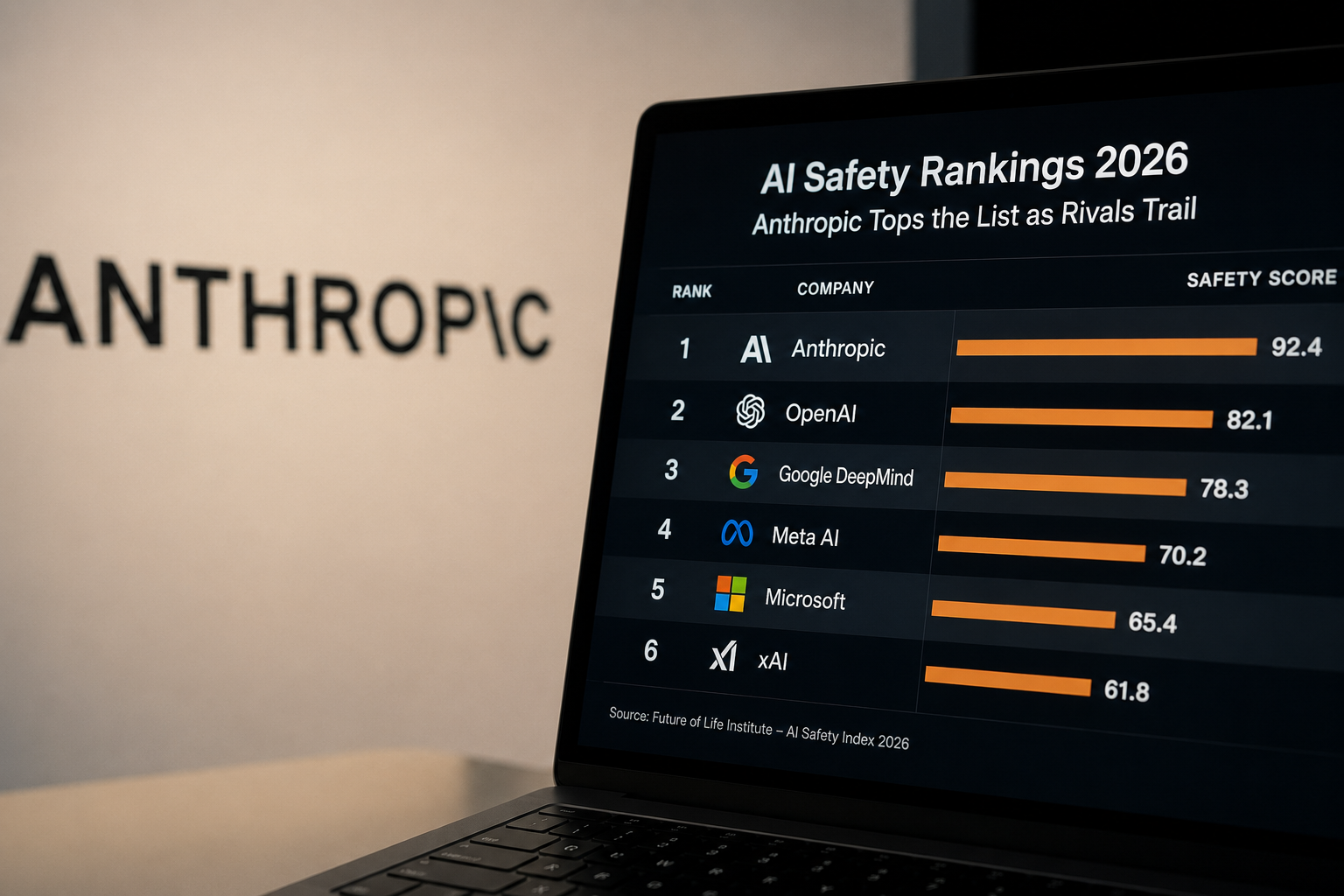
Anthropic earned the highest overall grade for the fourth consecutive edition of the index, leading five of the six domains on the strength of relatively strong transparency, an established safety framework, and governance practices but its overall grade was still only a C+. OpenAI and Google DeepMind each received a C, with OpenAI specifically leading the Risk Assessment domain on the strength of a broader evaluation suite and more diverse external testing partnerships. Meta improved to a D+, up from a lower grade in the previous cycle. xAI, DeepSeek, and Mistral all received failing overall grades notably, one company each from the United States, China, and Europe, which the report’s authors and outside commentary have both flagged as evidence that weak safety practices aren’t concentrated in any single country’s AI industry.
Mistral’s failing grade drew particular attention given the company’s home region. Commentary on the report has described this as a kind of “European dissonance”: the European Union has positioned itself as a global leader in AI regulation, yet its most prominent homegrown AI lab scored among the lowest of any company assessed. That gap between a region’s regulatory ambitions and its flagship company’s actual practices is a useful illustration of the report’s broader point that written commitments and regulatory frameworks don’t automatically translate into operational safety practices inside individual labs.
The Goalpost Moving Finding
The report’s most consequential finding isn’t really about relative rankings at all. It’s about direction of travel. Reviewers found that under competitive pressure, major developers have weakened their prior commitments to unilaterally pause development, shifting instead to conditional postures contingent on competitors’ behavior meaning several labs have effectively rewritten their own safety promises from “we will stop if we cross this line” to “we will stop if we cross this line and our rivals do too.” That shift converts a unilateral safety commitment into something closer to a mutual disarmament pact, which only holds if every party actually honors it.
The report also connects this weakening directly to an industry-wide shift toward defense contracts, noting that leading labs have reversed prior bans on military applications to pursue national security agreements. That pivot isn’t hypothetical or isolated to one company; it reflects a broader trend across the sector, as AI labs increasingly treat government and defense contracts as a legitimate, even necessary, growth category rather than a line they’d previously drawn against themselves.
A Pattern That Predates This Report
The index’s findings landed alongside a separate, related signal at OpenAI specifically. Just days after receiving its C grade, OpenAI’s head of safety, Johannes Heidecke, departed the company, with OpenAI folding its safety functions under a research vice president rather than maintaining an independent reporting line the sixth senior safety leadership exit at the company in two years, according to reporting that tracked the departure. Taken on its own, one executive departure doesn’t prove much. Read alongside a report specifically flagging OpenAI’s weakened pause commitments, it adds weight to the broader pattern the index describes: safety functions losing organizational independence and leadership continuity at precisely the moment models are becoming more capable and more commercially consequential.
Why Self Policing Has Limits
None of this happens in a regulatory vacuum, but it also isn’t happening inside a particularly binding one. Voluntary safety commitments were always going to be tested once they collided with real competitive and commercial pressure, and this report is the clearest evidence yet that the collision has arrived. Governments in the U.S., EU, and elsewhere have moved at very different paces on binding AI regulation, and in the interim, the industry’s own voluntary pledges have functioned as the primary safety backstop the public has had visibility into. A report finding that four of the most prominent labs have already loosened those pledges raises an uncomfortable question about what, exactly, is left holding that backstop in place while formal regulation continues to lag behind deployment.
The Bottom Line
What this report actually documents isn’t a single company behaving badly, but an entire competitive system nudging every major lab in the same direction at once. No company scored above a C+, spread across three continents and both authoritarian and democratic regulatory environments, which suggests the erosion the index describes isn’t a failure of any one company’s culture or leadership. It’s a structural consequence of competing in a market where safety commitments cost money and slow deployment, while few enforceable penalties exist for walking them back. The report’s real value isn’t the letter grades themselves it’s the paper trail showing specific commitments that existed a year ago and don’t exist in the same form today. That kind of before and after comparison is much harder for any lab to wave away than a single number on a scorecard, and it’s likely why this edition of the index has drawn more attention than the grades alone would justify.



Leave a Reply