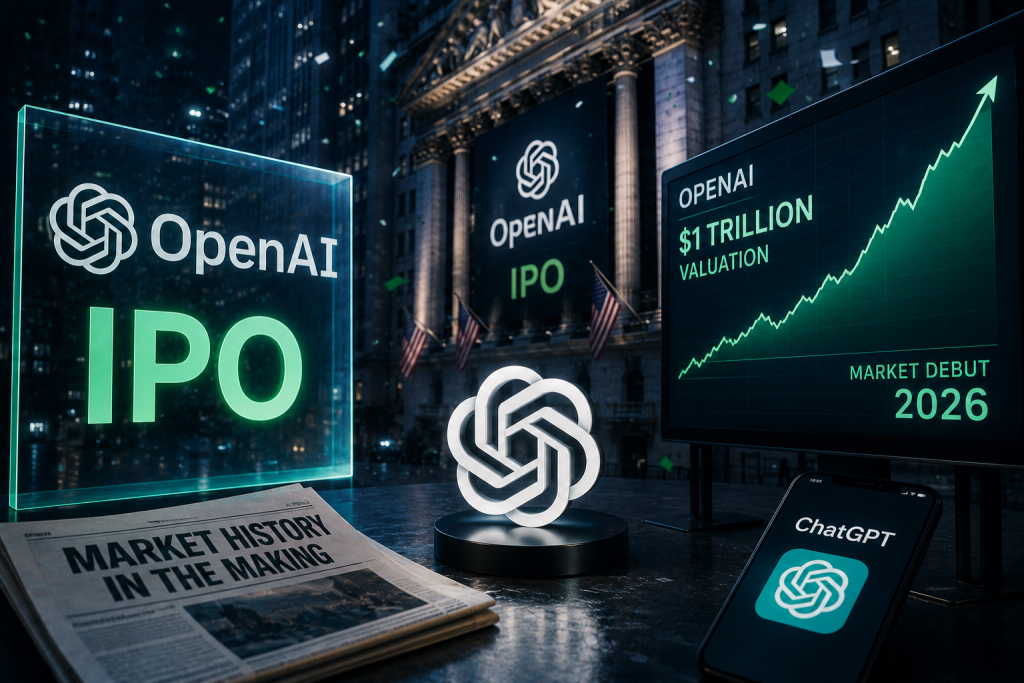
OpenAI IPO 2026 is coming and when it arrives it will be one of the most consequential moments in the history of technology investing, artificial intelligence, and the relationship between Silicon Valley and Wall Street.
On June 8 2026, OpenAI publicly confirmed what had been rumoured for months the company behind ChatGPT, the artificial intelligence assistant used by over 900 million people every week, has filed confidentially with the US Securities and Exchange Commission for an initial public offering. The filing was made quietly. The implications are anything but.
This is the company that started the modern AI revolution when it released ChatGPT in November 2022 and watched it become the fastest growing consumer application in history. The company that turned artificial intelligence from a research curiosity into a mainstream technology that hundreds of millions of people use before breakfast. The company that triggered a race among every major technology corporation on earth to catch up with what it had built.
Now it wants to go public. And the numbers involved are extraordinary enough that even people who have been following the AI industry closely are doing double takes.
What Is OpenAI and How Did It Get Here
OpenAI was founded in 2015 as a non-profit artificial intelligence research laboratory with a stated mission of ensuring that artificial general intelligence benefits all of humanity. The founding team included Sam Altman, Elon Musk, Greg Brockman, and several prominent AI researchers who shared a belief that the development of advanced AI was too important to be left entirely to profit-driven corporations.
That non-profit origin story has since become one of the most complicated chapters in modern technology history. The organisation restructured into a capped-profit company to attract the investment needed to compete at the frontier of AI development. Microsoft invested billions and became a major stakeholder. The relationship between the original mission and the commercial reality of running one of the most resource intensive technology companies in the world created tensions that played out very publicly including the brief firing and reinstatement of Sam Altman as CEO in late 2023, one of the most dramatic corporate governance episodes Silicon Valley has ever produced.
By 2026 OpenAI has completed a further restructuring into a public benefit corporation, raised over $40 billion in total funding, and achieved annualised revenue of over $20 billion up from $6 billion just two years earlier. The transformation from research lab to commercial AI powerhouse is complete. The IPO is the next logical step in that transformation.
The Numbers Behind the OpenAI IPO
The financial picture behind the OpenAI IPO is simultaneously impressive and complicated which is exactly what you would expect from a company that has grown faster than almost any in history while spending at a pace that matches its ambitions.
OpenAI’s annualised revenue passed $20 billion in early 2026 according to CFO Sarah Friar a figure that represents the fastest revenue growth ever recorded for a company of this scale. The primary drivers are ChatGPT subscriptions from individual users, enterprise API licensing to businesses building products on OpenAI’s models, and a growing suite of enterprise solutions aimed at large organisations deploying AI across their operations.
The valuation being discussed for the IPO sits around $300 billion based on the most recent private funding round though some analyst models project a public market valuation significantly higher depending on how investors price the company’s growth trajectory and strategic positioning. For context OpenAI’s most recent private valuation was $157 billion in late 2024. The trajectory since then has been steep.
Claude Fable 5: Anthropic’s Most Powerful Public AI Model Is Here
The complexity is on the cost side. OpenAI spends at a scale that matches its revenue ambitions. Computing infrastructure, model training, research and development, and the talent required to compete at the frontier of AI all come with price tags that make even $20 billion in annual revenue look modest against the investment required to maintain a leading position. The company has been burning cash while growing revenue simultaneously a pattern familiar from other technology companies that scaled aggressively before optimising for profitability.
The IPO proceeds would give OpenAI access to public capital markets to fund the next phase of infrastructure investment particularly the data center buildout and computing capacity required to train and run increasingly capable models.
Sam Altman and the Leadership Question
No discussion of the OpenAI IPO is complete without addressing the Sam Altman question because Altman is simultaneously OpenAI’s greatest asset and one of the most discussed risk factors in its public market story.
Altman has been the public face of the AI revolution in a way that few technology executives ever become the public face of their industry. His Congressional testimony, his media presence, his product announcements, and his vision for where AI is heading have shaped public understanding of the technology in ways that are inseparable from OpenAI’s brand. For many people OpenAI and Sam Altman are effectively synonymous.
That concentration of identity around a single individual is a genuine risk factor for public market investors as Tesla investors know very well from their experience with Elon Musk. When a company’s valuation is partly a bet on a specific person’s continued vision and leadership, events that affect that person affect the stock. The 2023 governance crisis when the OpenAI board briefly fired Altman before reversing course under pressure from employees and Microsoft demonstrated exactly how fragile that concentration can be.
Altman himself has indicated that the IPO timeline may be longer than the most optimistic external predictions. While the confidential S-1 filing signals serious intent, he has suggested the actual public debut may not happen immediately with the December 2026 window carrying approximately 69 percent probability according to prediction market pricing. The more likely scenario based on current signals is a 2027 debut, with the 2026 filing serving as preparation and regulatory groundwork rather than imminent listing.
OpenAI vs Anthropic — Two Very Different IPO Stories
The OpenAI IPO is happening in parallel with Anthropic’s own IPO preparations and comparing the two reveals important differences in how each company has positioned itself for public markets.
Anthropic filed its confidential S-1 in early June 2026 and is tracking toward a potential debut later this year at a valuation approaching one trillion dollars a figure that reflects revenue growth from $10 billion to $47 billion in five months and strong enterprise adoption driven by Claude Code and the broader Claude platform.
The revenue trajectories tell different stories. Anthropic’s growth rate has been more recent and more explosive the company effectively quintupled its revenue in less than half a year. OpenAI’s revenue is larger in absolute terms but growing from a bigger base at a somewhat slower rate. Both companies are losing money on an operating basis as they invest in infrastructure and research but the scale of investment required and the path to profitability look different between the two.
Anthropic IPO 2026: The Shocking Truth Behind Claude AI’s Nearly $1 Trillion Valuation
The safety positioning also differs in ways that matter for regulatory risk particularly given the EU AI Act taking effect on August 2 2026. Anthropic has built its entire identity around safety-first AI development, which positions it relatively well for regulatory compliance. OpenAI has made significant safety investments but its public positioning has been more mixed balancing commercial ambition with safety commitments in ways that have sometimes generated controversy.
For investors evaluating both companies the comparison raises a genuinely interesting question about which approach to AI development creates more durable enterprise value in a world where AI regulation is becoming a real operational consideration rather than a theoretical future concern.
What the OpenAI IPO Means for ChatGPT Users
For the hundreds of millions of people who use ChatGPT regularly the OpenAI IPO has practical implications that are worth understanding clearly.
Going public means going from private investor accountability to public shareholder accountability and those two types of accountability feel very different from the inside of a company. Private investors in OpenAI have been willing to fund losses in pursuit of growth and mission. Public shareholders will eventually want to see a path to profitability that does not depend entirely on continued revenue growth at current rates.
That pressure toward profitability will shape decisions about ChatGPT pricing, feature availability, and the balance between the free tier experience and paid subscription offerings. The free tier that makes ChatGPT accessible to hundreds of millions of users exists partly because OpenAI has been generously funded by private investors willing to accept losses in pursuit of scale. A public company has quarterly reporting obligations and shareholders who will scrutinise every dollar spent on free access against the revenue it generates.
This does not mean the free tier disappears immediately or even soon. But it does mean the economics of access will be under more scrutiny after the IPO than before it and users who rely on free access should understand that the financial structure supporting it is changing.
For enterprise users the IPO may actually improve the experience public companies have stronger incentives to invest in enterprise reliability, security, compliance, and support than private companies whose primary accountability is to a small group of investors. The discipline of public market accountability tends to improve operational standards in ways that enterprise customers benefit from.
Claude AI vs ChatGPT 2026: Which AI Assistant Is Actually Better?
The Microsoft Relationship — The IPO’s Most Complicated Factor
Any serious analysis of the OpenAI IPO has to address the Microsoft relationship because it is the most significant complicating factor in the company’s path to public markets.
Microsoft invested approximately $13 billion in OpenAI across several rounds and currently holds a roughly 49 percent revenue share arrangement that gives it priority access to OpenAI’s models through Azure. That arrangement has been enormously valuable to Microsoft Azure’s AI growth has been substantially driven by OpenAI model access and enormously valuable to OpenAI in providing computing infrastructure and enterprise distribution.
But the arrangement also creates structural complexity for the IPO. Public market investors buying OpenAI shares will be investing in a company that shares nearly half its revenue with a single strategic partner. The terms of that arrangement, how it evolves post-IPO, and what happens when Microsoft’s interests and OpenAI’s public shareholder interests diverge these are questions that will need clear answers in the S-1 prospectus before institutional investors commit at scale.
The relationship is being renegotiated as part of OpenAI’s corporate restructuring and IPO preparation. How that renegotiation concludes will significantly affect how investors value the company in public markets because the revenue share structure as currently reported implies a very different economic picture than a company retaining its full revenue would present.
The AI IPO Wave — What Three Listings Mean for the Industry
The near-simultaneous movement of SpaceX, Anthropic, and OpenAI toward public markets is not coincidental. It reflects a structural shift in how the AI industry is financing itself and a recognition that the scale of investment required for the next phase of AI development exceeds what private markets can comfortably supply.
Training frontier AI models, building the data center infrastructure to run them, and maintaining the research talent required to stay competitive all require capital at a scale that makes even the largest venture capital rounds look modest. Public markets offer access to capital that private funding simply cannot match at the required scale.
The timing also reflects a window of opportunity. AI company valuations have been rising rapidly and investor appetite for AI exposure is strong. Going public during a period of enthusiasm and high valuations is rationally preferable to waiting for conditions that may be less favourable. All three companies appear to be making the same calculation the window is open and the cost of waiting is real.
For the broader technology industry the AI IPO wave signals the maturation of artificial intelligence from a research frontier into an established commercial sector with the financial infrastructure of a major industry. The companies going public are not startups with promising technology. They are revenue-generating businesses with enterprise customer bases, established products used by hundreds of millions of people, and competitive moats built on years of investment and development.
That maturation has implications for how AI develops from here. Public companies face accountability structures, regulatory scrutiny, and operational disciplines that private companies can avoid. The AI industry is about to become significantly more visible, more accountable, and more subject to the normal forces that shape how public companies behave.
What Happens Next
The immediate next step for OpenAI is completing the SEC review process for its confidential filing and deciding on timing for the public prospectus. The December 2026 window appears most likely based on current signals though market conditions between now and then will influence the final decision significantly.
Between the filing and the actual listing OpenAI will need to resolve the Microsoft revenue share renegotiation, demonstrate continued revenue growth to support its target valuation, navigate the EU AI Act compliance requirements that take effect in August, and maintain the operational stability that enterprise customers require.
The company will also need to address the governance questions that the 2023 board crisis raised particularly around what protections exist for the safety mission in a public company structure where shareholder value is a legal obligation.
SpaceX IPO 2026: The Risky $1.77 Trillion Gamble That Could Make Musk the First Trillionaire
All of these are solvable problems for a company with OpenAI’s resources and talent. But they are genuinely complex problems that will shape what the company looks like when it eventually reaches public markets — and what investors are actually buying when they purchase shares.
Frequently Asked Questions
When is the OpenAI IPO happening?
OpenAI filed confidentially with the SEC on June 8 2026 signalling serious IPO intent. The actual listing is most likely in December 2026 or potentially 2027 Sam Altman has indicated the timeline may be longer than external predictions suggest. Prediction markets currently price a December 2026 debut at approximately 69 percent probability.
What is OpenAI’s valuation for the IPO?
OpenAI’s most recent private valuation was approximately $300 billion. Public market analysts project a range depending on how investors price the growth trajectory some models suggest significantly higher valuations at listing.
How does OpenAI’s IPO compare to Anthropic’s?
Anthropic is tracking toward a near-term debut at close to a trillion dollar valuation driven by explosive recent revenue growth. OpenAI has larger absolute revenue but is growing from a bigger base. Both companies are investing heavily and operating at a loss. The safety positioning and regulatory risk profile differs between the two.
What does the OpenAI IPO mean for ChatGPT users?
Public market accountability will eventually create pressure toward profitability that affects pricing and free tier economics. Enterprise users may benefit from improved operational standards. The free tier is not immediately at risk but the financial structure supporting it is changing.
What is the Microsoft factor in the OpenAI IPO?
Microsoft holds a roughly 49 percent revenue share arrangement with OpenAI that complicates the IPO picture. How this arrangement is renegotiated as part of IPO preparation will significantly affect how investors value the company.
Is OpenAI profitable?
OpenAI generates over $20 billion in annualised revenue but continues to spend heavily on infrastructure, research, and talent. The company is not currently profitable on an operating basis a common pattern for technology companies scaling aggressively before optimising for margins.
The OpenAI IPO 2026 is not just a financial event. It is a milestone in the story of how artificial intelligence moved from a research frontier to a commercial industry that shapes how hundreds of millions of people work, learn, and communicate every day.
The company that started this revolution by releasing ChatGPT into the world in November 2022 is preparing to invite the world to own a piece of what that revolution created. The numbers are extraordinary. The complications are real. And the implications for how AI develops from here more visible, more accountable, more subject to the forces that govern public companies are significant for everyone who uses these tools.
The AI IPO wave that started with SpaceX, accelerated with Anthropic, and is now building toward OpenAI is reshaping the financial infrastructure of the most important technology sector of the 21st century. Whether you are an investor, a ChatGPT user, or simply someone paying attention to where technology is taking us this story is worth following closely.
The IPO is coming. The question is not whether but when.
 Microsoft AI Coding Tools 2026: The Uncomfortable Truth Developers Are Just Finding Out
  AI Jobs at Risk by 2030: The Honest Truth Nobody Is Telling You
  Claude Fable 5: Anthropic’s Most Powerful Public AI Model Is Here What You Need to Know
  Anthropic IPO 2026: The Shocking Truth Behind Claude AI’s Nearly $1 Trillion Valuation
  7 Powerful Claude AI Effort Settings Tips Every Beginner Must Know
  Grok AI Review 2026: Is Grok The Most Underrated AI Assistant Right Now?
  Claude Fable 5 vs ChatGPT 2026: The Battle Forcing Millions to Finally Ditch One AI for the Other