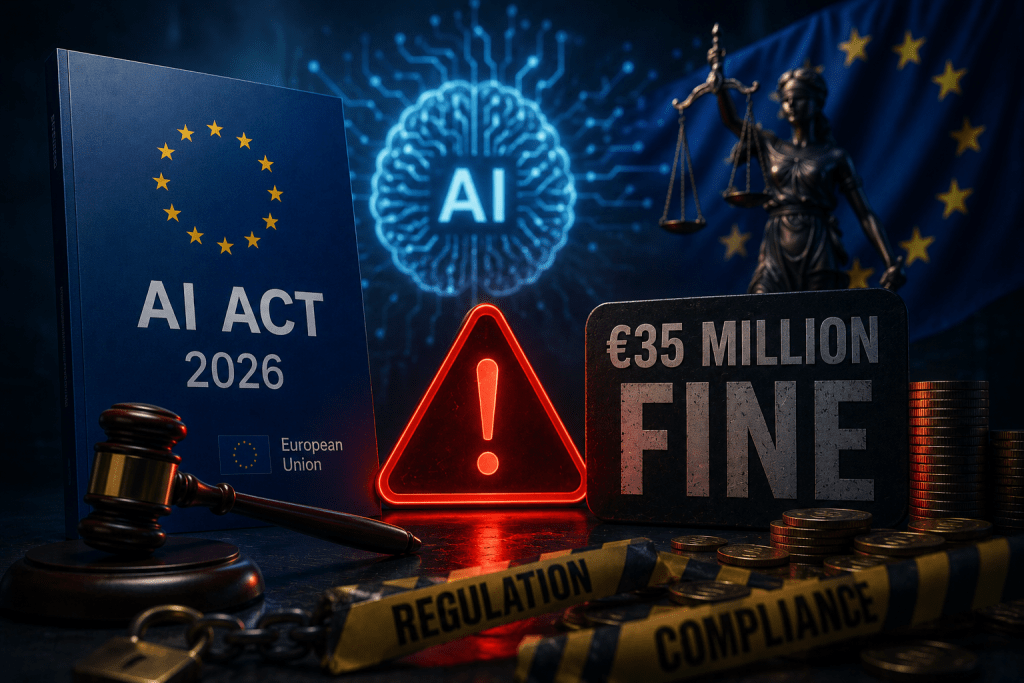
The EU AI Act 2026 is fifty-three days away from changing the global artificial intelligence industry forever and most people using AI tools every single day have absolutely no idea it is coming.
While the world has been watching SpaceX prepare for the largest IPO in history, Anthropic launch its most powerful model ever, and Apple rebuild Siri from scratch, a different kind of milestone has been quietly ticking toward its deadline. On August 2 2026, the most comprehensive artificial intelligence law ever written will begin applying in full and the companies behind the tools you use daily, from Claude AI to ChatGPT to Google Gemini, will face consequences for non-compliance that are genuinely staggering in scale.
This is not a story about bureaucrats writing rules nobody follows. This is a story about the first real attempt by any government in the world to put legally enforceable boundaries around artificial intelligence and what it means for the technology, the companies, and the people whose lives AI is increasingly shaping.
What Is the EU AI Act 2026 and Why Does It Exist
The EU AI Act is a comprehensive piece of legislation passed by the European Union that creates a legal framework governing how artificial intelligence systems can be developed, deployed, and used across Europe. It is the first law of its kind anywhere in the world at this scale and because it applies to any company whose AI systems affect people in EU member states, its reach extends far beyond Europe’s borders.
To understand why the EU AI Act exists you need to understand the problem it is trying to solve. Artificial intelligence has been developing at a pace that regulation has consistently failed to keep up with. Companies have deployed AI systems in hiring, lending, healthcare, law enforcement, and education decisions with profound consequences for real people’s lives with essentially no legal accountability for what those systems do or how they do it.
The EU decided that was unacceptable. The result was years of drafting, debating, and negotiating a law that tries to match the level of risk an AI system poses with the level of oversight it requires. The more consequential the AI application, the more stringent the requirements. The riskier the system, the more accountability the company deploying it must demonstrate.
That sounds reasonable in principle. The implications in practice are going to reshape how AI companies operate in ways that are only now beginning to become clear.
The Risk Tier System How the EU AI Act Actually Works
The EU AI Act does not treat all artificial intelligence the same way. It divides AI systems into four risk categories and applies different rules to each one which is both the law’s greatest strength and the source of most of the complexity companies are trying to navigate.
Unacceptable Risk sits at the top of the framework and covers AI applications that are simply banned outright. Real-time biometric surveillance of people in public spaces. Social scoring systems that rate citizens based on behaviour. AI that manipulates people’s subconscious without their awareness. Facial recognition databases built by scraping images from the internet without consent. These are not regulated they are prohibited. Any company deploying AI in these categories in the EU faces not just fines but outright bans.
High Risk is the category where most of the practical complexity lives. AI systems used in employment decisions screening CVs, assessing candidates, monitoring workers. AI used in education evaluating students, determining access to programmes. AI in healthcare diagnostics, treatment recommendations, patient monitoring. AI in financial services credit scoring, insurance underwriting. AI in law enforcement. AI in critical infrastructure. All of these are classified as high risk and face requirements that are genuinely demanding mandatory risk assessments, human oversight obligations, transparency requirements, data governance standards, and regular auditing.
Limited Risk covers AI systems that interact with people in ways where transparency matters but the stakes are lower chatbots, content recommendation systems, AI-generated content. The primary requirement here is disclosure. If you are talking to an AI you have the right to know you are talking to an AI. If content was generated by AI it must be labelled as such.
Minimal Risk covers everything else spam filters, AI in video games, basic recommendation systems which faces no specific obligations under the framework.
The challenge for companies is that the lines between these categories are not always obvious and the cost of getting the classification wrong is severe.
The Fines Why $35 Million Is Just the Starting Point
The penalties in the EU AI Act are not designed to be absorbed as a cost of doing business. They are designed to be genuinely prohibitive large enough that even the biggest technology companies in the world cannot simply budget for non-compliance the way they might with smaller regulatory fines.
For the most serious violations deploying prohibited AI systems, providing false information to regulators, systematic failure to meet high risk requirements fines reach up to 35 million euros or 7 percent of global annual turnover, whichever is higher.
For a company like Google, 7 percent of global annual turnover is not 35 million euros. It is a number with several more zeros. The structure of the fine whichever is higher means that for large companies the relevant ceiling is not the fixed amount but the percentage, which scales with the size of the business.
For violations that are serious but do not reach the top tier failures in transparency, data governance issues, incomplete risk assessments fines reach up to 15 million euros or 3 percent of global turnover. Still substantial enough to focus executive attention.
For smaller companies and startups the law includes proportionality provisions that can reduce these amounts, acknowledging that a fine calculated as a percentage of a startup’s turnover should not be identical in absolute terms to the same percentage applied to a trillion dollar company. But the principle remains non-compliance has real financial consequences that scale with the scale of the business.
What Changes on August 2 2026
The EU AI Act has been coming into force gradually since it passed. Different provisions have applied at different times. But August 2 2026 is the date when the full framework for high-risk AI systems takes effect which is the category that covers the AI applications with the most direct impact on people’s lives.
From that date, companies deploying high-risk AI systems in the EU must have completed risk management programmes. They must have human oversight mechanisms in place. They must be able to demonstrate that their AI systems meet accuracy, robustness, and cybersecurity requirements. They must have documented the data used to train their systems and be able to show that data governance standards were met. And they must have registered their systems in an EU database of high-risk AI applications.
For general purpose AI models the category that includes the large language models powering Claude, ChatGPT, and Gemini additional transparency and evaluation obligations apply to models trained on more than 10 to the power of 25 floating point operations. That threshold captures the most powerful models and requires their developers to provide technical documentation, comply with EU copyright law, and publish summaries of the training data used.
For the most capable general purpose AI models those deemed to pose systemic risk due to their scale and capability there are additional requirements including adversarial testing, incident reporting to the European AI Office, and cybersecurity measures. Anthropic, OpenAI, and Google are all almost certainly in scope for these provisions.
What This Means for Claude AI, ChatGPT, and Gemini
The AI tools that millions of people use daily are directly in scope for the EU AI Act and the companies behind them have been preparing for compliance for months though the full picture of how each company is responding will only become clear as August approaches.
Anthropic, which is preparing for its own IPO at nearly a trillion dollar valuation and has built its entire brand around AI safety and responsible development, is arguably better positioned for EU AI Act compliance than many competitors. The safety-focused design philosophy that makes Claude acknowledge uncertainty rather than always sounding confident, the investment in interpretability research, and the careful approach to capability deployment all align reasonably well with what the EU AI Act requires in terms of risk management and human oversight.
Claude Fable 5: Anthropic’s Most Powerful Public AI Model Is Here
OpenAI faces a more complex compliance picture given the breadth of ChatGPT’s deployment across high-risk categories and the ongoing restructuring of its corporate governance. The confidential IPO filing announced on June 8 introduces additional pressure to demonstrate regulatory compliance to investors who will scrutinise any regulatory liability in the prospectus.
Google’s position is interesting because Gemini is increasingly embedded in workplace tools Gmail, Docs, Drive that are used in employment and business contexts, some of which fall into high-risk categories. The depth of that integration means compliance is not just about the AI model itself but about how AI assistance is woven into the applications where people do consequential work.
For everyday users the most visible change may be in how these tools communicate about their AI nature and limitations. Disclosure requirements mean AI generated content must be labelled. Chatbot interactions must be identifiable as AI. And users in the EU will have new rights to explanations when AI systems are used to make significant decisions about them.
Why American Companies Cannot Just Ignore It
One of the most important aspects of the EU AI Act is that it does not only apply to European companies. It applies to any AI system that affects people in EU member states which means American companies whose products are used by EU residents are in scope regardless of where those companies are based or where their AI systems are developed and run.
This is the same principle that made the EU’s General Data Protection Regulation GDPR so significant beyond Europe’s borders. When the GDPR came into effect in 2018 it forced companies worldwide to change how they handled personal data because the cost of non-compliance exceeded the cost of compliance for any company serving European users. The EU AI Act is designed on the same principle and is expected to have the same extraterritorial effect.
The practical result is that August 2 2026 is a deadline not just for European AI companies but for every major AI company in the world that has European users which is essentially all of them. The compliance programmes that Anthropic, OpenAI, Google, and Microsoft have been building are not European regulatory exercises. They are global operational changes driven by the scale of what non-compliance could cost.
The Colorado Connection America’s Own AI Law Arrives June 30
While the EU AI Act is the larger story, it is worth noting that the United States is not entirely without AI regulation either. The Colorado Consumer Protections for Artificial Intelligence Act takes effect June 30 2026 just two days away making Colorado the first US state with comprehensive AI consumer protection legislation.
The Colorado law applies to deployers and developers of high risk AI systems serving Colorado residents in employment, healthcare, financial services, education, housing, and legal services. It requires a risk management programme, annual impact assessments, disclosure to consumers when high-risk AI is used, and mechanisms for consumers to appeal AI driven decisions.
Colorado is one state. The EU is a bloc of 450 million people. But the Colorado law matters because it signals the direction American regulation is moving and because it gives US companies a domestic precedent to build compliance programmes around before federal AI legislation inevitably follows.
What Happens to Companies That Are Not Ready
The honest answer is that enforcement of the EU AI Act will not be instantaneous on August 2. Regulators need to build capacity, processes, and enforcement infrastructure. The first major fines are unlikely to arrive on August 3.
But the legal obligations apply from the effective date regardless of enforcement timing. Companies that are not in compliance are exposed from that date and the direction of EU regulatory enforcement suggests that high profile cases will be pursued deliberately to establish precedent and signal seriousness to the market.
The GDPR experience is instructive here. Enforcement was slow initially but accelerated significantly once regulators had built capability. The largest GDPR fine to date 1.2 billion euros against Meta in 2023 came years after the regulation took effect but demonstrated clearly that the EU was willing to use the full scale of its enforcement powers.
Companies that are not ready for the EU AI Act by August 2 are not necessarily immediately at risk of maximum fines but they are operating with legal exposure that compounds over time as enforcement capacity grows.
What This Means for Everyday AI Users
For the millions of people who use Claude, ChatGPT, Gemini, and other AI tools in their daily lives, the EU AI Act creates rights and protections that did not previously exist in law.
The right to know when you are interacting with AI rather than a human is now legally enforceable in the EU. The right to an explanation when an AI system makes a significant decision about you a loan application, a job screening, a healthcare assessment is codified. The right to human review of consequential AI decisions is required for high-risk applications.
These rights matter most in the contexts where AI decisions have the highest stakes. The person who is rejected for a job after an AI screening system assessed their CV now has a legal right to understand how that decision was made. The patient whose healthcare pathway was shaped by an AI diagnostic tool has a right to human oversight of that process. The student assessed by an AI evaluation system has protections against purely automated determinations of their academic future.
For casual users of AI writing tools, research assistants, and productivity applications the changes are less dramatic primarily transparency disclosures rather than fundamental shifts in how the tools work. But the framework being established now will shape how AI development proceeds for years to come.
Frequently Asked Questions
What is the EU AI Act?
The EU AI Act is the world’s first comprehensive artificial intelligence law, passed by the European Union. It creates a risk-based framework that governs how AI systems can be developed, deployed, and used with requirements and fines that scale with the risk level of each application.
When does the EU AI Act take full effect?
The full framework for high-risk AI systems takes effect on August 2 2026. Additional provisions for general purpose AI models are also applying from this period. Some provisions took effect earlier in the phased implementation timeline.
What are the fines for violating the EU AI Act?
The most serious violations carry fines of up to 35 million euros or 7 percent of global annual turnover whichever is higher. Less serious violations face fines up to 15 million euros or 3 percent of global turnover.
Does the EU AI Act affect American companies?
Yes. It applies to any AI system affecting people in EU member states regardless of where the company is based. American AI companies with European users which includes all major AI providers are in scope.
Does the EU AI Act affect Claude AI and ChatGPT?
Yes. Both are in scope as general purpose AI models and their deployment in high-risk contexts falls under the framework. Anthropic, OpenAI, and Google have all been building compliance programmes in preparation for the August 2 deadline.
What rights do EU users have under the EU AI Act?
EU users have the right to know when they are interacting with AI, the right to explanations when AI systems make significant decisions about them, and the right to human review of consequential AI-driven decisions in high-risk categories.
What AI applications are completely banned under the EU AI Act?
Prohibited applications include real-time biometric surveillance in public spaces, social scoring systems, AI designed to manipulate people subconsciously, and facial recognition databases built by scraping images without consent.
The EU AI Act 2026 is the most significant regulatory development in the history of artificial intelligence and it arrives in fifty-three days whether the industry is ready or not.
For the companies behind the AI tools the world has come to rely on it represents the end of a period where capability could race ahead of accountability without legal consequence. For the people using those tools it represents the first meaningful legal framework of protections around technology that is making increasingly consequential decisions about their lives.
The $35 million fine figure gets the headlines. But the deeper significance of the EU AI Act is what it represents the moment when artificial intelligence stopped being something that happened to people and started being something that happened within a legal framework designed to protect them.
August 2 is coming. The countdown has already started.
The EU AI Act Takes Full Effect In:
Days
Hours
Minutes
Seconds
 10 Best AI Note-Taking Apps for Students in 2026 That Actually Work
  How to Use Claude AI for Beginners: 7 Simple Steps to Powerful Results 2026
  Claude AI vs ChatGPT 2026: Which AI Assistant Is Actually Better?
  10 Best AI Tools for Students in 2026 (Free and Paid Options)
  10 Best Free AI Tools for Beginners in 2026
  Microsoft AI Coding Tools 2026: The Uncomfortable Truth Developers Are Just Finding Out
  AI Jobs at Risk by 2030: The Honest Truth Nobody Is Telling You
  Grok AI Review 2026: Is Grok The Most Underrated AI Assistant Right Now?
  Claude Fable 5 vs ChatGPT 2026: The Battle Forcing Millions to Finally Ditch One AI for the Other