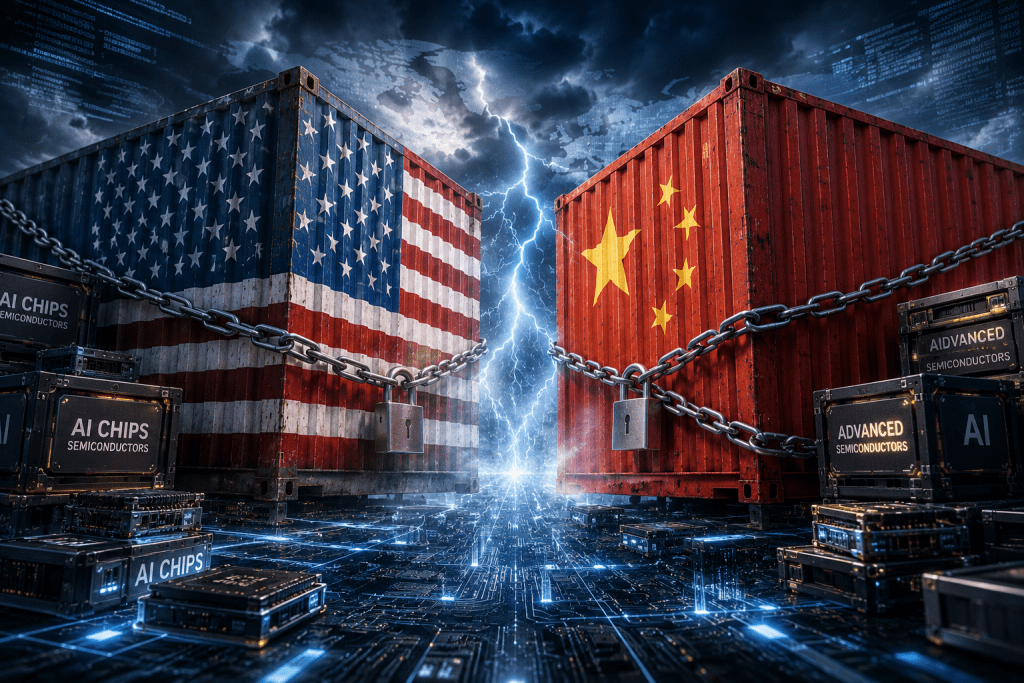
For the past two years the story of AI and geopolitics has been told mostly in one direction. America restricts chip exports to China. America adds Chinese AI companies to blacklists. America tightens controls on the technology that powers artificial intelligence. China responds with public statements, accelerated domestic investment, and diplomatic protests.
That framing changed this week.
Beijing blacklisted 56 American firms this week after Washington pulled Anthropic’s top models from foreign hands. Anthropic’s own IPO filing admitted the trigger was a routine coding request that rival models can handle. Microsoft’s CEO warned that letting a few models eat everything will not survive politically.
The AI export war just stopped being one-directional. And the implications for every company, government, and individual who depends on American artificial intelligence are more significant than any single week’s headlines have captured.
How We Got Here
To understand what happened this week you need the full timeline because the events of the past month did not emerge from nowhere. They are the culmination of a confrontation that has been building since the Trump administration took office.
The United States has been systematically tightening controls on AI-related exports to China since 2022 restricting the advanced Nvidia chips that power AI training, adding Chinese technology companies to military blacklists, and attempting to prevent China from accessing the semiconductor supply chain that makes frontier AI development possible.
China’s response has been to accelerate domestic AI development, pour billions into domestic chip manufacturing, and build AI companies DeepSeek, Baidu, Alibaba, and others that are attempting to close the capability gap with American labs using whatever hardware they can access.
The Pentagon earlier this month updated its so-called 1260H list by adding a slew of Chinese technology companies to a roster of entities it believes have aided Beijing’s military. China’s response to that update was the 56-firm blacklist that landed this week.
But the event that fundamentally changed the dynamic was not the chip controls or the blacklists. It was the Fable 5 ban.
Why the Fable 5 Ban Changed Everything
When the US government pulled Anthropic’s Fable 5 and Mythos 5 models from global access on June 12, it crossed a threshold that previous export controls had not reached. For the first time, Washington applied export controls directly to a deployed commercial AI model not to the chips that run it, not to the company that makes it, but to the software itself.
The signal this sent to the rest of the world was stark. American AI capabilities, which governments and companies globally have been integrating into their critical systems, can be withdrawn instantly and unilaterally when Washington judges the national security risk to be sufficient.
Anthropic’s own filing admitted the trigger was a routine coding request that rival models can handle. That admission matters enormously for the geopolitical argument around American AI export controls. If Fable 5 can be pulled because a jailbreak exists that enables something rival models can already do, the standard being applied is effectively a prohibition on deploying any AI model with meaningful cybersecurity capability abroad.
That standard, applied consistently, would end the global commercial deployment of American frontier AI. And it would hand the international AI market to competitors Chinese and European who are not subject to the same restrictions.
China’s Response 56 American Firms Blacklisted
China’s blacklisting of 56 American firms is a direct response to the escalating pattern of American AI and technology export controls and it represents a meaningful escalation in the mutual nature of the confrontation.
China imposed trade restrictions on dozens of US firms in retaliation for the Pentagon’s updated blacklist of Chinese technology companies. The 56 firms face restrictions on their ability to operate in China, procure Chinese components, and access Chinese markets.
The specific firms on the list span defence contractors, technology companies, and firms involved in semiconductor supply chains targeting the industrial base that supports American technological advantage in precisely the areas China most wants to develop domestically.
The timing is deliberate and the message is clear. For every American action restricting Chinese access to frontier technology, Beijing will impose costs on American companies with China exposure. The question of whether those costs are symmetric whether Beijing can impose equivalent pain on American companies to what Washington can impose on Chinese ones is the central strategic calculation driving both sides.
Microsoft’s Warning The Political Sustainability Problem
One of the most significant statements of the week came not from a government official but from Microsoft’s CEO, who identified the fundamental political problem with the current trajectory of AI concentration.
Microsoft’s CEO warned that letting a few models eat everything will not survive politically.
That warning is directed at the domestic American political situation as much as the international one. The consolidation of frontier AI capability into a small number of American companies Anthropic, OpenAI, Google DeepMind creates a political economy that is difficult to sustain. When those companies are simultaneously dependent on government goodwill for their export control treatment and using their capabilities to influence government policy through super PACs and lobbying, the political backlash risk becomes real.
The AI export war is not just a US-China story. It is also a story about the political sustainability of a model where three or four American companies effectively control the global frontier of artificial intelligence and the US government controls whether and how that frontier gets deployed internationally.
What This Means for AI Users and Businesses
For individuals who use AI tools and businesses that have integrated American AI into their workflows, the export war has practical implications that go beyond the current Fable 5 outage.
The risk that American AI capabilities can be withdrawn from international users is now demonstrated fact rather than theoretical concern. Any business that has built critical workflows around American frontier AI models Claude, ChatGPT, Gemini is now operating with infrastructure that can be pulled from non-American users with 90 minutes of notice.
For businesses outside the United States, the rational response to that risk is diversification. European alternatives like Mistral, Chinese alternatives for domestic use, and open-source models that cannot be subject to export controls all become more attractive when the reliability of American AI access is in question.
For American AI companies preparing for IPOs Anthropic most immediately the export control risk is a material disclosure item. Anthropic’s own filing admitted the trigger was a routine coding request that rival models can handle an admission that the export control standard being applied could restrict any capable model, not just the most powerful ones.
The Recursive Self-Improvement Wildcard
Beneath the immediate policy dispute lies a longer-term concern that explains why the stakes feel so high to everyone involved.
Advanced AI differs from encryption in another respect too. Whereas cryptography eventually became widely available abroad, America today enjoys a clear lead in AI. China, hobbled by American chip controls, is probably about a year behind. That advantage could become unassailable if Anthropic or other American labs crack recursive self-improvement, whereby models write better versions of themselves and thereby accelerate progress. Many insiders think that is entirely possible.
Recursive self-improvement AI systems that can meaningfully improve their own capabilities is the technological threshold that would make the current American lead in AI potentially permanent rather than temporary. If American labs achieve that capability while China is still catching up, the export control regime currently creating so much friction would have served its purpose. If China closes the gap first or simultaneously, the entire strategic premise of the current policy falls apart.
The export war is ultimately a race against time. America is betting that restricting China’s access to frontier AI long enough will allow American advantages to compound into a permanent lead. China is betting that domestic development, combined with access to open-source models and whatever frontier capabilities it can acquire through other means, will close the gap before American restrictions become decisive.
Frequently Asked Questions
Why did China blacklist 56 American firms?
China blacklisted 56 American firms in direct retaliation for the US Pentagon updating its military company list with additional Chinese technology companies and for the broader pattern of American AI and technology export controls that culminated in the Fable 5 ban.
Is the US-China AI export war new?
The underlying technology competition has been building for years but the mutual nature of the current confrontation is new. America has been restricting Chinese access to AI chips and technology for years. China’s current round of firm-level retaliatory blacklisting represents an escalation in the direct costs being imposed on American companies.
What does this mean for businesses using American AI tools?
It means the risk of American AI capabilities being withdrawn from international users is demonstrated fact. Businesses outside the US that have built critical workflows on American frontier AI models should factor this risk into their planning and consider diversification toward alternatives that cannot be subject to export controls.
Could Anthropic’s IPO be affected?
Yes. The export control risk is a material disclosure item in any IPO filing. Anthropic’s own admission that the trigger for the Fable 5 ban was a routine coding request that rival models can handle raises questions about the regulatory risk premium investors should apply to a company whose most capable products can be pulled from global markets without warning.
What is recursive self-improvement and why does it matter here?
Recursive self-improvement refers to AI systems that can meaningfully improve their own capabilities writing better versions of themselves. If an American lab achieves this before China closes the current capability gap, the American AI advantage could become permanent. This is the technological stakes underlying the export war and the reason both sides treat the competition with such urgency.
Bexorn Verdict:
The AI export war of 2026 is not going to resolve quickly. The structural forces driving it American determination to maintain technological advantage, Chinese determination to achieve technological independence, and the genuine national security implications of frontier AI capabilities are not going away.
What changed this week is the mutual nature of the confrontation. America can restrict Chinese access to frontier AI. China can impose costs on American companies with China exposure. Both sides have now demonstrated willingness to use those tools aggressively.
The winners in this environment are the companies and governments that are not caught in the middle open-source model providers that cannot be subject to export controls, European AI labs that are not subject to American restrictions and not targeted by Chinese retaliation, and the governments that have moved early to build sovereign AI capabilities that do not depend on either American or Chinese goodwill.
The era of AI as a purely commercial, globally available technology is ending. What replaces it is a fractured landscape where access to frontier AI depends increasingly on which country you are in and which side of an escalating technology confrontation your government has chosen.
Related Reading:
• The US Government Just Pulled the Plug on Claude Fable 5 and Anthropic Is Fighting Back
• Getty Images Signed a Deal With OpenAI The Company It Spent Years Trying to Destroy
 OpenAI Jalapeno Chip Is Here and NVIDIA Should Be Paying Attention
  Getty Images Signed a Deal With OpenAI The Company It Spent Years Trying to Destroy
  Claude Fable 5 Moved Behind Paywall Today
  DeepSeek Raised $7.4 Billion and the Investors Got Absolutely Nothing to Show for It
  Google Lost a Nobel Prize Winner to Anthropic and That Is Only Half the Problem
  Regular Investors Outbid Wall Street on SpaceX and Some of Them Already Regret It
  AMC Robotics Vietnam Hub Is Proof the Hardware Race Has Left Silicon Valley
  SpaceX Space Data Centers: The Wildly Ambitious Plan to Build a Million AI Supercomputers in Orbit
 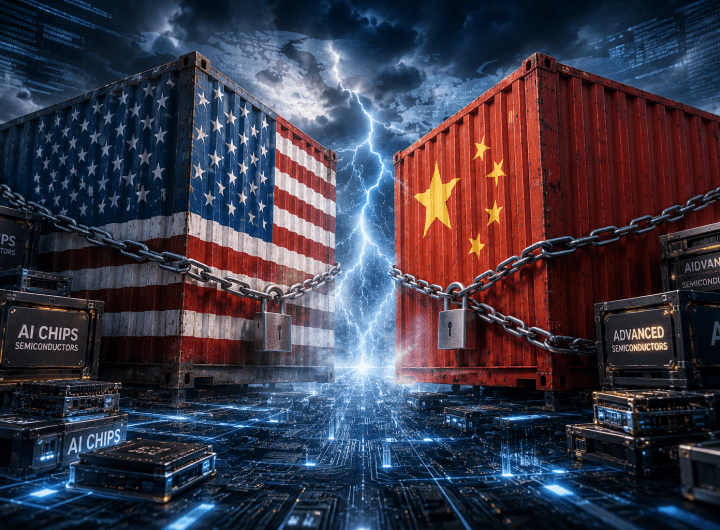 AI Export War 2026: China Fired Back and America’s AI Advantage Is Now Under Serious Threat