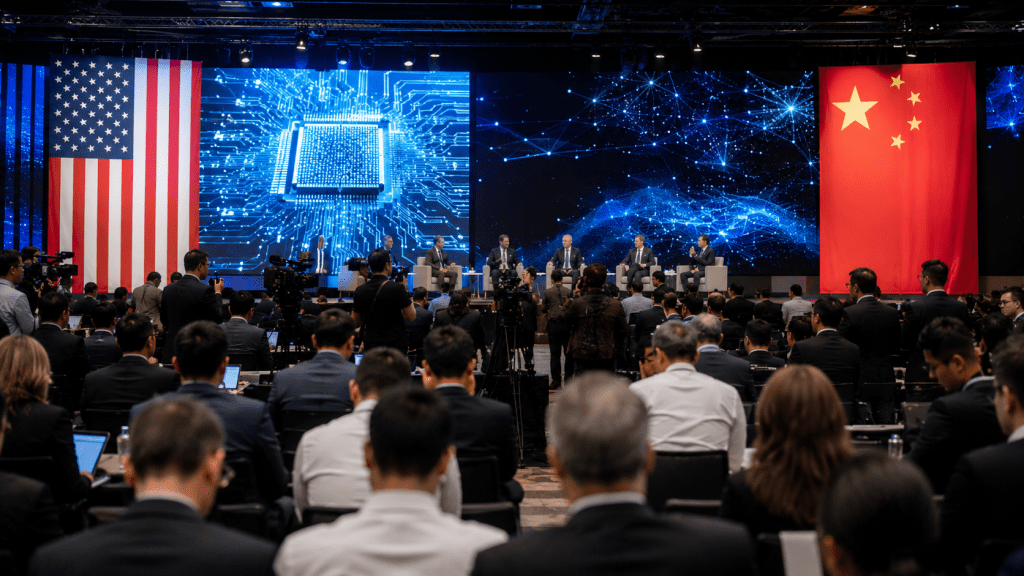
On June 13, 2026 one day after the U.S. government banned Anthropic’s Fable 5 and Mythos models from global access China’s Zhipu AI released GLM-5.2. The timing was either extraordinary coincidence or a pointed signal. Either way, the message landed clearly. Two independent security evaluations published that week delivered a verdict that Washington’s export control architects did not want to hear: Zhipu AI’s GLM-5.2, a Chinese open weight model, had matched or approached leading U.S. AI on the exact class of cybersecurity capability that justified the Fable 5 ban. (ACM Digital Library)
The model is freely downloadable by anyone on Earth. No export order can reach it.
That’s not a footnote to the story. It is the story. The United States has spent the better part of two years treating its most capable AI models as a strategic advantage that can be managed through access controls limiting who can use them, which countries can deploy them, and under what conditions. The GLM-5.2 benchmarks are the clearest evidence yet that this strategy has a fundamental structural problem: you cannot control a capability once it exists freely in the open.
China Is Catching Up Faster Than Expected
The skepticism that greeted Chinese AI after DeepSeek R1 dropped in January 2025 the claims of gamed benchmarks, distilled outputs, misleading cost figures has not aged well. Chinese models now match or exceed mid tier Western models on most standard benchmarks, though the absolute frontier remains held by closed source Western providers. (SHRM) The gap has closed. The debate has shifted from whether it is closing to how much further it will close and how fast.
The best Chinese model still trails the top proprietary models from OpenAI, Anthropic, and Google by roughly 9 points on composite benchmarks, but the gap has closed faster than most industry forecasts predicted. That gap is not evenly distributed across capabilities. On certain specific tasks including the cybersecurity vulnerability detection that triggered the Fable 5 ban in the first place Chinese models have moved from clearly behind to functionally competitive.
The cost dimension is equally significant, and often gets less attention than the benchmark comparison. Chinese AI labs offer their models at increasingly competitive prices while narrowing the performance gap with U.S. counterparts. Kimi K2.5 costs four times less than OpenAI’s GPT-5.2 while achieving the same Intelligence Index score on Artificial Analysis’s benchmark aggregator. (Bloomberg) When capability is roughly comparable but cost is dramatically lower, commercial adoption follows regardless of geopolitics. One partner at U.S.-based venture capital firm Andreessen Horowitz provided a rough estimate that 80 percent of U.S. startups use Chinese base models to develop products for their business. (Bloomberg) That’s not a fringe finding. It describes something close to mainstream practice in early-stage American AI development.
The structural reasons for Chinese labs’ rapid progress are worth understanding rather than dismissing. China’s current dominance in open weight AI is partly a strategic response to U.S. export controls on advanced GPU hardware. Facing restrictions on Nvidia’s H100 and A100 chips since October 2022, Chinese labs were forced to innovate on software efficiency and that constraint produced breakthroughs that now benefit the entire industry. (SHRM) This is one of the recurring ironies of technology competition: the pressure intended to limit a rival’s capability can produce innovations that reshape the underlying competitive dynamics. Zhipu AI’s GLM-5.1 was notably the first frontier model trained entirely on Huawei Ascend chips, without any Nvidia hardware. That’s a meaningful milestone, not just for China but for anyone tracking what AI development looks like when it has to happen outside the current GPU supply chain.
Why Cybersecurity Has Become the Next AI Battlefield
Cybersecurity is where the capability gap has collapsed most visibly, and it’s also where the implications are most immediately consequential. This isn’t coincidence it reflects both the measurability of security tasks and the particular attention that governments have paid to this domain.
Intelligence agencies for the United States, Canada, the UK, Australia, and New Zealand warned in a joint statement that advanced AI models capable of wreaking havoc in the cyber domain are “months away” from being broadly publicly available, despite efforts by AI companies to withhold them or restrict their access. The Five Eyes alliance framed this explicitly: “Frontier AI models are anticipated to exceed current industry expectations, fundamentally transforming both offensive and defensive cyber capabilities.” (arXiv)
China’s response to the Fable 5 ban wasn’t Zhipu’s GLM-5.2. Chinese cybersecurity firm 360 unveiled Tulongfeng, an AI tool it says can go head to head with Anthropic’s Mythos the model so capable the Trump administration banned it from foreign nationals. Tulongfeng is designed to automatically discover software vulnerabilities. A second tool, Yitianzhen, is built to automate cyber defense and incident response. (Semantic Scholar) The company’s founder described vulnerability finding AI as a national strategic asset a framing that mirrors, almost exactly, how American officials have talked about Fable 5 and Mythos.
The problem with treating AI cybersecurity capability as a national strategic asset is that the capability doesn’t stay national. AI models capable of exploiting cybersecurity weaknesses are already available through multiple channels: older commercial models, open source versions, or foreign and black market sources. And while newer models like Mythos are reportedly significantly more powerful for cybersecurity related tasks, the breakneck pace of frontier model development often means that yesterday’s restricted frontier AI is tomorrow’s free, open source AI.
The Open Source Problem Nobody Has Solved
Because GLM-5.2 is an open weight model under the MIT license, anyone can download it, remove its safety guardrails, fine tune it for specific targets, and run it locally with no visibility to any provider or security team. Security researchers confirmed that Russian language forums were already discussing how to adapt the model for offensive purposes within days of its release. (ACM Digital Library)
This is the central tension that no government has found a satisfying answer to. The same openness that makes open source AI beneficial enabling researchers, small companies, and developing economies to access capable models without paying frontier prices also means there is no chokepoint at which access can be controlled. You can ban a hosted API. You cannot un release model weights. The Fable 5 ban targeted an API. GLM-5.2’s weights are on Hugging Face. The reason companies are using models from China is because these models offer the best performance at their price point, and there are no frontier open weight models from the United States. That gap between what American labs have built and what they’ve made freely available is exactly what Chinese labs are exploiting.
How U.S. AI Companies Are Responding
OpenAI and Anthropic have both complained about Chinese distillation of their models using outputs from their systems to train competing models without authorization. In February 2026, OpenAI submitted a memo to Congress’s China Select Committee alleging DeepSeek distilled its models, training on ChatGPT outputs obtained through obfuscated third party routers to mask their source. Days later, Anthropic accused DeepSeek, Moonshot, and MiniMax of coordinated distillation against Claude. (Manifold) Whether or not these allegations prove legally actionable, they represent something real: the techniques and outputs that U.S. labs have spent billions developing are being used as training material by competitors who are then releasing the results openly.
The export control strategy has run into an equally uncomfortable reality. The U.S. Department of War and some agencies have already barred Chinese AI models from government systems. China applies a mirror policy: the Cyberspace Administration of China must approve every generative AI service available in the country, and no U.S. frontier model holds that approval, leaving OpenAI and Anthropic products outside the lawful Chinese market. (NeurIPS) Both countries are using regulatory access as a competitive weapon. The asymmetry is that China can enforce market exclusion without an open internet it’s practiced this for years. The United States cannot achieve the same exclusion without restrictions that would require every developer and enterprise to police which models they use, something that has proven practically difficult even when legally mandated.
A host of companies, including Microsoft, are weighing how they can offer Chinese models on their platforms, a development that is set to alter the balance of power. Microsoft distributing Chinese models through Azure would be one of the more significant reversals in the technology competition narrative the company that is simultaneously OpenAI’s largest investor potentially becoming a distribution channel for OpenAI’s Chinese rivals.
Why This Matters for Businesses and Everyday Users
The AI race tends to get discussed in terms of national security and geopolitical competition, which is accurate but incomplete. For the developer evaluating which model to build on, the enterprise choosing a vendor, or the individual deciding which AI tools to use, the narrowing gap between Chinese and U.S. models has immediate practical consequences.
The most immediate one is price. When DeepSeek made its 75% discount on V4-Pro API pricing permanent in May 2026, it wasn’t just a promotion it was a signal that the price floor for frontier-adjacent AI was being redefined. DeepSeek V4 Pro output is roughly 34x cheaper than GPT-5.5 while remaining within a few benchmark points on standard evaluations. For any company running high volume AI workloads, that difference is measured in millions of dollars annually, and the competitive pressure it creates on American labs to reduce their own prices benefits every business buying API access.
The security question for businesses is more complicated. The U.S. Department of Homeland Security has explicitly warned that China’s National Intelligence Law can compel Chinese companies to provide data from U.S. persons or businesses on government demand regardless of where servers are physically located. (ACM Digital Library) For companies in regulated industries healthcare, finance, legal, government contracting this legal obligation is a hard stop, regardless of how the models perform. The alternative that many have settled on is self hosting open weight Chinese models on their own infrastructure, which eliminates the data residency concern while preserving the cost advantage. It requires technical capacity that many smaller businesses don’t have, which is its own kind of barrier.
For ordinary users, the effects are less direct but still real. The competitive pressure from Chinese labs is one of the primary forces keeping American AI prices down and feature development moving quickly. The models you use today are cheaper and more capable than they would be in a world where OpenAI and Anthropic faced no meaningful competition.
Could This Reshape the Global AI Race?
The binary framing U.S. leads, China follows has already been overtaken by a more complicated reality. In manufacturing, 67% of Chinese industrial firms have deployed AI in production, compared with 34% of analogous U.S. firms. In logistics, China’s JD Logistics has leveraged AI to offer 12 hour delivery in core cities, versus Amazon Prime’s 1 to 2 days. Model capability benchmarks and deployment reality are different measurements, and China is ahead on deployment in several sectors that matter for economic productivity.
Kimi K2.6 became the first open weight model to beat GPT-5.4 on SWE Bench Pro a benchmark designed to measure real world software engineering capability on actual GitHub repositories. GLM-5.1 beat Claude Opus 4.6 on a key coding benchmark earlier this quarter. These are not theoretical achievements. They’re signals that on specific capability dimensions, the Chinese frontier has moved past specific U.S. models.
The reaction from other countries is shaping up to be as consequential as the competition between the two primary actors. Tokyo based Sakana AI launched Fugu, a frontier model it says stands shoulder to shoulder with Anthropic’s Fable 5, positioned explicitly as a hedge strategy a way to preserve access to frontier AI capability without dependence on either U.S. export control policy or Chinese data residency law. Its website advertises “delivering frontier capability without the risk of export controls.” (Semantic Scholar) European officials responded to the Anthropic model bans by calling for deeper domestic AI investment. Middle power countries that have watched the U.S. China dynamic unfold are increasingly treating AI sovereignty the ability to develop and deploy capable AI without dependence on either superpower’s policy decisions as a strategic priority rather than an aspirational goal.
The rapid pace of frontier AI development means cyber risk assumptions can become outdated in months, not years. The Five Eyes alliance said this about cybersecurity specifically, but it applies to the competitive landscape broadly. The assessments made about China’s AI capabilities twelve months ago have been revised repeatedly. The assessments made today will almost certainly require revision again before the end of the year.
Final Thoughts
There’s a version of this story that’s told as a straightforward threat narrative: China is catching up, the United States is losing its lead, action is required. That version is not wrong, exactly, but it misses something important about how this technology actually works.
The AI capability that the U.S. government tried to contain by banning Fable 5 and Mythos is now approximately replicable by a freely downloadable Chinese model that anyone on Earth can run on their own hardware. The export control did not prevent that outcome. It may have accelerated it, by creating a market incentive for Chinese labs to demonstrate they could match what had been restricted. The Huawei parallel that the Booz Allen report drew is instructive: the effort to contain Huawei telecommunications equipment cost billions and took years, and remains incomplete. AI model weights are far less containable than telecommunications hardware.
What this suggests is that the question worth asking is not whether the U.S. can maintain an exclusive lead in frontier AI capability. The evidence increasingly suggests it cannot at least not on the timescale that policy decisions are being made. As one researcher who led security teams at Google and Stripe put it: restricting access to advanced U.S. models is “incentivizing companies across the globe to use cheaper but very capable Chinese open weight models, while at the same time undermining the U.S. AI industry.”
The more durable question is what happens when two countries with different legal frameworks, different conceptions of data rights, and different relationships between their governments and their technology companies both have access to roughly equivalent AI capability. That question doesn’t have a clean technical answer. It’s a political and institutional one, and it will be resolved by decisions that go well beyond which model scores better on the next cybersecurity benchmark.
FAQs
Why is cybersecurity becoming important in AI?
Which countries lead AI development today?
Can open-source AI become as powerful as closed models?
Why are governments becoming more involved in AI?
Further Reading on BEXORN
• Inside the OpenAI IPO: What Public Markets Mean for the Future of AI
• Why Google’s Best AI Researchers Are Leaving for Anthropic and OpenAI
• OpenAI’s New GPT-5.6 Rollout Explained: Why Not Everyone Can Use It Yet
• How Anthropic’s Claude Became a Serious Competitor to ChatGPT
 Why Are Google’s Best AI Scientists Leaving? Inside the Talent War Reshaping Artificial Intelligence
  OpenAI Jalapeno Chip Is Here and NVIDIA Should Be Paying Attention
  AI Export War 2026: China Fired Back and America’s AI Advantage Is Now Under Serious Threat
  Getty Images Signed a Deal With OpenAI The Company It Spent Years Trying to Destroy
  Claude Fable 5 Moved Behind Paywall Today
  DeepSeek Raised $7.4 Billion and the Investors Got Absolutely Nothing to Show for It
  Behind Every AI Delay Is a Much Bigger Story
 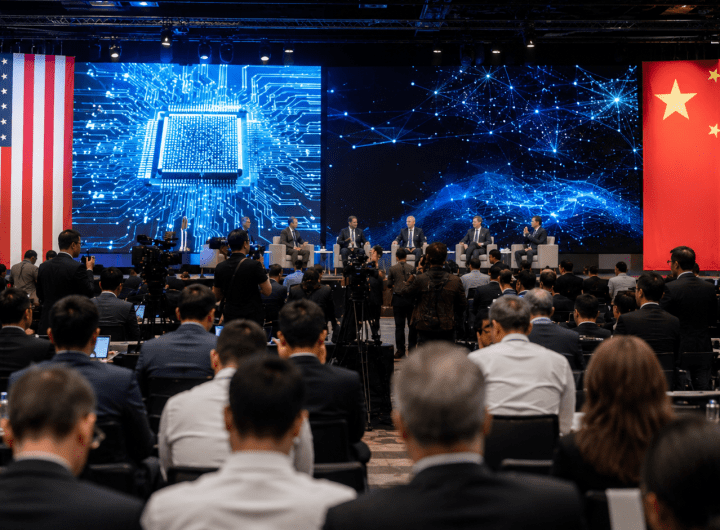 The AI Gap Between China and the US Is Getting Smaller
  Inside the OpenAI IPO: What Public Markets Mean for the Future of AI
  How Anthropic’s Claude Became a Serious Competitor to ChatGPT