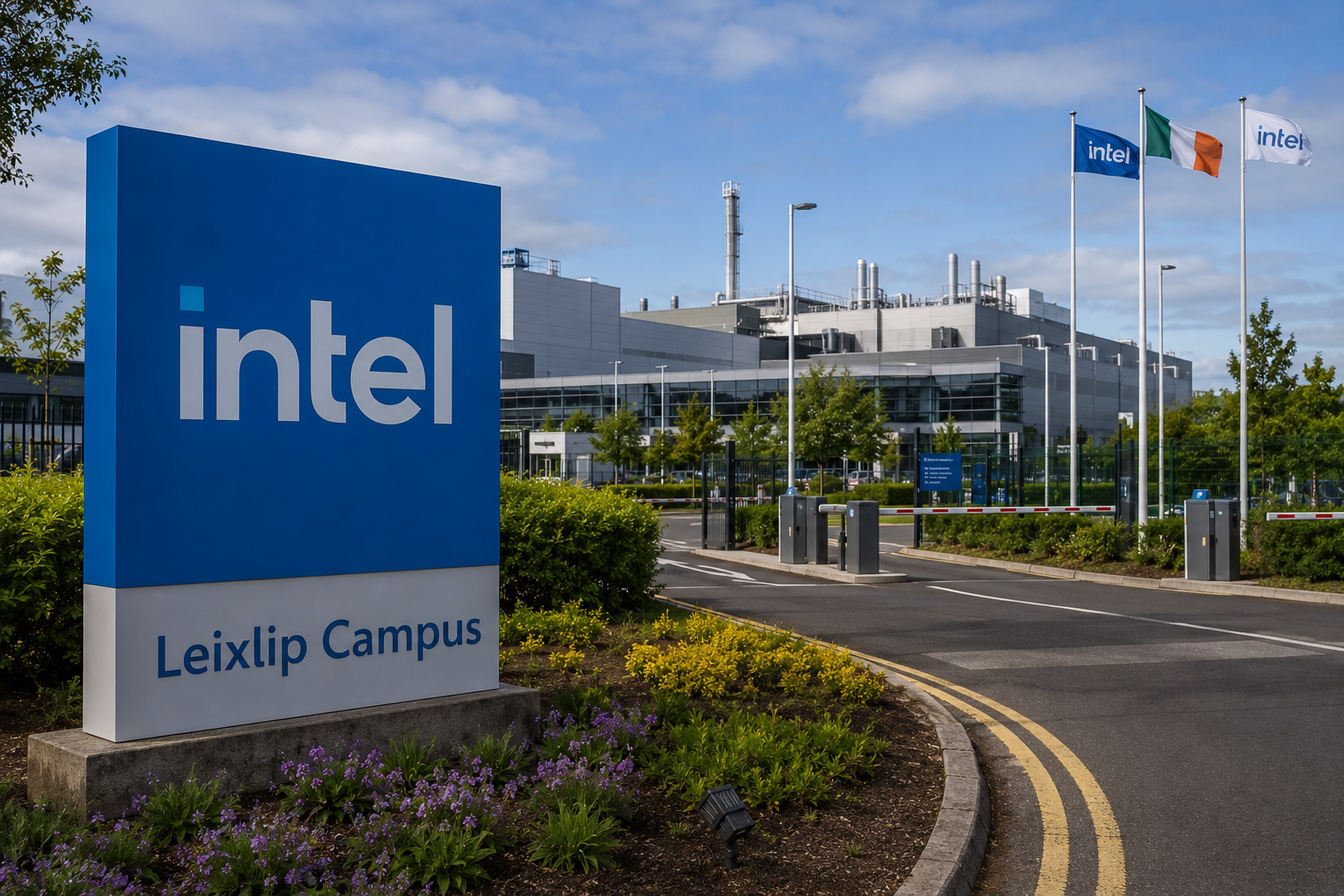
Intel announced a €5 billion ($5.7 billion) capital investment at its Leixlip campus outside Dublin on Monday, aimed at expanding production of the data center processors powering the current AI infrastructure boom. The investment represents roughly 30% of Intel’s entire $17 billion capital expenditure budget for 2026, a striking share of the company’s annual spending to direct at a single European site, and it lands at a moment when Intel is trying to convince both customers and investors that its manufacturing arm can still compete for AI-driven demand against dominant rivals like TSMC.
What the Investment Covers
The money is earmarked for upgrading existing fabrication facilities at Leixlip rather than building new ones from scratch, including installing new manufacturing equipment and expanding the automated track system that links production modules across the site. The campus currently produces Intel’s Xeon 6 processors and will add capacity for next-generation Xeon chips built on Intel’s Intel 3 manufacturing node, the company’s advanced process technology aimed at data center and AI workloads. Intel says most of the funding will be deployed by the end of 2027, and the expansion will add several hundred jobs to a site that currently employs roughly 4,900 people.
Naga Chandrasekaran, Intel’s chief technology and operations officer, framed the investment as a direct commitment to the company’s foundry customers the external chipmakers that pay Intel to manufacture their designs describing the goal as maximizing what Leixlip can deliver to that business rather than simply expanding Intel’s own product capacity.
Part of a Bigger Comeback Story
This isn’t Intel’s first major move in Ireland this year, and reading it in isolation understates the story. In April, Intel paid $14.2 billion to buy back the 50% stake in the Leixlip facility it had previously sold to Apollo Global Management, a reversal that reflects growing confidence in the site’s role in Intel’s broader turnaround strategy. That strategy centers on Intel Foundry, the manufacturing division the company is building out specifically to compete with TSMC for the business of chip designers who don’t operate their own fabrication plants a market Intel has historically ceded ground in, even as demand for AI silicon has made foundry capacity one of the most valuable assets in the industry.
Since establishing its European headquarters in Ireland in 1989, Intel has invested more than €30 billion in the country, with over half of that total going toward a fabrication plant built between 2019 and 2023 that doubled Ireland’s semiconductor manufacturing capacity. This latest €5 billion commitment extends that pattern rather than marking a new direction, but the timing, right after reacquiring full ownership of the site, suggests Intel now sees Leixlip as core infrastructure for its AI ambitions rather than an asset worth diluting through outside investment.
Why Ireland, and Why the Market Reacted Coolly
Ireland’s own government treated the announcement as a significant vote of confidence. Taoiseach Micheál Martin welcomed the investment as reinforcing Ireland’s position at the center of Europe’s advanced manufacturing ecosystem, and Intel has separately framed the expansion as contributing to the European Union’s broader tech-sovereignty ambitions, part of building a more resilient domestic semiconductor supply chain that doesn’t depend entirely on manufacturing capacity in Taiwan or the United States.
That framing carries real weight for Ireland specifically, given how concentrated the country’s corporate tax base has become. Just three companies account for almost half of Ireland’s corporate tax intake, according to analysis from the country’s fiscal watchdog, and that concentration has drawn political attention from Washington. The Trump administration has criticized Ireland’s trade relationship with the U.S., arguing the country runs a surplus at America’s expense, and has pushed for American firms to re-shore profits currently booked through Irish subsidiaries as part of its broader “America First” trade posture. Intel’s own statement addressed that tension directly, with the company noting the U.S. government recognizes Intel operates as a global company that has to keep investing in multiple markets simultaneously, not just domestically.
Investors, for their part, didn’t greet the announcement enthusiastically. Intel’s stock fell roughly 6% following the news, a reaction that likely reflects broader skepticism about Intel’s foundry turnaround generally rather than doubts about this specific investment. Committing 30% of a full year’s capital budget to upgrading one existing site, rather than building new capacity or funding next generation R&D more broadly, can read to some investors as reinforcing an already established position rather than making the kind of aggressive new bet that would signal Intel is closing the gap with TSMC.
The Bottom Line
What makes this investment worth watching isn’t the headline number so much as what it reveals about where Intel believes its comeback actually depends. Leixlip isn’t a new frontier for the company; it’s three and a half decades of accumulated infrastructure and institutional knowledge, and Intel is betting that upgrading what already works there will generate more usable AI chip capacity, faster, than building fresh capacity elsewhere would. That’s a reasonable bet given the timeline pressure Intel is under to prove its foundry business viable, but it’s also a more conservative one than the market’s cool reaction suggests investors wanted to see. Whether this expansion meaningfully narrows Intel’s gap with TSMC will depend less on the €5 billion figure itself and more on whether Intel Foundry can convert this added capacity into signed contracts with external chip designers the real measure of whether Intel’s manufacturing comeback is actually working, rather than just well funded.




Leave a Reply