If you’ve been paying for Claude from India, you already know the annoyance: dollar billing, currency conversion fees on top of the sticker price, and 18% GST added at checkout, all for a subscription priced for a different market. Anthropic has started fixing that. As of this week, Claude’s website and mobile apps are showing India-specific rupee pricing for some users, cutting out the currency conversion markup that made Claude noticeably more expensive here than in the US, once fees were factored in. Here’s exactly what the new pricing looks like, what’s still missing, and whether it’s worth subscribing.
What Changed
Anthropic has begun listing local, GST-inclusive rupee pricing across its Pro, Max, and Team plans in India, rather than charging users in US dollars and letting banks and card networks handle the conversion. This matters because India is Claude’s second-largest market globally after the US, accounting for roughly 5.8% of total usage, so the change addresses friction for a genuinely large slice of Anthropic’s user base rather than a minor regional tweak.
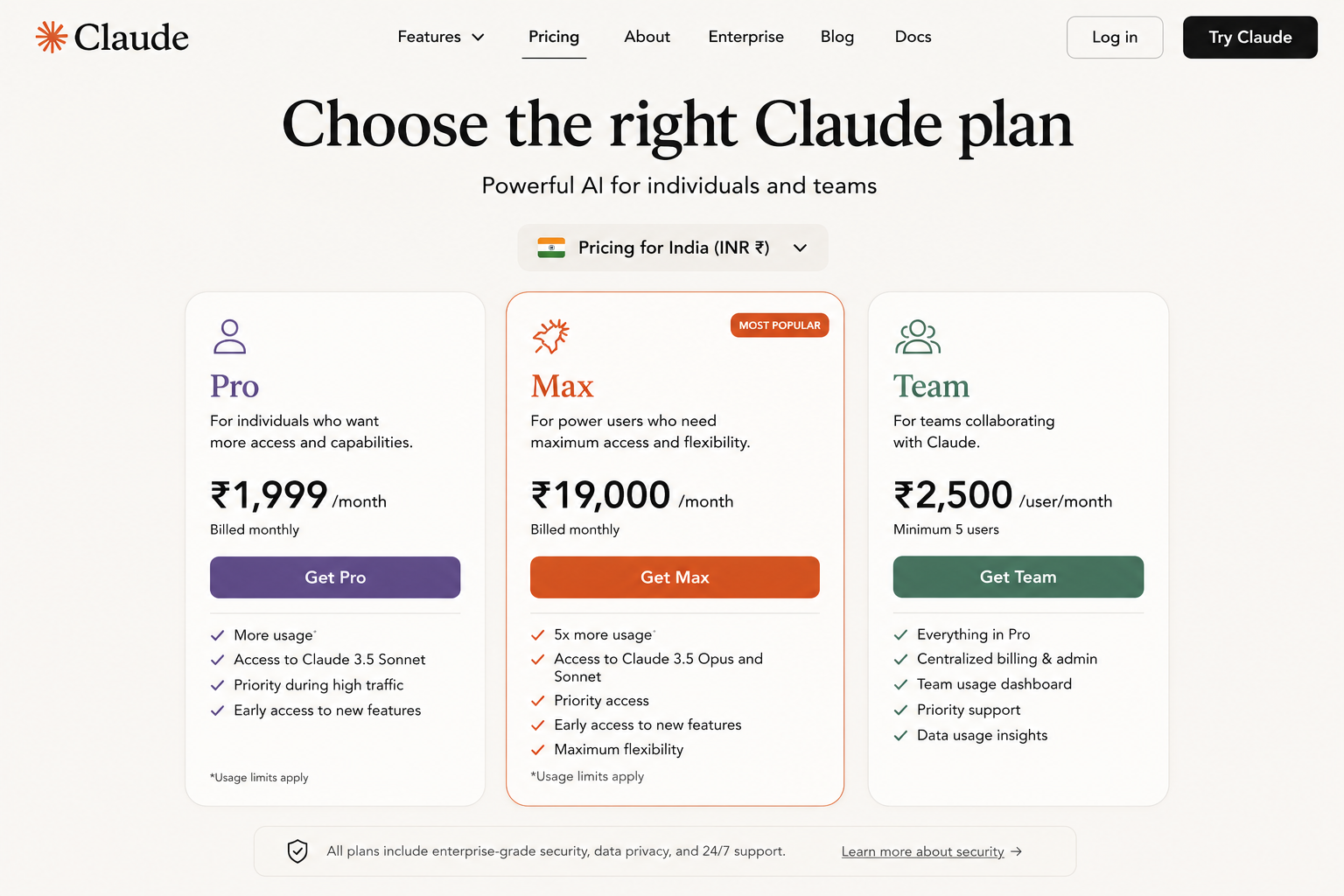
Claude Pricing in India
Claude Pro now starts at ₹2,000 a month when billed annually (working out to roughly $21), compared with the equivalent $17-a-month annual rate in the US. Monthly billing without an annual commitment runs closer to ₹2,399. The Pro plan includes access to Claude’s Sonnet 5, Opus, and Fable 5 models, a usage limit five times higher than the free tier, Research mode, unlimited projects, memory, web search, voice mode, and Claude Code.
Claude Max starts at ₹11,999 a month for the 5x tier (around $125), against $100 in the US, with the higher 20x tier running ₹23,999 a month. Max plans add expanded usage limits on top of everything in Pro, along with Claude Cowork.
Claude Team starts at ₹2,399 per seat per month for the Standard tier when billed annually (₹2,999 with monthly billing), compared with $20 per seat in the US. The Premium tier runs ₹11,999 per seat annually, or ₹14,999 with monthly billing. Team plans add a 200,000-token context window, API-rate usage credits, centralized billing and administration, single sign on, domain capture, and a guarantee that Anthropic doesn’t train its models on Team account content by default.
All of these listed prices include GST and other local taxes, so what you see is genuinely what you pay, rather than a base price with fees layered on afterward.
How This Compares to Before
Under the old dollar-based system, Indian users paid the direct US dollar equivalent of each plan, converted at whatever rate their bank or card applied, plus 18% GST charged separately, plus in many cases an international transaction fee from the card issuer. The new India pricing folds GST into a single listed rupee figure and removes the currency conversion step entirely, though it’s worth noting the effective price in dollar terms is still somewhat higher than the raw US sticker price Anthropic appears to have built in some regional pricing adjustment rather than simply converting the US price one-to-one after removing fees.
What’s Still Missing
The most notable gap is payment method. Anthropic has not yet enabled UPI, India’s dominant instant payments network, meaning users still have to pay by card or through Apple’s and Google’s app store billing systems rather than the payment method most Indians actually use day to day. That’s a meaningful omission given OpenAI rolled out rupee pricing for ChatGPT with UPI support back in August, giving it a genuine convenience edge over Claude in the Indian market even as Claude catches up on rupee pricing itself.
There’s also been some turbulence around model access specifically in India. Anthropic briefly suspended non U.S. access to its Fable 5 and Mythos 5 models in June under export control restrictions; Fable 5 access has since been restored, though Mythos 5 remains limited. That’s separate from the pricing rollout, but worth knowing if you’re subscribing partly for access to Anthropic’s newer models.
Is It Worth Subscribing?
If you’re already using Claude and paying in dollars, switching to rupee pricing should reduce your total monthly cost once currency conversion and international fees are removed from the equation, even though the underlying rupee price runs somewhat above a pure dollar to rupee conversion. If you’re deciding between Claude and a competitor for the first time, the calculus is closer: ChatGPT’s UPI support makes it more convenient to pay for right now, though Claude’s Pro and Max tiers include capabilities, like Claude Code and Research mode, that may matter more than payment convenience depending on what you’re using the subscription for. For most individual users in India, Pro at ₹2,000 a month annually is the more sensible starting point than jumping straight to Max, unless you’re already running into Pro’s usage limits regularly.
FAQS
Bottom Line
This is a genuinely useful change for anyone in India who’s been paying Claude’s dollar price with conversion fees stacked on top, even if the rupee pricing itself isn’t a straightforward bargain compared to the raw US rate. The bigger gap right now is UPI support, and until Anthropic adds it, ChatGPT retains a real convenience edge for Indian users used to paying that way for everything else. If you’re choosing based on price and payment ease alone, that gap matters. If you’re choosing based on which assistant handles your actual workload better, rupee pricing removes one more reason to hesitate before committing to Claude specifically.

Leave a Reply