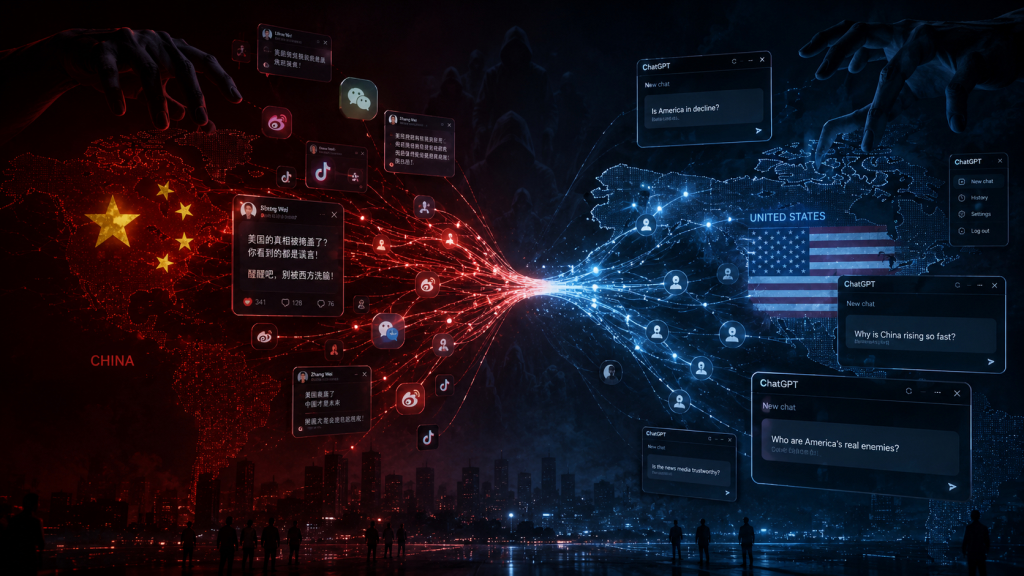
OpenAI just confirmed something that raises serious questions about AI’s role in global information warfare and the admission landed quietly enough that most people missed what it actually means.
OpenAI banned a network of China linked accounts that used ChatGPT to draft social media influence campaigns specifically targeting American public debates around tariffs and data centres. The accounts used ChatGPT to generate content posts, comments, narratives designed to shape what Americans think about two of the most politically charged economic topics in the country right now.
This is not a hypothetical risk about what AI could be used for in the future. It happened. OpenAI caught it, banned the accounts, and disclosed it. That disclosure is the starting point for a conversation the AI industry has been avoiding about what responsibility AI companies carry when their products become tools for foreign interference in domestic political debate.
What Actually Happened
The accounts were China linked meaning they had connections to Chinese state or state adjacent actors based on OpenAI’s investigation. They used ChatGPT specifically to draft content targeting US debates around two issues tariffs, which sit at the centre of the current US-China trade relationship, and data centres, which are ground zero for the competition over AI infrastructure dominance between the two countries.
The choice of targets is not random. Tariffs directly affect Chinese exports to the United States. Data centres and AI infrastructure have become a national security issue as both governments compete for semiconductor supply chains, GPU capacity, and the physical buildings that AI runs on. These are not obscure policy topics they are the exact pressure points where public opinion could meaningfully influence political decisions that affect the economic relationship between the world’s two largest economies.
Using AI to generate influence content about AI policy is a particular kind of irony that the disclosure did not dwell on but is worth naming directly.
Why This Is Bigger Than One Banned Network
The significance of this disclosure is not the specific accounts that were banned. Those accounts are gone. The significance is what their existence reveals about the landscape going forward.
ChatGPT has approximately 900 million weekly active users. The same capability that lets a student write an essay or a small business owner draft a marketing email also lets a state sponsored influence operation generate hundreds of targeted social media posts in minutes, in fluent American English, calibrated to specific regional and demographic audiences. The scale advantage that AI gives legitimate users speed, quality, volume applies equally to illegitimate ones.
OpenAI’s detection and disclosure is the good news in this story. The company identified the network, removed it, and made the information public. That transparency matters and is not universal across the AI industry.
The harder question is what was not caught. Influence operations that succeed do not get disclosed because they are never detected. The accounts OpenAI banned represent the ones they found. The baseline assumption for anyone thinking seriously about AI and information integrity has to be that detected operations are a fraction of actual operations.
AI Jobs at Risk by 2030: The Honest Truth Nobody Is Telling You
What OpenAI Is Doing About It
Banning accounts after detection is a reactive measure. The more important question is what proactive steps the AI industry is taking to make this harder before it happens.
OpenAI has invested in detection systems that flag unusual patterns in how the platform is being used high volume content generation across multiple accounts with similar structural patterns is one signal. The challenge is that detection requires knowing what you are looking for, and influence operations evolve specifically to evade the patterns that previous operations established.
The timing of this disclosure coming in the same week as OpenAI’s confidential IPO filing is worth noting without overinterpreting. Companies preparing for public listings have strong incentives to disclose known problems proactively rather than have them surface after trading begins. The disclosure is the right thing to do regardless of timing. But the timing adds context.
For the broader AI industry the China linked operation is a preview of what the regulatory environment will focus on as AI companies go public and become subject to congressional scrutiny in a way that private companies are not. Anthropic’s policy proposals released this week recommending government frameworks for managing AI risks are partly a response to exactly this kind of threat landscape.
What This Means for Everyday Users
If you use ChatGPT, Claude, or any AI tool to get information about current events, this disclosure is a reminder that the content environment around you is increasingly shaped by AI not just the tools you choose to use, but the content other people are generating with AI tools to influence what you read and believe.
The social media posts you see about tariffs, trade policy, data centres, and AI regulation are increasingly likely to have been drafted, refined, or optimised with AI assistance regardless of who is behind them or what their motivations are. That is true of legitimate political communication and of influence operations alike.
The practical implication is not paranoia but calibration. AI-generated content is not automatically false or manipulative. But the volume of AI-assisted content in political and economic discourse is rising fast enough that the normal signals people use to assess credibility writing quality, apparent effort, volume of consistent messaging are no longer reliable indicators of human authenticity.
The Bigger Picture AI and the Information War
The China-linked ChatGPT operation is one data point in a pattern that is becoming impossible to ignore. AI tools have lowered the cost of producing persuasive content at scale to near zero. That affects elections, policy debates, financial markets, and public health discourse simultaneously.
The companies that build these tools are aware of the risk. OpenAI’s disclosure proves that. Anthropic’s government policy proposals released this week acknowledge the same threat landscape explicitly. But awareness and solution are different things and the solution to AI-enabled influence operations at scale does not yet exist in a form that any government or company has fully implemented.
What does exist is transparency. OpenAI telling the public what happened which accounts, which topics, which platform is the minimum standard that all AI companies should be held to when their products are used this way. Whether that standard becomes a regulatory requirement rather than a voluntary disclosure is one of the most important AI policy questions of 2026.
Apple WWDC 2026: Siri Gets AI Superpowers and Claude Is Now on iPhone
Frequently Asked Questions
What did OpenAI discover about China-linked accounts?
OpenAI banned a network of China-linked accounts that used ChatGPT to draft social media influence campaign content targeting American debates around tariffs and data centres. The accounts used AI to generate content designed to shape US public opinion on these issues.
Is ChatGPT being used for propaganda?
This specific case involved ChatGPT being used to draft influence campaign content. OpenAI detected and banned the accounts involved. Whether other undetected operations are using AI tools for similar purposes is unknown but considered likely by security researchers.
How did OpenAI detect the influence operation?
OpenAI has not disclosed the specific detection methods used, which is standard practice to avoid helping future operations evade detection. The company identified unusual usage patterns consistent with coordinated inauthentic behaviour.
What is OpenAI doing to prevent AI from being used for influence operations?
OpenAI has detection systems designed to identify coordinated inauthentic use of its platform, bans accounts when detected, and has committed to public disclosure. Critics argue reactive detection is insufficient and proactive technical and policy measures are needed.
Does this mean AI content cannot be trusted?
Not automatically but it means the volume of AI-assisted content in political and economic discourse is rising fast enough that writing quality and apparent effort are no longer reliable signals of human authenticity. Critical evaluation of sources remains important.
What does this mean for the AI companies going public?
As SpaceX, Anthropic, and OpenAI pursue public listings, the use of their products in influence operations becomes a regulatory and reputational risk that public investors will scrutinise. Proactive disclosure like this one is partly how companies manage that risk before and after listing.
OpenAI banning China-linked accounts for using ChatGPT in influence operations is a disclosure that deserves more attention than it received. Not because it reveals something unprecedented state actors using available communication tools for influence operations is as old as communication itself but because it confirms that AI has become a standard tool in that arsenal, used in real operations against real political targets right now.
The question the disclosure leaves open is the most important one. OpenAI found these accounts. What it cannot tell us is what it did not find and in information security, the operations you do not detect are the ones that succeed.
The AI industry going public in 2026 will face this question under congressional scrutiny in a way it never has as a private sector. How it answers will shape the regulatory environment for AI tools that hundreds of millions of people use every day.
 Anthropic Project Glasswing 2026: The Secretive AI Safety Program That Found 23,000 Security Holes
  Claude AI Growth 2026: The 306% Number That Should Worry Every ChatGPT User
  The AI IPO Race 2026: SpaceX, Anthropic and OpenAI Are All Going Public at the Same Time
  Microsoft AI Coding Tools 2026: The Uncomfortable Truth Developers Are Just Finding Out
  AI Jobs at Risk by 2030: The Honest Truth Nobody Is Telling You
  OpenAI IPO 2026: The Shocking Truth Behind ChatGPT’s $1 Trillion Public Debut
  ChatGPT Used for China Influence Operations: What OpenAI Just Admitted and Why It Matters