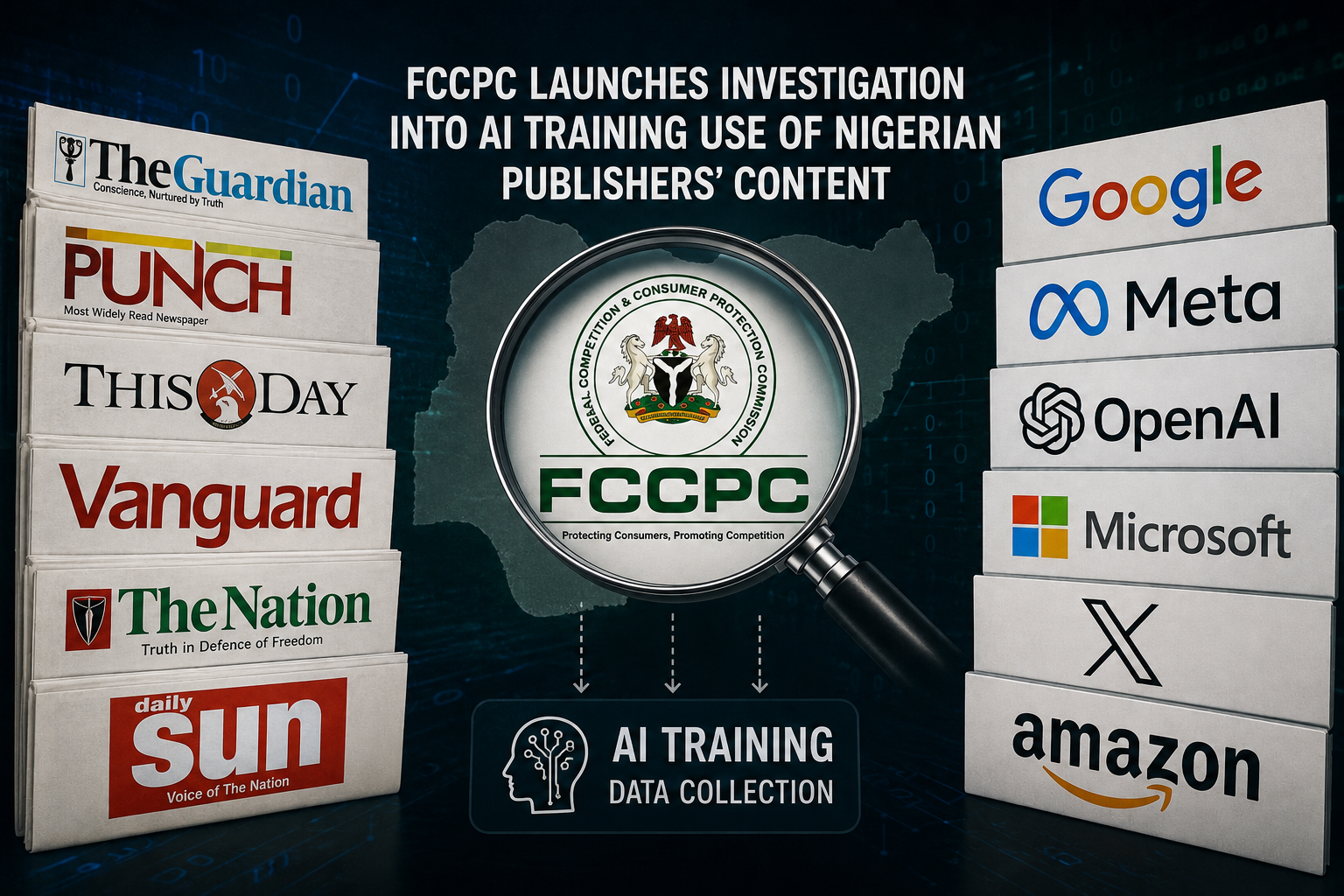
Nigerian President Bola Tinubu has directed the country’s competition regulator to investigate major technology companies over alleged anti-competitive practices and unauthorized use of news content, the Federal Competition and Consumer Protection Commission said late on Monday. The inquiry targets Meta, Alphabet, X, and generative AI platforms operating in Nigeria, and it follows a joint petition from the Nigerian Press Organisation, the umbrella body representing the country’s newspaper publishers, broadcasters, journalists, and online publishers. The directive marks the first time Nigeria’s federal government has formally mobilized its competition regulator against global technology platforms on behalf of local media.
The timing is not incidental. Nigerian publishers have watched similar fights play out in Australia, Canada, South Africa, and the European Union over the past several years, each ending with technology companies eventually paying local media for the value their content generates. Nigeria’s move signals that African publishers no longer see themselves as bystanders in that global reckoning, and it puts some of the world’s largest AI developers on notice in one of the continent’s largest media markets.
The Complaint Behind the Directive
The FCCPC’s inquiry centers on three specific allegations. The first is market dominance and anti-competitive conduct in Nigeria’s digital advertising and content ecosystem. The second, and the one drawing the most attention, is the unauthorized extraction, scraping, ingestion, or commercial use of copyrighted Nigerian news articles, broadcast materials, and other original journalistic content to develop and train generative AI systems. The third concerns fairness in negotiation: whether Nigerian publishers have been denied meaningful opportunities to negotiate fair compensation or commercial arrangements for the use of their work.
FCCPC Executive Vice Chairman Tunji Bello framed the probe as fact-finding rather than a predetermined conclusion, saying the commission’s responsibility is to determine the facts objectively and keep Nigeria’s digital ecosystem fair and consistent with national law. That framing matters for how the investigation will likely unfold. The commission has given no timeline, and it has stressed that opening an inquiry does not presume wrongdoing all parties, including Meta and Google, will have the opportunity to respond before any findings are issued. Google and Meta representatives acknowledged the enquiries and said they would respond after internal review.
Nigeria’s Track Record With Big Tech
This is not Nigeria’s first serious confrontation with a global technology company, and that history is part of why the new probe carries weight. In July 2024, the FCCPC imposed a $220 million administrative penalty on Meta following a joint investigation with the Nigeria Data Protection Commission over alleged consumer protection and data privacy violations. Meta is appealing that decision, and the matter remains before the courts. The earlier case demonstrated that Nigerian regulators are willing to pursue significant financial penalties against major platforms and are capable of prevailing, at least at the regulatory level, which gives the current investigation more credibility than a first-time challenge might carry.
What’s different this time is scope. The 2024 case was about data privacy. The current inquiry extends into competition law, copyright, and the commercial relationship between global platforms and Nigeria’s news industry a broader mandate that, if it produces findings against any of the named companies, could reshape how AI developers source training data across one of Africa’s largest media markets.
A Global Playbook Nigeria Is Borrowing From
Nigeria is not the first country to force this question, and the precedents elsewhere are instructive. Australia’s News Media Bargaining Code, introduced in 2021, gave publishers legal leverage to negotiate payment or trigger mandatory arbitration, resulting in roughly $1 billion in payments after Google and Meta initially threatened to exit the market rather than comply. Canada’s Online News Act, passed in 2023, pushed Google into a $73 million annual payment agreement. Closer to home, South Africa’s Competition Commission secured a commitment from Google to pay roughly $40 million annually for three to five years to support local publishers, an outcome the FCCPC’s own statement specifically referenced as a model it is watching closely.
The copyright dimension has moved just as fast in other jurisdictions. In the European Union, lawmakers demanded in January that AI providers pay for the use of copyrighted European content, and in May, the EU’s top court upheld an Italian order requiring Meta to compensate publishers over the use of news article snippets. In the UK, major outlets including the BBC, the Financial Times, and The Guardian formed the SPUR coalition earlier this year specifically to negotiate AI licensing terms collectively rather than one publisher at a time. Litigation is testing the same question in the United States, where The New York Times has sued OpenAI and Microsoft over the use of its articles in AI training, and in the UK, where Getty Images has pursued a similar claim against Stability AI. None of these cases has produced a single settled legal standard, but together they show regulators and courts converging on the same basic premise: AI training on journalism is not obviously free just because the content was publicly accessible online.
What’s at Stake for Nigerian Media and AI Companies
Nigerian reaction to the probe has split along familiar lines. Some social media users framed the investigation as government overreach into speech and technology, while others, including business commentators, described it as a legitimate stand against global platforms extracting value from local journalism without compensation. Both reactions point to the same underlying tension the FCCPC will have to navigate: protecting a media industry that argues it is being commercially hollowed out, without appearing to regulate AI or online speech more broadly than the competition mandate actually allows.
For Nigerian publishers, the practical stakes are straightforward. A finding of anti-competitive conduct could open the door to licensing negotiations or a compensation framework similar to South Africa’s, potentially creating a new revenue stream for outlets that have struggled to monetize digital journalism as advertising dollars shifted to global platforms. For the AI companies named in the probe, the more immediate concern is precedent a Nigerian finding against unauthorized scraping would add another data point to a pattern already forming across Europe, North America, and southern Africa, making it harder to argue that AI training on news content sits in a legal gray zone anywhere it operates.
The Bottom Line
What Nigeria has opened is not just a competition inquiry it’s a test of whether one of Africa’s largest media markets can extract the same kind of concessions from Big Tech that regulators in Australia, Canada, and South Africa have already won. The FCCPC’s history with Meta suggests Nigerian regulators are willing to see this through rather than let it fade as a symbolic gesture, and the global pattern the probe is drawing from suggests the eventual outcome, if the allegations hold up, is more likely to be a negotiated payment framework than a courtroom loss for either side. The real significance may be structural rather than financial: if Nigeria succeeds in forcing licensing terms onto AI training, it becomes a reference point for other African regulators watching the same platforms operate, largely unchecked, in their own markets.






Leave a Reply