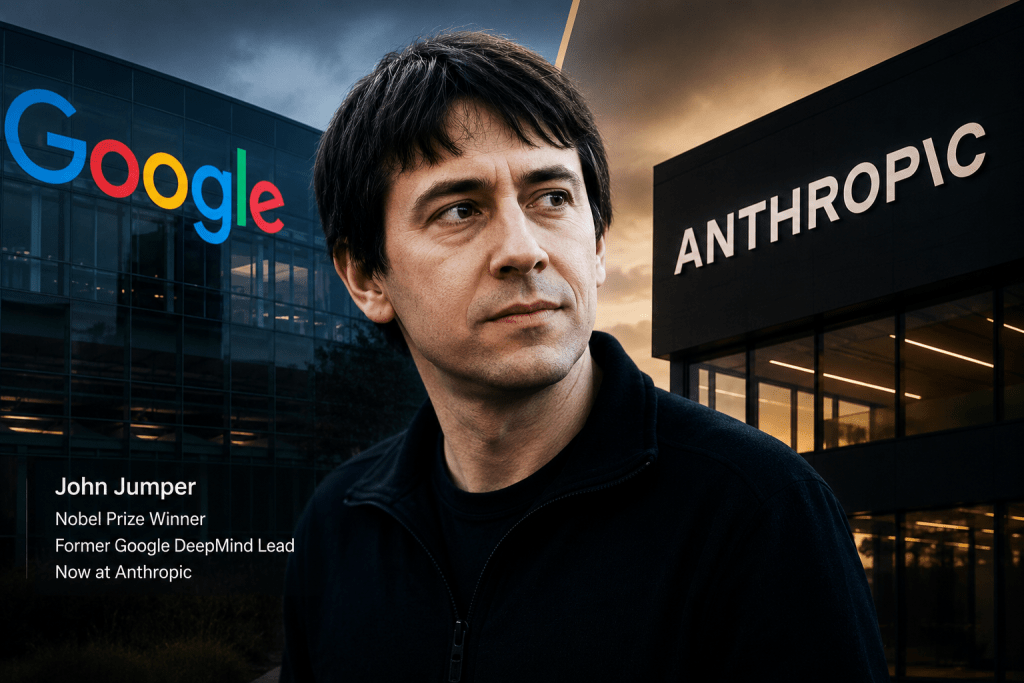
Google spent billions keeping its best AI researchers. In 48 hours, two of them walked out anyway and one of them just won a Nobel Prize.
John Jumper leaves Google DeepMind for Anthropic, and on the surface that sounds like corporate gossip one researcher moving to another lab. But when you dig into who John Jumper actually is, what he built, and what happened the day before he made his announcement, this story stops being gossip and starts being one of the most important signals about where the AI race is actually heading.
Let’s break it down from the beginning, because there is a lot here that mainstream headlines are skipping over.
First, Who Is John Jumper and Why Does It Matter That He’s Leaving?
Most people outside of science have never heard of John Jumper. That is about to change.
Jumper is the scientist who led the team that built AlphaFold2 an AI system that solved one of biology’s greatest unsolved puzzles. In 2024, that work earned him a share of the Nobel Prize in Chemistry. He was 38 years old at the time, making him the youngest chemistry Nobel laureate in over 70 years.
Here is the problem AlphaFold solved, explained simply. Every living thing every human, animal, plant, and bacterium runs on proteins. Proteins are molecules that do almost everything inside your body: they carry oxygen in your blood, fight infections, digest food, send signals between cells. The way a protein works depends entirely on its shape. And scientists had been trying for 50 years to figure out how to predict what shape a protein would fold into based on its chemical ingredients alone.
It sounds abstract until you understand what the answer unlocks. If you know a protein’s shape, you can design drugs that attach to it precisely. You can understand why diseases happen at a molecular level. You can accelerate research that used to take years into weeks.
AlphaFold2 cracked that. More than two million scientists across 190 countries have since used it to speed up research on malaria vaccines, cancer treatments, and drug resistant bacteria. The day Jumper’s Nobel Prize was announced, the scientific world basically stopped for a moment.
He spent nearly nine years at Google DeepMind. And now he is leaving for Anthropic.
What Did He Actually Post?
Jumper kept it short and genuine on X. He wrote that after nearly nine years, he decided to leave Google DeepMind and join Anthropic and that he planned to take some time to recharge first.
He thanked DeepMind CEO Demis Hassabis for taking a chance on him when he was just six months out of his PhD, barely proven in the field, and putting him in charge of a team working on one of science’s hardest problems. He called DeepMind a special place. There was no bitterness, no public drama.
Hassabis responded publicly, saying that what they achieved together with AlphaFold changed the world. He meant it Hassabis shared the Nobel Prize with Jumper. These two won humanity’s most prestigious scientific award together, and now they are working at competing AI companies.
That detail alone tells you something about the intensity of what is happening in this industry right now.
Now Here Is the Part That Made Everyone Stop and Stare
Jumper’s announcement dropped on a Friday. The day before Thursday another major Google researcher made headlines for leaving too.
Noam Shazeer, one of the co leads of Google’s flagship Gemini AI models, announced he was joining OpenAI. Shazeer is one of the co authors of the 2017 paper called “Attention Is All You Need” the research paper that introduced the Transformer architecture, which is the technical foundation underneath every major AI model today. ChatGPT, Claude, Gemini they all run on ideas that paper introduced. Without that paper, the AI boom you are living through right now probably does not happen on this timeline.
Google had paid roughly $2.7 billion in 2024 to bring Shazeer back. He had previously left Google to co-found Character.AI, the chatbot startup. Google bought him back and he lasted less than 22 months before announcing he was going to OpenAI.
So in 48 hours, Google lost the co author of the most important AI research paper of the past decade, and the Nobel Prize winner who led its most celebrated scientific project. That is not a normal week for any company.
Why Is Google Losing These People?
The honest answer is that nobody outside those companies knows exactly, because neither Jumper nor Shazeer gave detailed public explanations. But the pattern in the data says something.
Engineers at DeepMind have been leaving for Anthropic at a ratio of nearly 11 to 1, according to industry tracking. Bloomberg has reported that employees and executives inside DeepMind have raised concerns that the company does not have a clear answer for businesses wanting AI coding tools an area where Anthropic’s Claude Code and OpenAI’s products have built serious momentum.
Google is not struggling for money or compute or talent in a general sense. It has all three in abundance. What it seems to be struggling with is converting its research strength into products that businesses actually want to pay for and use every day. And when the people who built your most celebrated research projects start looking elsewhere, it suggests the environment for doing meaningful, ambitious work may feel more alive somewhere else right now.
Shazeer left despite a deal worth billions. Jumper leaves with a Nobel Prize that literally has DeepMind’s fingerprints on it. If neither prestige nor money solves your retention problem, the issue probably runs deeper than compensation.
What Does Anthropic Get Out of This?
This is where it gets really interesting because Anthropic did not hire Jumper to work on Claude. His background is not in language models. It is in computational biology, protein science, and AI applied to fundamental research.
In April, Anthropic paid $400 million in stock for a stealth biotech startup called Coefficient Bio. The company had fewer than 10 employees most of them former computational biology researchers from Genentech, one of the world’s leading biotech firms. Anthropic’s head of health and life sciences has said publicly that he wants a meaningful percentage of all life science work in the world to eventually run on Claude.
Adding a Nobel Prize winner whose work literally transformed how biologists understand proteins gives that ambition a level of scientific credibility that money alone cannot buy. Jumper is not just a hire he is a signal about what Anthropic thinks the next frontier of AI actually is: not just writing code and summarizing documents, but doing real science.
Anthropic is also hosting a science-focused event on June 30. The timing of Jumper’s announcement, a little over a week before that event, is probably not accidental.
What This Means for the Bigger AI Race
The conventional story about the AI race is that it is a battle between OpenAI, Google, Anthropic, and Meta fought on benchmarks and product releases and fundraising rounds. That is all true.
But underneath the product war is a talent war, and the talent war is increasingly one directional right now. The best researchers are moving toward Anthropic and OpenAI. The companies they are leaving from are spending more to try to hold people, not less.
Google is not collapsing. It has Gemini, it has enormous compute infrastructure, it has more than a million Pentagon users alone. It is a formidable operation by any measure.
But back-to-back weeks where your Nobel laureate and the co author of modern AI’s most important paper both choose to leave for competitors are not a coincidence. They are a message about where the energy in this industry actually is and right now, that energy is not centering on Google.
For Anthropic, this is a statement week. They landed a researcher who fundamentally changed biology. They are not just building a better chatbot. They are building something that wants to do science.
BEXORN VERDICT: 9/10 This Is the Biggest Talent Story of 2026
The Noam Shazeer move was already historic. John Jumper leaving the next day turns it into a pattern that Google cannot explain away with “these things happen.” Two of the most significant AI researchers of the past decade chose to leave, within 48 hours of each other, for Google’s two biggest competitors. That is not noise that is signal. Watch Anthropic’s June 30 science event very closely. Whatever they announce, Jumper’s arrival is the context that will make it land harder.
FAQ
Who is John Jumper?
John Jumper is a scientist who led the AlphaFold2 team at Google DeepMind. AlphaFold2 solved one of biology’s longest-standing problems by predicting how proteins fold into their shapes. That work earned him a shared Nobel Prize in Chemistry in 2024. He was the youngest chemistry laureate in more than 70 years.
Why did John Jumper leave Google DeepMind?
Jumper has not given a detailed public reason. He posted a warm farewell on X, credited DeepMind CEO Demis Hassabis for supporting him, and said he planned to take time to recharge before starting at Anthropic. No conflict or controversy was cited.
What will John Jumper do at Anthropic?
Neither Anthropic nor Jumper has disclosed his exact role. But given his background in computational biology and Anthropic’s recent $400 million acquisition of a biotech startup, the most likely direction is AI applied to life sciences and scientific research.
What happened at Google the day before Jumper’s announcement?
Noam Shazeer, co-author of the 2017 “Attention Is All You Need” paper and co-lead of Google’s Gemini models, announced he was leaving Google for OpenAI. Google had reportedly paid $2.7 billion to bring him back from Character.AI less than two years earlier.
Should this worry Google?
Google is still a dominant force in AI with massive infrastructure and products. But losing two of its most significant researchers in 48 hours is a real signal about where momentum in the talent market currently sits and that is worth taking seriously.
Related Reading
• Google Paid 2.7 Billion Dollars to Keep Noam Shazeer and He Left for OpenAI Anyway
• Anthropic Overtakes OpenAI in Business for the First Time and the Numbers Are Wild
 Regular Investors Outbid Wall Street on SpaceX and Some of Them Already Regret It
  SoftBank’s Masayoshi Son Says Robots Are the Next Trillion Dollar Bet and He Just Put Real Money Behind It
  SpaceX Bought The AI Coding Tool You Use For 60 Billion Dollars
  Boston Dynamics Atlas Locked In 30000 Robots A Year And Your Factory Is Next
  SpaceX goes public: Elon Musk hits trillionaire status after a record-breaking IPO.
  Visa Stopped $2.6 Billion in Fraud But the Criminals haven’t given up.
  The Tokenmaxxing Trap: Reasons AI Budget Startups Are Failing in 2026
  Google Lost a Nobel Prize Winner to Anthropic and That Is Only Half the Problem
  Claude vs ChatGPT for Business in 2026 New Spending Data Settles The Debate
  Best AI Tools for Founders 2026 and the Mistake Most Founders Make Buying Them