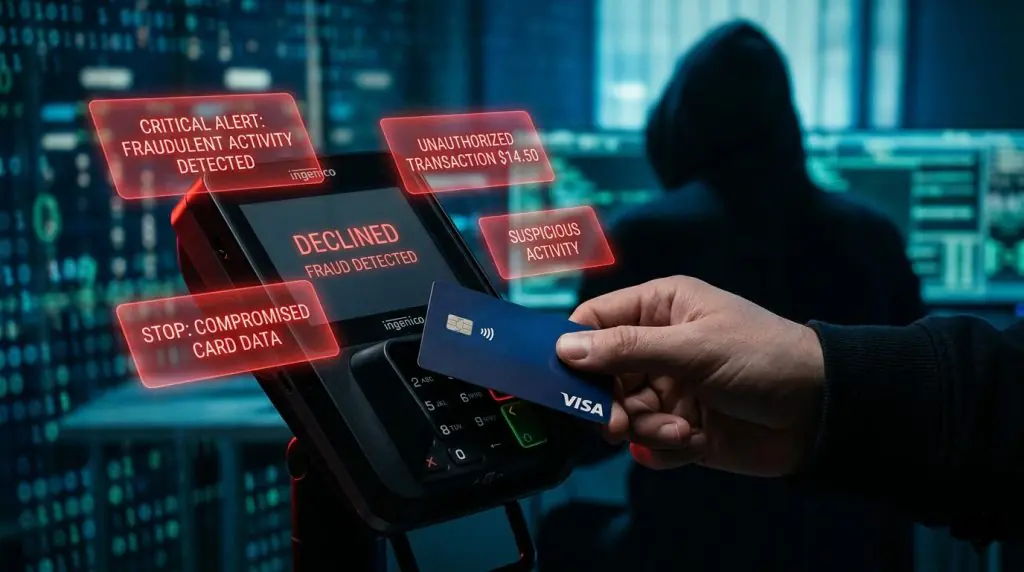
Visa AI fraud 2026 is the story of an arms race and right now both sides are using the same weapon.
Here is something worth thinking about the next time you tap your card to pay for coffee. While you are doing that, Visa’s AI is scanning that transaction against billions of data points, cross-referencing it with signals from fraud networks across dozens of countries, and deciding in milliseconds whether your payment looks legitimate. It has been doing that for years. But in the last two years something changed Visa built a dedicated team whose only job is to hunt criminal networks before they ever reach your card. And that team just hit a milestone that tells you everything about how sophisticated financial crime has become.
Visa’s specialized Visa Scam Disruption team has identified and helped stop more than $2.6 billion worth of fraudulent activity in just over two years of operation.
$2.6 billion. Stopped. Before it reached consumers.
What Visa AI Fraud Detection Looks Like in Practice
The Visa Scam Disruption team does not just monitor transactions. It hunts networks.
Employing advanced analytics, AI, and intelligence gathered from across Visa’s global network, the VSD team detects suspicious activity that may indicate organized criminal operations. The team includes experts from law enforcement and military backgrounds working alongside data scientists and payment specialists.
One operation in Europe shows exactly how this works in practice. The VSD team tracked a widespread survey scam running across social media that promised beauty boxes, digital cameras, and toolkits at bargain prices. Once cardholders made an initial purchase they were unknowingly signed up for recurring payments at much higher sums. The team eventually identified around 1,000 different merchants at 21 European banks, shutting down a scam ring responsible for around $100 million in fraudulent earnings.
One thousand fake merchants. Twenty one banks. One hundred million dollars. And the team found it by following the pattern not the individual transaction.
In another operation, Visa used AI to correlate transactions with IP data and map a network of merchants with similar scam attributes to identify the full infrastructure of the scheme. Visa then shut down nearly 12,000 fraudulent merchants, preventing losses of over $37 million in fraud.
This is what AI powered fraud detection looks like at scale. Not blocking a suspicious card. Dismantling the entire criminal infrastructure behind thousands of suspicious cards simultaneously.
The Problem Is That Criminals Are Using AI Too
Here is the uncomfortable truth that Visa’s announcement carries inside it.
Visa’s Spring 2026 Biannual Threats Report reveals that scams have become the fastest growing source of consumer harm as criminals increasingly use artificial intelligence and social engineering to manipulate people into authorizing payments themselves. From July to December 2025 alone, Visa identified nearly $1 billion in scam-related activity making scams the single largest category of consumer payment fraud.
Michael Jabbara, SVP of Payment Ecosystem Risk and Control at Visa, said: “The rapid adoption of AI has fundamentally lowered the barrier to entry for fraud. What once required deep technical skill can now be executed with a prompt.”
Read that last sentence again. The same AI tools that Visa’s analysts use to identify fraud patterns are available to anyone with an internet connection. The same large language models powering Claude and ChatGPT can generate thousands of personalized phishing emails in seconds. The same AI image tools can create fake websites that are visually indistinguishable from your bank’s login page.
Visa noted that cybercriminals are using AI to automate their attacks rapidly generating thousands of tailored phishing messages designed to exploit individual vulnerabilities rather than sending generic spam. The company’s chief risk officer described it plainly: the industry is now in a situation where you need AI to fight AI.
That framing matters. This is not a technology problem with a technology solution. It is an ongoing arms race where both sides are upgrading their weapons in real time.
What Changed and Why It Matters Now
The additional $1.6 billion in fraud attempts detected since October 2025 alone shows the rapid expansion of scam activity across international markets. The pace is accelerating, not slowing down.
The shift in criminal strategy is equally important to understand. While core payment security continues to strengthen at the network level, criminals are redirecting their efforts away from technical system compromises toward exploiting human trust. Unlike traditional fraud, these attacks typically do not require breaching technology at all.
In plain English: hackers used to break into bank systems. Now they break into people. They call you pretending to be your bank. They send you an email that looks exactly like PayPal. They create a fake version of a website you trust. The technology is secure. The human on the other end of the phone is not. And AI makes every one of those deceptions faster, cheaper, and more convincing than anything that was possible two years ago.
What This Means for You Right Now
The practical takeaways from Visa’s announcement are simple but worth stating clearly.
Your card network is actively hunting fraud networks not just flagging suspicious transactions after the fact. That is a meaningful shift that most consumers do not know about. The $2.6 billion figure is not money that was stolen and recovered. It is money that never left consumers’ accounts because the criminal operation was dismantled before it could complete the fraud.
But Visa’s own data makes clear that the defensive advantage is not permanent. AI tools help fraudsters test, automate, and run scams faster phishing emails used to be generic, but criminals can now rapidly generate thousands of tailored messages to their target audiences, making it significantly more likely that a person will open an email or respond to a text.
The best protection against AI powered scams is not technology. It is knowing that the scams exist, understanding how they work, and developing the habit of verifying before you act especially when something creates urgency, offers something too good to be true, or asks you to move money quickly.
FAQ
How much fraud has Visa’s AI stopped in 2026?
Visa’s Scam Disruption team has identified and helped stop more than $2.6 billion in fraudulent activity over just over two years, including $1.6 billion detected since October 2025 alone.
What is the Visa Scam Disruption team?
It is a specialized unit within Visa’s Payment Ecosystem Risk and Control division that combines AI, data analytics, and experts from law enforcement and military backgrounds to proactively hunt and dismantle global fraud networks before they reach consumers.
Are criminals also using AI for fraud?
Yes. Visa’s own 2026 Threats Report confirms that criminals are using AI to automate scam campaigns, generate personalized phishing messages at scale, and create more convincing fake communications making AI-powered fraud faster and cheaper than ever before.
What is the biggest fraud threat to consumers right now?
According to Visa’s data, scams where criminals manipulate people into authorizing payments themselves are now the single largest category of consumer payment fraud, surpassing traditional card breaches and technical hacks.
How can I protect myself from AI-powered scams?
Verify before you act. Any message creating urgency, requesting payment, or offering something unexpected should be verified through official channels not by clicking links or calling numbers provided in the message itself.
Related Reading
• EU AI Act 2026: What It Means for Every American Tech User
 Claude Fable 5 Moved Behind Paywall Today
  DeepSeek Raised $7.4 Billion and the Investors Got Absolutely Nothing to Show for It
  Google Lost a Nobel Prize Winner to Anthropic and That Is Only Half the Problem
  Regular Investors Outbid Wall Street on SpaceX and Some of Them Already Regret It
  SoftBank’s Masayoshi Son Says Robots Are the Next Trillion Dollar Bet and He Just Put Real Money Behind It
  SpaceX Bought The AI Coding Tool You Use For 60 Billion Dollars
  What Is AGI Artificial General Intelligence in 2026 and Are We Already Living With It?
  The Tokenmaxxing Trap: Reasons AI Budget Startups Are Failing in 2026