Tenaga Nasional Berhad, Malaysia’s national electricity utility, has built what it describes as the country’s first agentic AI defense system for critical infrastructure, and the target it was built to fight is not a hacker or a foreign adversary. It’s illegal cryptocurrency mining, a form of energy theft that TNB estimates drains roughly RM640 million a year across nearly 14,000 identified cases and threatens grid stability for paying customers. The project won the Data & AI category at Malaysia’s Enterprise Innovation Awards, presented July 8-9 at the AIBP Conference in Kuala Lumpur, and it marks one of the clearest examples yet of a national utility putting autonomous, decision-making AI directly into the defense of physical infrastructure rather than just using it for analysis or forecasting.
From Reactive Detection to Predictive Deterrence
The system works by coordinating a network of autonomous agents across several distinct information sources satellite imagery, thermal signatures, social media intelligence, and historical patterns of past theft to predict where illegal mining operations are likely to set up before they actually go live. That is a meaningful shift from how utilities have traditionally handled energy theft, which has mostly meant responding after unusual consumption patterns show up on a meter or a substation reports an anomaly. TNB’s system is built to intervene earlier, shifting enforcement from reactive detection to what the company calls intelligence-led deterrence.
Early results suggest the approach works better than traditional detection alone. In field validation across pilot regions in Kuala Lumpur, Selangor, and Perak, the system achieved a 40% on-site hit rate, meaning enforcement teams dispatched based on the system’s predictions found an active illegal operation roughly four times out of ten. TNB projects RM14 million in revenue protection specifically from the deterrent effect of the program, on top of whatever direct enforcement recovers, and the company has laid out a roadmap to scale the system from its three-region pilot to nationwide coverage.
A Small System Against a Growing Problem
The scale of the underlying theft problem explains why TNB built something this sophisticated rather than simply adding more inspectors. Illegal cryptocurrency mining draws enormous, sustained electricity loads that are deliberately hidden from billing systems, and unlike a single bad meter reading, these operations tend to cluster in industrial and semi-rural areas where legitimate demand is already hard to distinguish from illicit demand using conventional monitoring. Multiplying nearly 14,000 identified cases across a national grid, at RM640 million a year in losses, gives a sense of why TNB frames this as a stability issue for ordinary consumers rather than purely a revenue problem for the utility. Electricity theft at that scale doesn’t just cost money it distorts load forecasting and puts unplanned strain on transmission infrastructure that legitimate customers ultimately share.
The Bigger Grid Story Behind the Headline
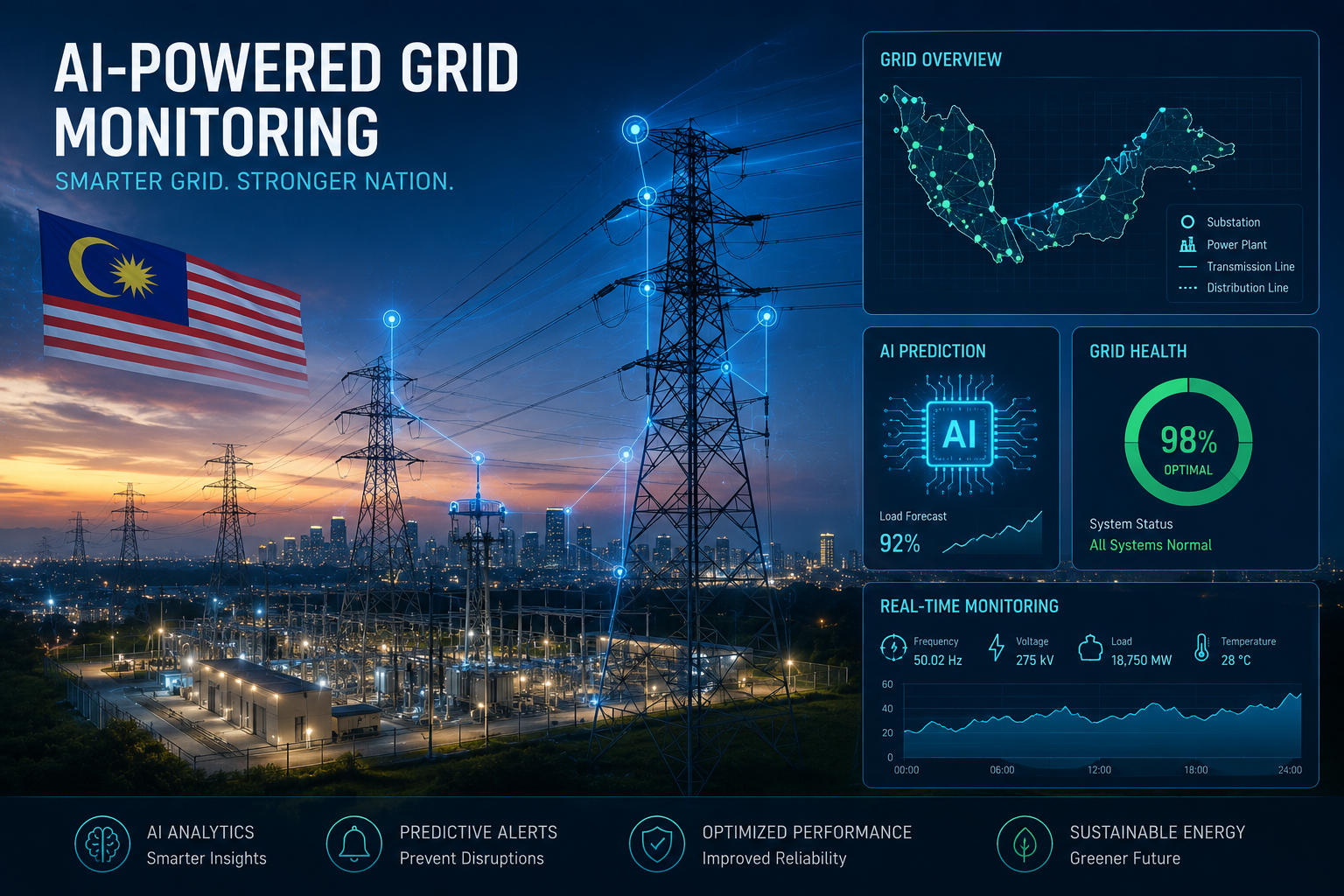
This project doesn’t exist in isolation. TNB is in the middle of a broader modernization effort, with plans to invest RM40 billion over the next two years to upgrade Malaysia’s electricity grid infrastructure, including a wider rollout of AI-enabled smart grid technology. The company has described its broader AI ambitions using the analogy of a smart GPS for electricity, aiming to give itself real-time visibility into how power moves and where problems are forming, rather than relying on the kind of periodic manual monitoring that has historically defined grid operations. Malaysia’s own Energy Transition Conference this year adopted the theme “Energy & AI: The Synergy for Energy Transition,” a reflection of how central this pairing has become to the country’s national energy planning rather than a one-off pilot project.
There’s a genuine irony sitting underneath all of this. Malaysia’s electricity grid is under mounting pressure from the same technology category that’s now helping defend it. Data centre electricity consumption in the country is projected to rise from 7% of total demand today to 31% by 2035, driven largely by AI infrastructure investment concentrated in Johor and other emerging hubs. Peninsular Malaysia’s peak demand is forecast to grow at a compound annual rate of 5.1% through 2035, and much of that growth traces directly back to AI workloads. TNB’s agentic AI system for grid defense and the AI driven data centre boom straining the same grid are, in a sense, two faces of the same technological wave one improving the grid’s resilience, the other testing it.
Why This Matters Beyond Malaysia
TNB’s win came alongside AirAsia’s recognition in the Open category at the same awards, and organizers noted that more than half of this year’s submissions involved AI or machine learning, with a clear shift toward agentic and autonomous systems that act on data rather than simply reporting it. That pattern matters regionally: Southeast Asian utilities and infrastructure operators are increasingly treating agentic AI not as an experimental layer bolted onto existing operations, but as an operational tool making real enforcement and dispatch decisions with measurable financial outcomes attached.
For other national grid operators watching from elsewhere in the region, or beyond it, TNB’s system offers a concrete data point rather than a hypothetical use case: a 40% predictive hit rate and RM14 million in protected revenue are numbers that can be compared, scrutinized, and potentially replicated. Given how many countries are grappling with both AI driven electricity demand growth and long-standing infrastructure theft problems, a validated agentic system built specifically for grid defense is likely to draw interest well beyond Malaysia’s borders.
The Bottom Line
What makes TNB’s system notable isn’t the novelty of using AI in a utility plenty of national grids already run forecasting and anomaly-detection models. It’s the shift to autonomous agents that coordinate across disparate data sources and make enforcement-relevant predictions before losses occur, applied to a problem, energy theft, that has resisted purely technical fixes for years because it depends on human concealment as much as electrical anomalies. Malaysia’s grid faces genuine strain from the AI boom itself, through surging data centre demand that will consume nearly a third of the country’s electricity within a decade. That the same country is now using agentic AI to plug one of its oldest revenue leaks is a reminder that the technology reshaping electricity demand can also be turned toward protecting the system that has to absorb it.





Leave a Reply