Nvidia is rejecting reports that its next-generation Kyber NVL144 AI server rack has slipped into 2028, setting up a public disagreement over the company’s roadmap at a time when hyperscalers are planning their next wave of AI infrastructure investments. Research firm SemiAnalysis reported on Monday that Kyber, the rack architecture designed to house Nvidia’s 2027 Rubin Ultra chips, has been delayed by more than 12 months because of manufacturing problems with a critical circuit board. Nvidia’s response was brief and unambiguous: a company spokesperson told reporters, “Our roadmap is intact.”
That two-sentence denial doesn’t settle much on its own, but the underlying dispute matters well beyond one product’s release date. Kyber represents the next step in Nvidia’s strategy of packing more chips into a single interconnected rack, and any slippage in that timeline creates room for rivals like AMD and Google to compete more aggressively at the high end of AI infrastructure a market Nvidia has dominated largely because no one else could match its pace.
The Circuit Board at the Center of the Dispute
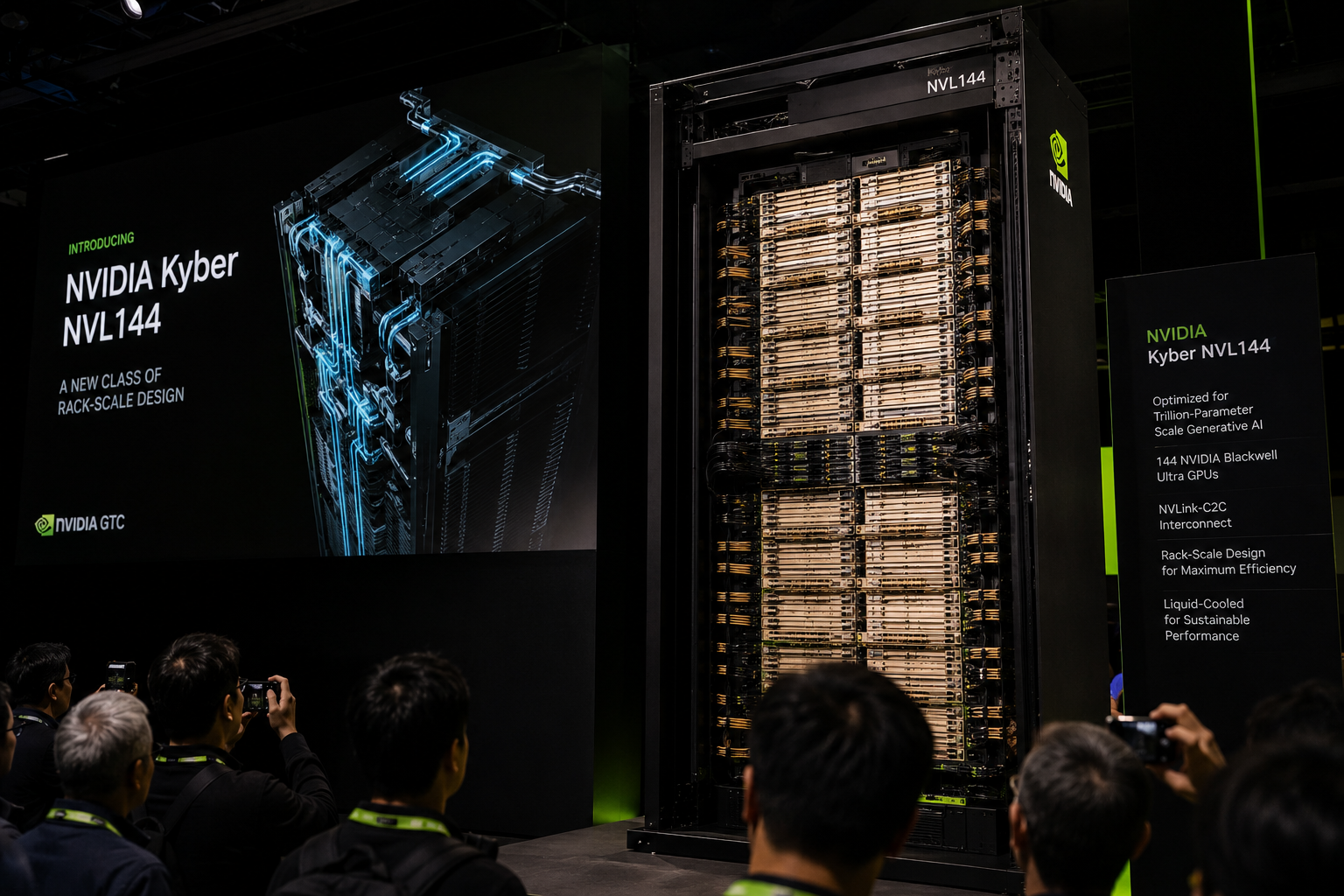
Kyber is the codename for a server cabinet built to hold 144 of Nvidia’s Rubin Ultra GPUs, mounted vertically rather than horizontally to increase density and cut latency between chips. CEO Jensen Huang personally showed off the design at Nvidia’s GTC conference in March, presenting it as the natural successor to the company’s current 72-chip racks. SemiAnalysis says the problem isn’t the GPUs themselves but the PCB midplane, a specialized multi-layer circuit board reportedly as many as 78 layers that carries power and high-speed NVLink signals across the rack without relying on thousands of individual cables. According to the firm, that board “remains challenging from a manufacturability standpoint,” a technical bottleneck serious enough to push the entire system’s release from 2027 into 2028.
SemiAnalysis also reported that Nvidia had developed a fallback design, called NVL72x2, that would have bolted together two of its current-generation racks to approximate Kyber’s power output. That workaround has reportedly been scrapped after cloud service providers and hyperscalers pushed back, calling the design awkward and operationally costly to run at scale.
A larger system called NVL576, which would link eight Kyber racks through optical connections, is also said to face delays or limited production volume, according to the report. Taken together, SemiAnalysis argues Nvidia currently lacks a proven way to expand its scale-up architecture for Rubin Ultra beyond what current racks already offer.
A Muted Market Reaction, So Far
Investors did not treat the report as a crisis. Nvidia’s stock moved only modestly on the news, with different outlets describing the reaction as flat, slightly up, or down by roughly 1%, depending on the trading window measured a range that suggests uncertainty rather than alarm. The more pronounced reaction showed up elsewhere: shares of Asian PCB and component suppliers, including firms tied to advanced circuit board manufacturing, fell after the report circulated, a sign that investors see the story as relevant to Nvidia’s supply chain as much as to Nvidia itself.
The distinction matters because a delay in a next-generation product is not the same as a drop in current demand, and SemiAnalysis itself struck an unusually bullish note on Nvidia’s near-term financials even while reporting the setback, projecting the company’s data-center compute revenue could exceed Wall Street’s consensus estimate for the second half of fiscal 2027 by roughly 20%. Nvidia’s existing Rubin systems have reportedly entered full production, with deliveries to major cloud customers, including Amazon Web Services, Microsoft Azure, and Google Cloud, scheduled to begin this fall. Whatever is happening with Kyber, it hasn’t touched the product line actually shipping right now.
Manufacturing Is Becoming the Competitive Battleground
The specifics of the Kyber report point to a shift that extends well beyond Nvidia. For years, the pace of AI hardware progress was set largely by chip design how many transistors could be packed onto a die, how efficiently a GPU could handle matrix math. Increasingly, the constraint sits somewhere else entirely: in packaging, in cooling, in power delivery, and in the physical circuit boards that connect thousands of chips into something that behaves like a single computer.
A 78-layer PCB midplane is not a component that a company can simply order more of when demand rises. It requires manufacturing precision at a scale the industry has not needed before, and Nvidia’s own supply chain, spread across Taiwan and other manufacturing hubs, has to catch up to specifications the company’s design teams have already finalized on paper. That gap between engineering ambition and manufacturing reality is exactly where SemiAnalysis says Kyber has stalled.
This is also why the report specifically named co-packaged optics, the technology that integrates optical components directly into chip packaging, as a factor shaping whether Nvidia’s larger NVL576 configuration ships on any reasonable timeline. Optical interconnects, board complexity, and thermal design are no longer supporting details in an AI hardware story. They are becoming the story, and any company racing to build the next generation of AI infrastructure Nvidia included now has to solve manufacturing problems at the same pace it solves architectural ones.
The Bottom Line
Nvidia denying a delay it hasn’t detailed, and a research firm publishing a delay it can’t fully verify from outside the company, leaves this story genuinely unresolved, and that’s worth stating plainly rather than picking a side prematurely. What is clear is that Nvidia’s current-generation Rubin systems are shipping on schedule to major cloud customers this fall, and that whatever happens with Kyber NVL144 won’t be felt for at least another year.
The debate over Kyber isn’t really about one server rack. It’s about whether Nvidia’s pace of AI hardware innovation is beginning to collide with the physical realities of manufacturing increasingly complex systems circuit boards with dozens of layers, optical interconnects still maturing, and cooling and power demands that scale faster than factories can adapt. Rivals don’t need Nvidia to stumble badly to gain ground. They just need enough daylight to make their own rack designs look competitive for a year or two, and this report, confirmed or not, is already giving them that opening.




Leave a Reply