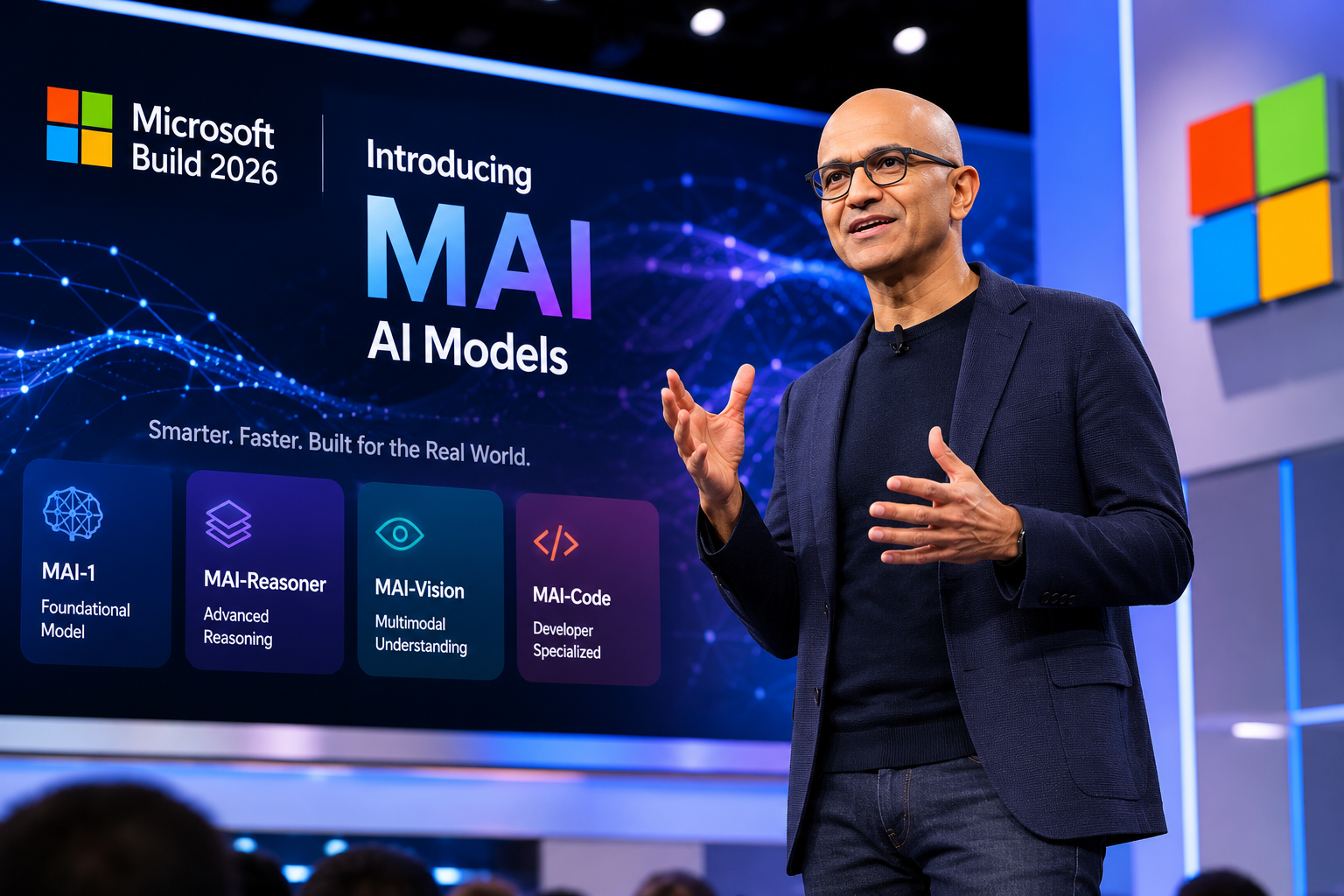
When Microsoft took the stage at Build 2026 in San Francisco, the announcement did not sound like a break from OpenAI. It sounded like a company insuring itself against a bet it had already made. Seven new artificial intelligence models, built entirely in-house under the internal brand MAI, went live without a single line of code borrowed from OpenAI’s technology. Microsoft’s AI strategy has been inseparable from its relationship with OpenAI for most of the past three years, anchored by a $13 billion investment and an exclusive Azure partnership that made the two companies feel like one entity to much of the industry.
Build 2026 did not end that arrangement. It gave Microsoft something it never had before: a credible alternative to point to. This is not a story about Microsoft replacing OpenAI. It is a story about Microsoft reducing how much its future depends on any single partner, including the one it helped build into the most valuable AI company in the world.
From Partner to Competitor
The relationship began as a bet with obvious upside on both sides. Microsoft’s primary role in the AI boom had been supplying cloud infrastructure and services while taking multibillion dollar equity stakes in OpenAI and, later, Anthropic. Azure gave OpenAI industrial scale compute it could not have built alone. OpenAI gave Microsoft a story about what came after Windows and Office a reason for enterprises to see Microsoft as an AI company rather than a software company adapting to one.
That arrangement worked cleanly while the two companies’ interests pointed the same direction. They no longer do. OpenAI evolved from a research supplier into a platform company with its own enterprise customers, developer ecosystem, and consumer brand, while Microsoft evolved from a distributor into a product company whose margins depend on minimizing what it pays outside vendors. Both positions are reasonable on their own terms. Together, they created friction that showed up in April, when the two companies quietly restructured their agreement.
The new terms tell the real story. Microsoft remains OpenAI’s primary cloud partner, but OpenAI can now serve its products across other cloud providers. Microsoft keeps a license to OpenAI’s intellectual property through 2032, but that license is non exclusive, and Microsoft has stopped paying OpenAI a revenue share, even as OpenAI’s payments to Microsoft continue through 2030 under a capped arrangement. Neither company called it a breakup. It reads more like two partners renegotiating leverage before their paths diverge any further and Build 2026 is the clearest evidence yet of where Microsoft intends to take its half of that divergence.
Building the MAI Model Family
The MAI lineup is not a single flagship trying to prove a point. It is a stack. MAI-Thinking-1, Microsoft’s first reasoning model, runs on 35 billion active parameters with a 256,000-token context window, and the company has stressed that it was built from scratch without distilling from any other lab’s models a detail aimed directly at enterprise customers wary of where their AI’s training data actually originated. MAI-Code-1-Flash, a lighter coding-focused model, is now woven directly into GitHub Copilot and Visual Studio Code. Five additional models round out the family, covering image generation, transcription, and voice synthesis.
Microsoft has leaned hard on benchmark comparisons to make its case. In blind evaluations, the company says MAI-Thinking-1 was preferred over Anthropic’s Claude Sonnet 4.6 and performed on par with Claude Opus 4.6 on the SWE-Bench Pro coding benchmark. It also claims a Frontier Tuning process, which adapts a model inside a customer’s own compliance boundary, lifted one internal task’s completion rate from 13% to 87%, with an Excel-tuned version reportedly matching a frontier OpenAI model at up to ten times lower cost. These are Microsoft’s own figures, unverified externally, and deserve the same skepticism any company’s self-reported benchmarks warrant. But the economic logic behind them is straightforward regardless of the exact numbers: running models on Azure instead of licensing them from an outside vendor lets Microsoft avoid paying royalties on every token, savings it can then pass to developers as frontier-model pricing climbs elsewhere.
Owning More of the AI Stack
The model launch was only half of what Microsoft showed at Build. The other half was silicon and infrastructure built to run those models more cheaply than anyone else’s hardware could. Microsoft said the MAI models were co-designed alongside its Maia 200 inference accelerator, with efficiency gains coming specifically from pairing the two. Azure’s new Cobalt 200 Arm-based virtual machines, still in preview, are aimed at the same goal from the infrastructure side, targeting Linux-based agentic workloads with what Microsoft describes as significant processor gains.
This is the part of the strategy that separates a marketing moment from an actual structural shift. A company that owns its models, its chips, and the cloud they run on does not need to win every benchmark to change the economics of enterprise AI. It needs its stack to be good enough, cheap enough, and deeply enough embedded into tools people already use Windows, Azure, GitHub that switching away becomes more trouble than it is worth. That is the same playbook Google has run for years by pairing Gemini with its own tensor processing units, and that Amazon has run by pairing Nova models with Trainium chips. Microsoft spent three years watching that approach from the sidelines while OpenAI carried its AI ambitions. Build 2026 is the moment it decided to build the sidelines into infrastructure of its own.
A Different Competitive Landscape
Microsoft’s timing lands in the middle of a wider industry recalibration. Anthropic confidentially filed for a U.S. IPO on June 1, and OpenAI is reportedly pursuing a public offering of its own, meaning both companies now face investor scrutiny over whether their revenue can eventually justify the capital being spent on frontier training. Microsoft occupies an unusual position in that story: it is financial backer, cloud host, and increasingly direct competitor to both companies at once, a triple role that gives it more leverage than almost anyone else in the industry but also more exposure if any one relationship sours.
That exposure cuts in a specific direction. If OpenAI comes to see Microsoft’s MAI models as a genuine threat rather than a hedge, it has options it has already begun diversifying its own infrastructure toward Oracle and the Stargate project, and further movement away from Azure would cost Microsoft real cloud revenue. Google and Amazon, meanwhile, are watching a rival hyperscaler validate the vertical-integration strategy they have both pursued for years, which strengthens the case that owning the stack, not renting it, is becoming the industry’s default posture rather than an unusual one.
Microsoft’s Long Term Bet
None of this happens overnight, and Microsoft has been careful not to pretend otherwise. MAI models do not yet handle most production traffic inside Copilot, where OpenAI and Anthropic’s systems still do the bulk of the work the practical dependency remains even as the strategic one loosens. Microsoft still needs Nvidia for training compute and chip partners like Qualcomm for the devices running its AI agents, a reminder that full independence isn’t really on offer to anyone in this industry yet.
The rollout plan reflects that gradualism. Microsoft says MAI models will ship as open-weight under permissive licenses, alongside compact edge versions built to run on Qualcomm and Intel NPU-equipped Windows PCs without needing a cloud connection at all a fundamentally different commercial relationship than licensing a model from a partner whose own pricing is still being negotiated in public. One industry forecast expects MAI models to power the majority of Copilot’s features by late 2027, with Microsoft substituting its own models for OpenAI’s wherever quality allows. That is a projection, not a promise, and Microsoft’s own history with earlier in-house efforts suggests the timeline could slip well past it.
The Bottom Line
The headline from Build 2026 was never really about seven new models. It was about Microsoft deciding it no longer wants its AI future to be a story someone else gets to write. For three years, Microsoft’s advantage was distribution it hosted, funded, and packaged OpenAI’s research faster than any rival could respond. That advantage is now colliding with a harder truth: the partner Microsoft built into a category-defining company has its own ambitions, its own customers, and its own path to the public markets, and none of those paths require staying inside Microsoft’s stack forever.
Owning models, chips, and cloud infrastructure together doesn’t mean Microsoft is walking away from OpenAI. It means Microsoft is making sure that if OpenAI ever walks away from it, the company has something of its own left standing. That is a slower, quieter kind of strategy than a product launch, and it is exactly why it is the one worth watching.
external sources:
CNBC coverage of the Build 2026 MAI launch; Forbes analysis of Microsoft’s AI stack strategy; Windows Central report on the seven MAI models; reporting on the April Microsoft-OpenAI agreement restructuring



Leave a Reply