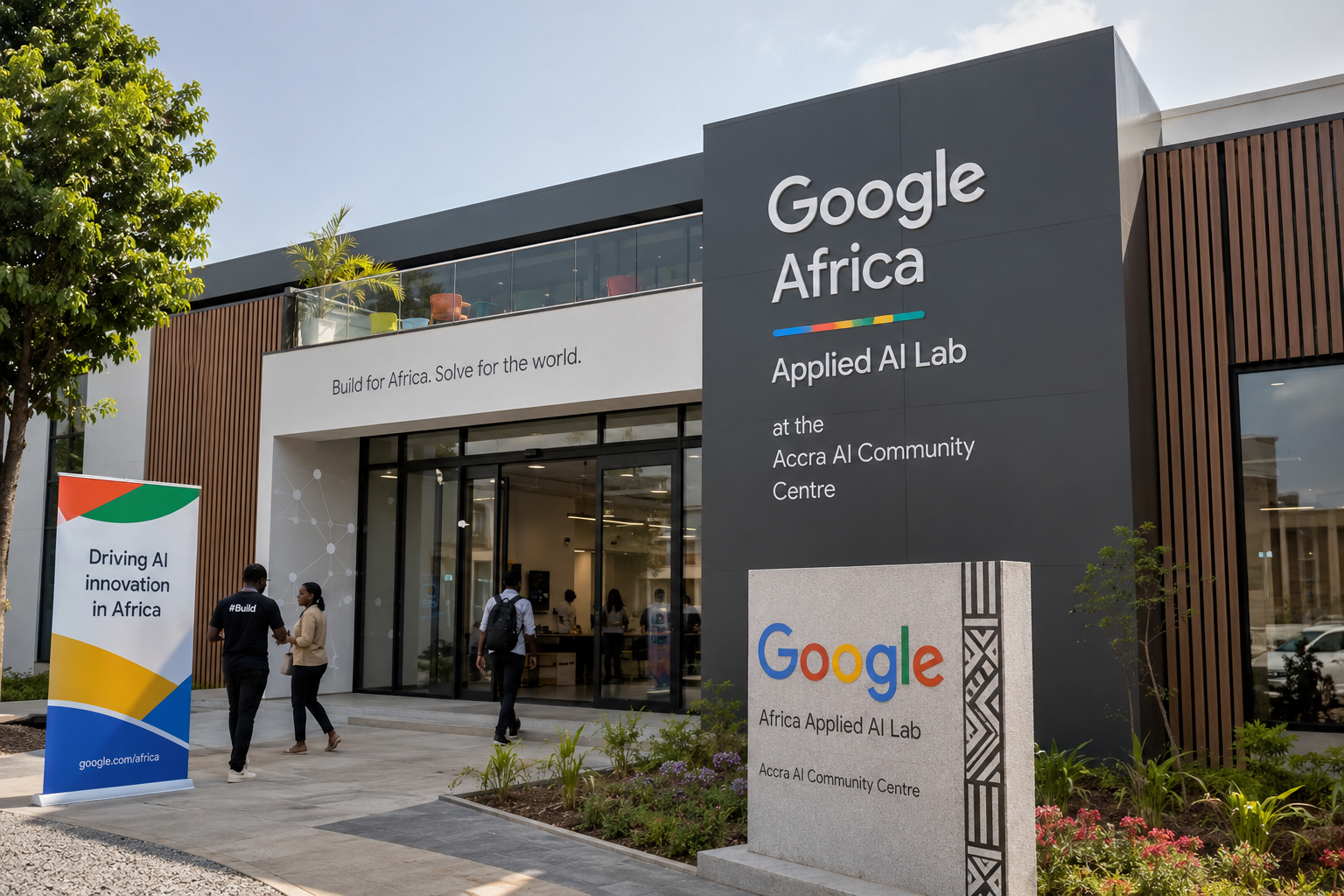
Google will launch Africa’s first applied artificial intelligence laboratory in Accra, aiming to help African startups build AI-powered products and scale them into globally competitive businesses. The company announced the initiative on July 1 in Johannesburg during its first Google Cloud Summit in Africa, where it also confirmed it had exceeded its goal of investing $1 billion on the continent over five years. Named the Google Africa Applied AI Lab, the facility will be based at the AI Community Centre in Accra, pairing African founders and researchers directly with Google experts and giving them early access to the company’s latest AI models before those models reach the general market.
The lab’s stated ambition is specific and deliberately outsized: helping build Africa’s first generation of AI-native unicorns, privately held companies valued above $1 billion. That framing matters because it signals Google isn’t positioning this as a research grant or a training program, but as a commercialization bet on a continent that has produced only a handful of billion dollar startups so far, nearly all of them in fintech.
From Research to Commercialization
Accra wasn’t chosen arbitrarily. Google opened Africa’s first AI research center in the city in April 2019 under Senegalese researcher Moustapha Cissé, and that center has spent the years since working on flood forecasting, maternal health, food security, and African-language AI tools foundational research rather than commercial products. In July 2025, Google expanded its footprint with the AI Community Centre, backed by $37 million in funding for research, training, and infrastructure.
The Applied AI Lab represents a deliberate shift in what that Accra presence is for. Rather than functioning as a traditional accelerator or classroom-based training program, the initiative centers on collaborative product development between Google experts and selected startups, with the explicit goal of bridging the gap between world-class foundational research and market-ready products. In other words, Google is moving its seven year old Ghana research investment from generating papers and prototypes toward generating companies.
How the Program Works
The lab organizes its work around five thematic areas Google has identified as the technological futures most likely to reshape the continent: the future of work, knowledge, software development, creativity, and entertainment. Selected startups receive early access to cutting-edge models from Google DeepMind, including Gemini, Gemma, and Veo, to experiment with commercial use cases ahead of public release, along with hands-on technical mentorship from Google Research and go to market support from venture capital partners including 4DX Ventures, Norrsken22, Novastar Ventures, and Ventures Platform.
Who Can Apply
Structurally, the program favors substance over prestige. Preference goes to startups with funding and commercial traction, from pre-seed through Series A, though Google says it will consider founders and researchers at earlier stages with strong ideas and credible plans. Participation doesn’t require giving up equity, though selected teams may be approached separately with funding offers from the Google AI Futures Fund or its VC partners. Applications opened July 1 and close August 31, with an initial co-development period running from mid-September to early December, culminating in an in-person demo day at the Accra centre where startups present to Googlers, investors, and partners.
Part of a Broader Johannesburg Package
The Accra lab was one of five initiatives Google unveiled at the Johannesburg summit, presented to roughly 3,000 attendees as part of a broader push the company is framing as a turning point for its African investment strategy. The others included a new undersea connectivity hub in South Africa’s Eastern Cape and an accelerator supporting 15 South African startups, part of a wider commitment to back 50 African ventures between 2024 and 2028. South African President Cyril Ramaphosa opened the summit by describing the moment as Africa stepping “boldly into the age of artificial intelligence,” positioning the country as a catalyst for the continent’s broader digital growth.
Google’s own account, delivered by senior vice president James Manyika, tied the announcement directly to the company’s existing five-year African investment commitment, framing the AI opportunity for the continent as significant and the new initiatives as building on infrastructure, innovation, and skills work already underway. That framing is worth taking with the usual caution applied to any company’s account of its own philanthropic and commercial strategy Google’s Africa investments also serve Google’s long-term interest in expanding cloud and AI market share on a continent every major technology company is now competing for.
Why Africa’s Unicorn Gap Matters Here
The context that makes this lab more than another corporate accelerator program is the size of the gap it’s trying to close. Africa has produced comparatively few unicorns relative to its population and growing technology talent pool, and the ones it has produced skew heavily toward fintech in Nigeria, Egypt, and South Africa sectors with clearer, faster paths to revenue than AI research typically offers. Whether AI-native companies can follow that same path, built on foundational model access rather than payment infrastructure, is genuinely untested at scale on the continent.
That’s the real experiment embedded in this lab, beyond the mentorship and model access. Google is betting that pairing African founders with frontier AI tools before those tools are publicly available gives them enough of a head start to build genuinely competitive, differentiated products rather than applications that could be replicated once anyone with an API key can access the same underlying models.
The Bottom Line
What distinguishes this initiative from Google’s earlier Accra investments is its explicit commercial intent this is a company betting that access to unreleased AI models, paired with hands-on technical mentorship, can compress the years it typically takes an African startup to move from an interesting idea to a fundable, scalable product. The real test won’t arrive with the December demo day itself, but with what happens after it: how many of the cohort’s products leave with paying customers or term sheets rather than polished prototypes, and whether any of them are still operating, let alone scaling, a year from now. That’s the number worth tracking, far more than the $1 billion headline figure Google attached to this launch.




Leave a Reply