Defense planners across major militaries are rethinking what a soldier’s job actually looks like. For most of the past century, technology sped up how quickly a human could act better rifles, faster jets, more precise artillery. Artificial intelligence changes the more basic question of who, or what, does the acting in the first place. AI is no longer a speculative frontier technology; it is now a structuring force in global power competition, reshaping how states gather intelligence, conduct warfare, project influence, manage borders, secure cyberspace, and even shape public perception. That shift is why India, alongside the United States, China, NATO, and Japan, is now treating AI-enabled defense as core strategy rather than an experimental sideline.
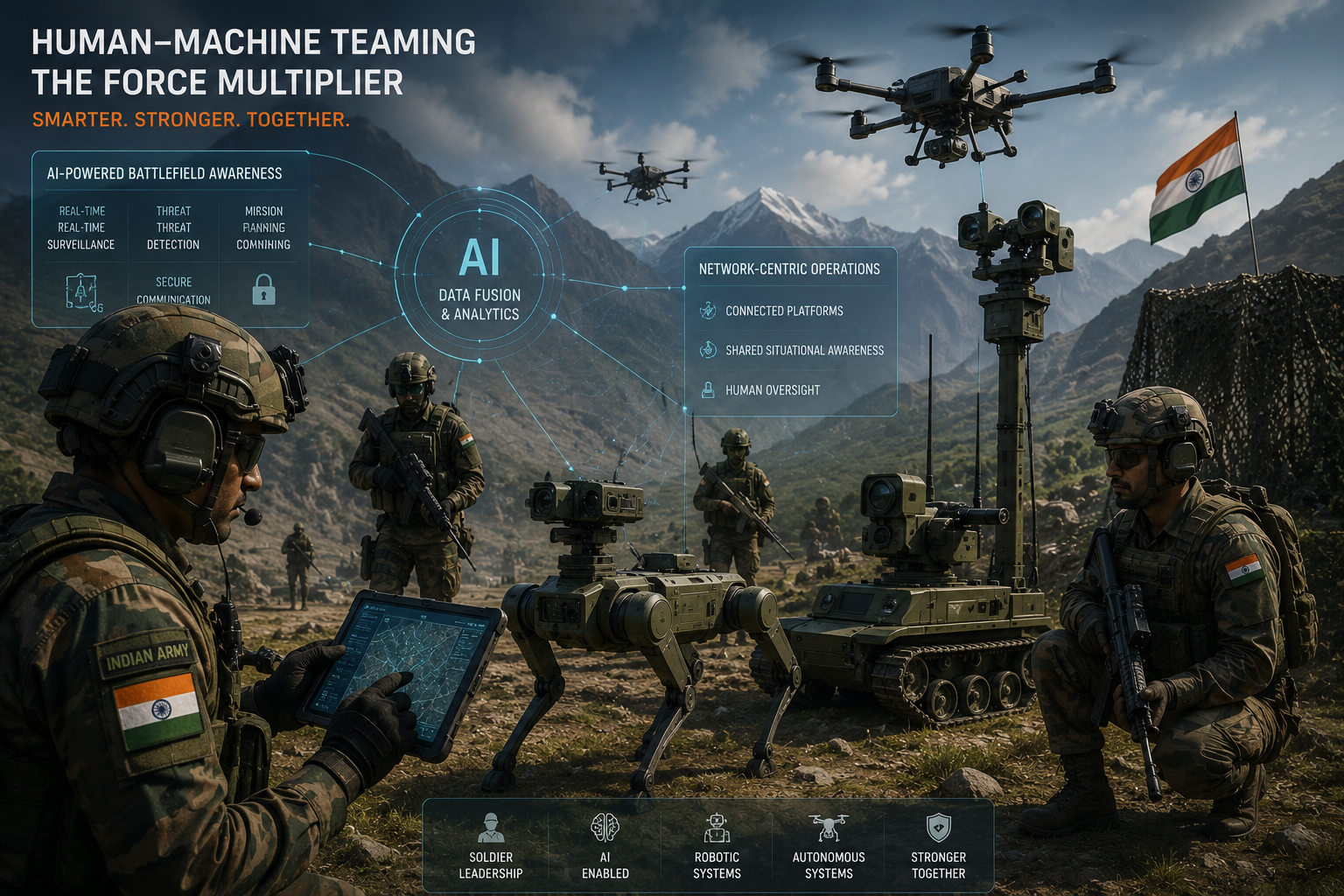
According to Indian defense trade reporting, the country’s emerging approach centers on a concept called Human Machine Teaming, and the core philosophy driving the effort is not to replace human soldiers but to establish AI-driven robots acting as force multipliers that take on exhausting and dangerous duties while human commanders retain full control over critical battlefield decisions.
What Human Machine Teaming Means for India
The most concrete example of this vision comes from the Defence Research and Development Organisation’s Research and Development Establishment (Engineers), based in Pune. As of mid-2026, the lab’s military grade humanoid programme has reached advanced testing phases, with a target completion date of 2027, (Defence News India) aiming to build a bipedal robot capable of navigating jungles, mountains, and urban combat zones where wheeled vehicles struggle. The immediate goal is preserving human life by sending machines into areas contaminated by improvised explosive devices, heavy gunfire, or chemical hazards, rather than exposing soldiers directly to those risks.
That humanoid effort sits inside a broader institutional structure. The Indian Army’s wider strategy does not rely on isolated machines; it champions what officials describe as a “centaur” approach, building integrated units where human troops and AI driven platforms operate side by side. Early AI software tools, referred to in reporting as Tadai and Ekalavya, are already being used to assist with target engagement and resource management, serving as precursors to a future where physical, intelligent machines provide real-time tactical support to commanders. Elsewhere in the force, the broader roadmap includes AI driven ISR systems for real time battlefield intelligence, automated target recognition drawing on platforms like the Netra UAV, and unmanned ground vehicles for logistics and mine detection in hazardous terrain.
A Vision Built From Defense Reporting, Not a Government White Paper
It’s worth being precise about what this account is, and isn’t. India has not published a single, unified national doctrine formally titled “Human-Machine Teaming.” What exists is a mix of defense trade journalism, DRDO program updates, and commentary from research institutes and retired officials describing a direction the country’s armed forces appear to be moving in, based on publicly available reporting rather than a formal government announcement. One recent academic analysis found that while India possesses strong technological potential and human capital, structural and institutional constraints currently limit the effective integration of AI into military operations a notably more cautious assessment than the headline ambitions suggest.
Indian officials have also been careful, at least in public forums, to frame this as augmentation rather than autonomy. At this year’s defense summit in Bengaluru, senior military leaders stressed that while AI is transforming warfare, human judgment must remain central, with officials stating clearly that AI can support decision-making but cannot replace human thinking. That distinction, between AI-assisted decisions and AI-made decisions, is the thread running through nearly every piece of Indian defense reporting on this topic, and it’s a meaningfully different posture from some of what other militaries are already fielding.
How India’s Approach Compares
Set against its counterparts, India’s reported direction looks deliberate rather than laggard, though the pace differs sharply by country.
United States
Washington has moved furthest toward full autonomy in practice. The fiscal year 2026 defense budget carved out a dedicated $13.4 billion line specifically for AI and autonomous systems, and the core intelligence system used by U.S. combatant commands is expected to transmit fully machine-generated intelligence to commanders by June 2026, with no human hands involved in generating or distributing that content. The Pentagon has also formed a dedicated Barrier Removal Board to waive testing requirements that slow AI fielding, signaling a tolerance for governance risk in exchange for deployment speed that India has not publicly matched.
China
Beijing’s approach runs through civilian-military integration rather than a standalone defense budget line. China’s 2017 AI strategy aims to make the country the global AI leader by 2030, including military superiority through what it calls intelligentised warfare, with the PLA already using AI for facial recognition, satellite tracking, cyber operations, and decision-making tools, aided by collaborations with technology companies like Baidu and Alibaba under a “military-civil fusion” doctrine.
NATO and Japan
NATO and Japan sit somewhere between India’s cautious framing and the more aggressive US posture. NATO sees military AI as moving from the margins of experimentation into the core of how the alliance will fight and make decisions over the next decade, driven partly by demographic pressures and shrinking human force structures that are pushing militaries toward greater robotic integration, while a joint study with NATO’s Command and Control Centre of Excellence has specifically examined how Human-Machine Teaming can strengthen command and control at the operational level in an increasingly complex, multi domain environment.
Japan, meanwhile, has moved to formalize its own capability rather than build entirely in house. Japan’s Defense Ministry assembled a 30 member internal group to modernize its military capabilities around next generation drone and AI warfare strategies, drawing on operational lessons from the war in Ukraine, and separately, Japan has applied to join NATO’s DIANA project, which accelerates the development of AI and other advanced defense technologies a move that, if approved, would make Japan the first non-NATO member to participate.
Why the Investment Makes Sense, Without the Hype
It’s tempting to read stories like India’s reported humanoid soldier program as a leap toward autonomous killer robots, and that framing gets the emphasis backwards. The stated rationale across nearly all of these programs is narrower and more practical: reduce casualties, process more battlefield data than human analysts can handle alone, and keep pace with rivals who are investing regardless. India’s own strategic thinkers frame this shift around decision speed dominance, where victory increasingly depends on processing, interpreting, and acting on data faster than an adversary, alongside data-centric operations where intelligence, logistics, and targeting all revolve around large-scale data fusion. Recent operational experience appears to be reinforcing that logic directly: the Indian Army has reportedly fast-tracked its AI integration timeline following lessons drawn from Operation Sindoor in May 2025, a cross-border operation that Indian defense commentary has repeatedly cited as validating the need for faster, AI-assisted battlefield decision making.
None of this means the risks are hypothetical or distant. Scholars examining India’s defense AI strategy have specifically flagged that the formulation of an AI centric military doctrine must address human machine interaction protocols, escalation management, and ethical boundaries for autonomous systems, precisely because those questions remain unresolved even as the underlying hardware and software programs advance. The honest picture is one of parallel tracks: real capability development moving faster than the doctrine meant to govern it, a pattern visible in Washington and Brussels as much as in reporting on New Delhi.
The Bottom Line
What India’s reported push toward Human-Machine Teaming really describes is a familiar pattern playing out on a compressed timeline: military capability advancing through research labs and pilot programs faster than any government has fully codified how, or how far, that capability should be allowed to go. India’s own framing, at least in public, leans toward caution machines assist, humans decide but that framing is aspirational rather than settled law, and the gap between DRDO’s testing labs and a formal national doctrine remains real. It’s worth restating that much of what’s described here comes from defense trade reporting and institutional commentary rather than an official government white paper, a distinction that matters if these plans evolve. The comparison with Washington, Beijing, Brussels, and Tokyo doesn’t put India ahead or behind in any simple sense; it shows a group of very different militaries converging on the same underlying bet, that decision speed and reduced human exposure to risk are now central to fighting effectively. Whether India, or any of them, gets the human-machine balance right will likely be decided less by lab demonstrations than by how these systems perform, and are governed, under actual operational pressure.
External sources:
Defence News India report on DRDO’s humanoid robot programme; Observer Research Foundation analysis of AI and India’s national security; Atlantic Council report on NATO’s AI integration; Army Recognition report on Japan’s AI defense team





Leave a Reply