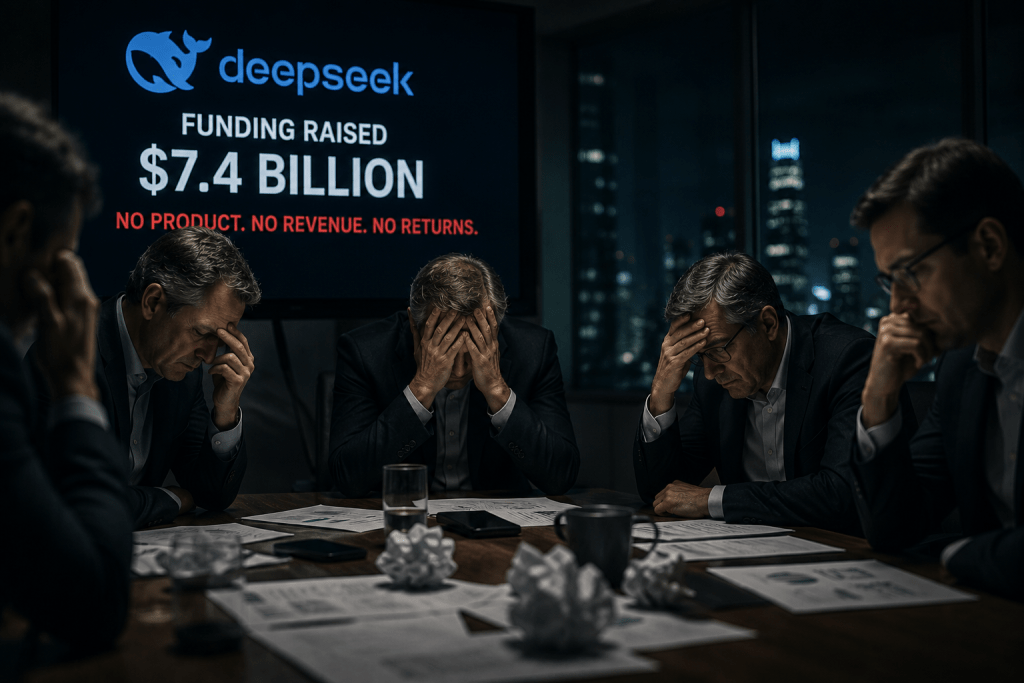
There are investment deals. And then there is whatever DeepSeek just pulled off.
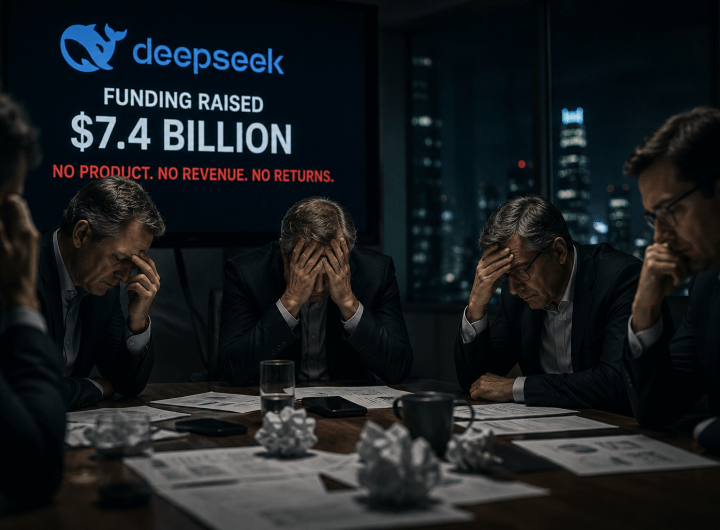
The Chinese AI company that scared Silicon Valley half to death in January 2025 just closed its first ever outside funding round $7.4 billion, the largest private AI financing in Chinese history. The investors who wrote those enormous cheques include some of the biggest names in Chinese technology. And almost every single one of them walked away with no voting rights, no direct ownership in the company, and their money locked up for five years with no way out.
One of them handed over $1.4 billion for that privilege.
This is the DeepSeek $7.4 billion funding deal 2026 story. And to understand why it happened this way why some of the savviest investors in Asia agreed to terms that would make a first-year business school student laugh out loud you need to understand where DeepSeek came from, what it built, and what it is actually worth to the people who control it.
How This Company Came From Nowhere Before the DeepSeek $7.4 Billion Deal
Most people outside of tech circles had never heard of DeepSeek before January 2025. That changed overnight.
DeepSeek was founded in July 2023 by Liang Wenfeng, the co-founder of a Chinese quantitative hedge fund called High Flyer. Unlike Western competitors that relied on venture capital or big tech cloud subsidies, DeepSeek financed itself entirely from the fund’s own resources until this round. (Fundup AI) No outside investors. No Silicon Valley backers. No billion dollar Series A. Just a hedge fund billionaire, a team of researchers, and a cache of Nvidia chips that High Flyer had been quietly accumulating before the US export bans kicked in.
What they built with those chips genuinely shocked the world.
In late 2024, DeepSeek released its V3 model free, open source, trained with less powerful chips and at a fraction of the cost of models built by OpenAI and Google. Then in January 2025, it released R1, a reasoning model that hit similar benchmarks or outperformed many of the world’s leading AI systems. DeepSeek revealed it had built R1 in just two months for under $6 million.
Read that again. Under $6 million. OpenAI reportedly spent around $100 million training GPT-4.
By January 27, 2025, DeepSeek surpassed ChatGPT as the most downloaded freeware app on the iOS App Store in the United States, triggering an 18% drop in Nvidia’s share price. (Fundup AI) President Trump called it a wake up call for American firms. Nvidia lost roughly $600 billion in market capitalisation in a single day the largest single day loss in stock market history at that point.
A Chinese startup nobody had heard of, built with money from a hedge fund, running on chips that weren’t even state of the art, had just shaken the most valuable AI ecosystem on earth to its core. That is the company that just raised $7.4 billion. And that context matters enormously for understanding why investors were willing to accept almost nothing in return for their money.
What the DeepSeek $7.4 Billion Funding Deal in 2026 Actually Looks Like
DeepSeek closed its firstever external funding round, raising more than $7.4 billion in a deal whose governance structure matters as much as its size. (International Banker)
Here is the structure, broken down simply.
Every commercial investor the companies and funds that wrote cheques did not put their money directly into DeepSeek. Instead, capital flowed into a limited partnership managed by CEO Liang Wenfeng himself. As a result, investors receive no direct equity in the company, no voting rights, and are subject to a five year lock up. Secondary sales or quick exits are off the table entirely. (Google)
You are not buying a piece of DeepSeek. You are putting money into a fund that Liang controls, which is connected to DeepSeek, and you cannot touch that money for five years. If the company becomes the most valuable AI firm in the world tomorrow, you have no say in what happens next.
The single largest backer in the round is the founder himself. Liang contributed roughly $3 billion approximately 40% of the total round. Tencent invested around $1.4 billion. Battery maker CATL contributed approximately $600 million. Rounding out the group is China’s National Artificial Intelligence Industry Investment Fund the state vehicle Beijing uses to channel capital into strategic technology sectors. (Google)
Now here is the part that makes the whole structure snap into focus.
There is one exception to the no rights structure. China’s National Artificial Intelligence Industry Investment Fund received direct corporate ownership, voting rights, and freedom from the lock-up. It bypasses the limited partnership wrapper entirely. (International Banker)
So in plain English: the Chinese state gets equity, votes, and liquidity. Everyone else gets a receipt and a five year wait.
Liang reportedly also personally vetted the identities of the backers behind the investing funds, to ensure that unknown or foreign capital could not end up holding shares. The structure is plainly designed to preserve the founder’s control and seal off the investor base. (Google)
Why Would Anyone Agree to These Terms? The DeepSeek Funding Logic Explained
This is the question every normal person reading this deal should be asking.
Why would Tencent one of the most sophisticated technology conglomerates in the world, a company that has made some of the smartest investments in Chinese tech history hand over $1.4 billion for zero votes and a five year prison sentence on its own capital?
The answer has several layers.
Layer one: DeepSeek has something everyone wants access to.
Tencent has invested heavily in its own Hunyuan AI model but remains behind domestic leaders such as ByteDance’s Doubao and DeepSeek. A closer relationship with DeepSeek could help Tencent strengthen its position as competition intensifies across China’s AI sector. (AI Frontiers)
This is not purely a financial investment. It is a strategic positioning play. Being associated with DeepSeek even without formal control gives Tencent access, relationships, and credibility in the AI race that it cannot easily buy elsewhere. The $1.4 billion is not just capital. It is an entry fee to stay close to the most technically impressive AI lab in China.
Layer two: The geopolitical context makes DeepSeek uniquely valuable inside China.
Western export bans mean DeepSeek cannot access frontier American silicon. Without the ability to buy that hardware, there is no reason for the company to try to match the multi billion dollar computing budgets of its US rivals. DeepSeek faces a different set of constraints and operates within them differently than any other Chinese lab. (AI Frontiers)
DeepSeek proved with R1 that extraordinary results are possible under severe hardware constraints. In a world where the US-China tech war is intensifying, that capability is not just impressive — it is strategically irreplaceable for Chinese companies that need domestic AI infrastructure they can actually rely on without fearing sanctions.
Layer three: The Chinese state’s involvement is a guarantee of sorts.
When Beijing’s National AI Investment Fund takes direct equity and voting rights in a company while everyone else takes diluted partnership units, that is a signal. It says this company is protected. It says the state considers DeepSeek a national strategic asset. For Chinese investors, having a company in your portfolio that Beijing has officially blessed with formal equity, not just warm words is its own form of security.
The deal is not crazy. It is just that the strategic logic only makes sense inside the specific context of Chinese tech in 2026. Outside that context, it looks like the strangest investment terms anyone has ever agreed to.
What DeepSeek Has Been Building While the World Was Waiting
While the funding deal was being structured, DeepSeek was working on its next major model and the story of building it says as much about the company as the fundraising structure does.
In mid-2025, DeepSeek ran into a serious training failure. The company was in the middle of migrating its training framework from Nvidia chips to Huawei’s Ascend processors a shift forced by US export restrictions. Internally, opinions on the direction of training were not unified. CEO Liang Wenfeng put forward his own demands, but it was difficult to find compromises at the execution level. (Crunchbase News)
This was a genuine crisis. The entire R1 breakthrough had been built on Nvidia hardware. Rebuilding that capability on entirely different chips chips that were not designed for this purpose and had never been proven at this scale was not a straightforward engineering task. It was a fundamental rebuild.
DeepSeek ultimately partnered with Chinese tech giant Huawei, which confirmed it supports the AI startup with its Supernode technology by combining large clusters of its Ascend 950 chips to provide more computing power. DeepSeek V4 was released in April 2026 the first model built on this new domestic hardware foundation, featuring both a Pro version for demanding tasks and a Flash version designed for faster, cheaper responses.
DeepSeek’s own technical paper concedes that V4’s reasoning and agentic capabilities are comparable to GPT-5.2, Gemini 3.0 Pro, and Claude Opus 4.5 models released roughly half a year earlier. The performance gap between DeepSeek’s models and the frontier US systems is real and independently verified, trailing the frontier by approximately eight months across a multi domain benchmark suite. (Crunchbase News)
So V4 is not the repeat earthquake that R1 was. It did not crash Nvidia’s stock price. It did not send Silicon Valley executives into emergency meetings at midnight. It is a genuinely strong open-source model scoring 80.6% on SWE-bench Verified as of June 2026, the highest score among open weight models but roughly 14 percentage points behind the closed-source frontier. (International Banker)
China’s AI is competitive. It is not yet leading.
The Part Governments Are Watching Very Closely
Beyond the investment structure and the model performance, this deal has a dimension that goes beyond business.
The legal framework carries real weight. NowSecure, a mobile security firm, found that DeepSeek’s iOS app communicates with Volcengine, the cloud platform operated by ByteDance, raising questions about how widely user data circulates within China’s technology ecosystem. Italy’s data protection authority blocked the app in January 2025 after the company’s responses to regulatory data inquiries were deemed completely insufficient. As of early 2026, governments including Australia, Taiwan, South Korea, and multiple US federal agencies including the Navy and NASA had banned or severely restricted DeepSeek use on government systems. (International Banker)
Now add the funding structure. The Chinese state’s National AI Investment Fund has direct equity and voting rights in DeepSeek. That is not a subtle detail. It is a formal declaration that this company sits inside the Chinese government’s strategic infrastructure. For every government that was already nervous about DeepSeek’s data practices, the formal state ownership stake in the funding round is the kind of thing that moves restriction conversations from “considering” to “implementing.”
Separately, in February 2026, Anthropic accused DeepSeek of using thousands of fraudulent accounts to generate millions of conversations with Claude in order to train its own large language models (Fundup AI) a practice known as distillation. DeepSeek did not publicly respond to that accusation. The Council on Foreign Relations separately noted that DeepSeek’s low prices are likely enabled partly by aggressive use of distillation attacks against US models, which saves it hundreds of millions in research and development costs.
All of which puts the DeepSeek $7.4 billion funding deal 2026 in a different light. This is not just a startup raising growth capital. It is a company with active government ties, data security allegations across multiple countries, accusations of training on competitors’ outputs, and a hardware strategy built on Huawei chips that were co designed specifically to bypass American restrictions. The money is real. The geopolitical stakes around it are equally real.
What DeepSeek Funding Deal in 2026 Means for the AI Race
Step back and look at the full picture.
By international standards, DeepSeek’s $50 billion valuation remains modest. US rival OpenAI recently closed a round at $852 billion, while Anthropic raised $65 billion at a $965 billion valuation. The disparity is largely geopolitical DeepSeek can only raise capital within China and has limited access to American hardware. (Google)
But that constraint cuts both ways. The same hardware restrictions that cap DeepSeek’s compute budget also forced it to develop efficiency techniques that American labs simply did not need to develop because they could always just buy more Nvidia chips. The R1 breakthrough happened precisely because there was no shortcut available. The constraint became the innovation.
With $7.4 billion now in its structure even in a limited partnership, even with the state’s hand visibly inside the company DeepSeek has more resources to train models, hire researchers, and build the next generation of hardware efficient AI than it has ever had before. Whether that translates to another R1-style moment that resets the global conversation, or whether it produces incremental upgrades that close the gap slowly over years, is the question everyone is watching.
What is not in question is that the AI race between the US and China is no longer a story about one side having all the chips, literally and figuratively. It is a story about two fundamentally different approaches to building the same thing and both sides are closer to the frontier than the other is comfortable admitting.
BEXORN VERDICT: 8/10 One of the Most Revealing Deals in AI History
The DeepSeek $7.4 billion funding deal in 2026 is not really about the money. It is about the structure. When a company raises the largest private AI round in Chinese history and still designs the terms so that every commercial investor gets zero control while the state gets everything, it tells you exactly where the power in Chinese AI actually lives. This is a national project wearing a startup’s clothing. The technology is real, the competitive threat to American AI is real, and the deal structure makes the geopolitical dimension impossible to ignore. Watch what governments do with DeepSeek access in the next six months because this funding round just made the decision a lot more politically loaded.
FAQ
What is the DeepSeek $7.4 billion funding deal in 2026?
DeepSeek, China’s most prominent AI startup, closed its first ever outside funding round raising $7.4 billion the largest private AI financing in Chinese history. The round values the company at over $50 billion. Investors include Tencent, battery maker CATL, and China’s state-backed National AI Investment Fund.
Why did investors get no voting rights in the DeepSeek deal?
All commercial investors placed capital into a limited partnership controlled by CEO Liang Wenfeng rather than directly into DeepSeek. This means they have no direct equity, no votes, and cannot exit for five years. The structure was designed to preserve the founder’s complete control over the company.
Who got voting rights in the DeepSeek funding round?
Only China’s National Artificial Intelligence Industry Investment Fund a state vehicle received direct corporate equity, voting rights, and freedom from the lock-up period. Every other investor got none of those things.
Is DeepSeek as good as ChatGPT or Claude?
Independent evaluations in 2026 found that DeepSeek V4 trails the frontier American closed-source models by approximately eight months in capability. It is the strongest open-source model available and significantly cheaper to use, but it has not matched or surpassed the top models from Anthropic, OpenAI, or Google.
Why are governments banning DeepSeek?
Multiple governments including Australia, Taiwan, South Korea, and US federal agencies have restricted DeepSeek use citing data security concerns. The app was found to communicate with ByteDance’s cloud platform. Italy blocked it entirely. The formal state ownership stake revealed in this funding round is likely to intensify those concerns.
What happened when DeepSeek released R1 in 2025?
DeepSeek R1 launched in January 2025 and briefly became the most downloaded app in the US App Store, surpassing ChatGPT. It triggered an 18% single-day collapse in Nvidia’s share price the largest single-day market cap loss in stock market history by demonstrating that world-class AI could be built for under $6 million using lower-tier chips.
Related Reading:
• What Is AGI Artificial General Intelligence in 2026 and Are We Already Living With It
• Google Lost a Nobel Prize Winner to Anthropic and That Is Only Half the Problem
 Claude Fable 5 Moved Behind Paywall Today
  Google Lost a Nobel Prize Winner to Anthropic and That Is Only Half the Problem
  Regular Investors Outbid Wall Street on SpaceX and Some of Them Already Regret It
  SoftBank’s Masayoshi Son Says Robots Are the Next Trillion Dollar Bet and He Just Put Real Money Behind It
  SpaceX Bought The AI Coding Tool You Use For 60 Billion Dollars
  Boston Dynamics Atlas Locked In 30000 Robots A Year And Your Factory Is Next
  DeepSeek Raised $7.4 Billion and the Investors Got Absolutely Nothing to Show for It
  What Is AGI Artificial General Intelligence in 2026 and Are We Already Living With It?
  The Tokenmaxxing Trap: Reasons AI Budget Startups Are Failing in 2026